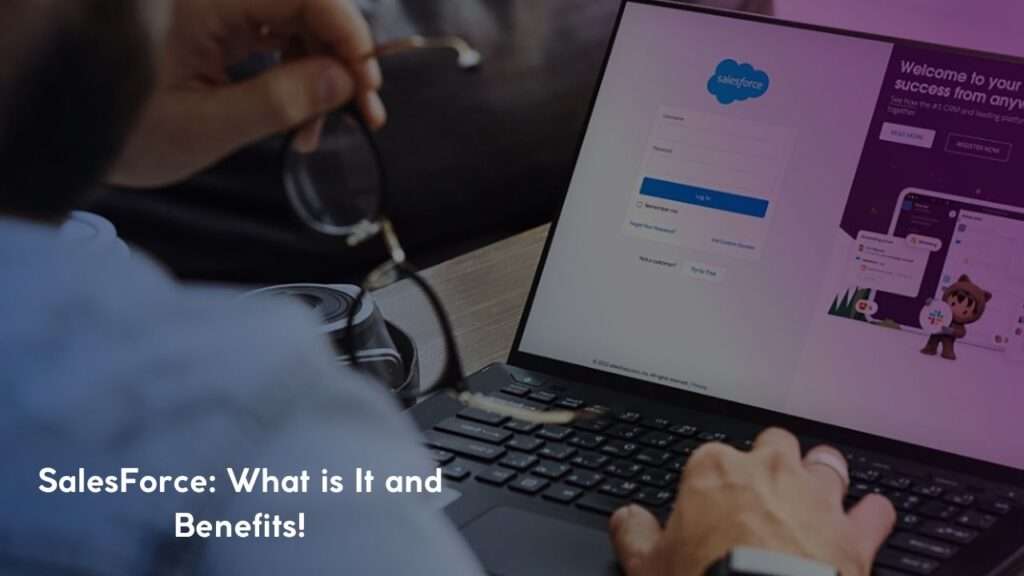
SalesForce: What is It and Benefits.

SalesForce-What-is-It-and-Benefits

Businesses must employ a platform to assist them effectively use their customer data in light of the expanding data generation. Salesforce is one such CRM platform. From Fortune 500 organizations to startups, Salesforce is used. You can go through the best salesforce training institute in pune to understand more.  Salesforce: Why Use It?  It will familiarize you with the word CRM before moving on to understanding what Salesforce is. Employees managed data manually in the past. They scribbled down notes and put them in files. They neglected to exploit all of the information that was available in this way.  As time went on and computers became more commonplace, businesses began using Excel sheets and documents to manage their data. This method, meanwhile, proved to be time-consuming and ineffective when dealing with enormous amounts of data.  Every person in the organization had to be able to manage and analyze enormous amounts of user data. Effectiveness here refers to strategies that could be used to raise client satisfaction. When CRM, or customer relationship management, was first established, it addressed the aforementioned problems.  Customer relationship management (CRM) programmes were at first housed on a business’s server. This became quite time-consuming and costly. These CRMs were likewise difficult to use.  The solution was to create an economical and cost-effective CRM tool and provide it as a service totally online. The fundamental concept of Salesforce was this.  What Is Salesforce?  Salesforce is a provider of cloud-based software that gives companies tools to identify more prospects, close more deals, and give their clients better service.  Famous American cloud-based software provider Salesforce, Inc. offers CRM services. For support, sales, and marketing teams around the world, Salesforce is a well-liked CRM application. Businesses can use cloud computing to improve connections with partners, customers, and potential customers by using Salesforce services. Businesses may track customer behavior, market to customers, and perform many other tasks with the Salesforce CRM.  With all of your measurements and data, a CRM platform enables you to dig deeper; you can also create a dashboard that presents your data graphically. Automation also allows for personalized outreach in addition to this. A CRM platform can also enhance customer service’s capacity to assist clients or a sales team’s outreach initiatives, which is a noteworthy additional benefit.  The Top 7 Salesforce Benefits  Time management improvement One of the best ways to enable a business to expand and develop is through time management, which is a significant benefit of Salesforce. You get access to thorough client information as well as practical planning tools in one location. No more wasting time looking through logs and files to get crucial information.  You may simply prioritize work for (and with) your clients by optimizing the sales funnel so that leads are swiftly converted into customers with the help of so much useful customer data.  Additionally, Salesforce offers a calendar tool that makes it simple to schedule tasks, conferences, phone calls, and more all in one location. You’ll be aware of when and what is upcoming.  Ultimate Accessibility Salesforce is accessible anywhere you have Internet access because it is cloud-based software. With the help of its app, you may access Salesforce on a desktop, laptop, or mobile device. This is crucial because a lot of business owners and team members routinely travel, whether locally, nationally, or even globally.  It is simpler to retrieve crucial data and keep up with clients when you can use your CRM tool through the secure cloud from anywhere. Information that needs to be kept private is safer here than it would be in a filing cabinet or on a local server.  Increasing Sales Running a business today without Salesforce can be expensive. Your team might generate a lot of data that needs to be kept on any given day. Without Salesforce, you’re probably going through this data manually, which means that you’re spending more time on administrative tasks than on cultivating relationships with customers.  When your time is limited, you have less time to develop your company, build relationships, and increase earnings. You’ll have more time to focus on the business because the tool handles these administrative tasks and more, which will result in longer-term financial gains.  Increasing Client Satisfaction Customers are more likely to be satisfied when they deal with a company that is aware of their demands and the status of their connection with you, which is similar to greater revenue (thanks to your CRM tool). You’ll have more time to spend attending to your clients through a shared platform if you spend less time on administrative tasks.  You can better serve your customers by having quicker access to their information, accounts, purchase history, and preferences because of a highly effective management system.  This Salesforce perk not only strengthens your bond with existing clients, but it also positions you to win over new ones. When your present clients are satisfied with your services, they are more inclined to recommend you to their friends.  Basic Account Management Plans for accounts can be easily created with Salesforce. When you have easy access to all the customer data you require, it will be simpler to enter that data into the appropriate accounts and then plan for those accounts to produce the best results for the client.  Customers receive goods or services that are precisely catered to their needs, you maintain organization, and you successfully manage your time for each client. By addressing their requirements, resolving their issues, and monitoring trends, you can better interact with your customers as these accounts are developed.  Reliable Reporting Your company is flooded with data, making it simple to become lost. Thanks to reliable reporting, Salesforce keeps relevant data structured and aids in making sense of new data.  Keep a record of all the information that your company gathers from sources such as social media, website analytics, app data, business software, and more. Reporting takes this mass of data, organizes it, examines it, and turns it into useful information. You can trust the … Read more

Data Analytics Industry Trends

Data Analytics Industry Trends | Ethan's Tech

Data is the driving force behind any organization in the present market trend in a plethora of different ways. In today’s expanding market, data science, big data analytics, and artificial intelligence are the three main themes. According to the Data analyst course in Pune “The data analytics sector is expanding tremendously as more businesses use data-driven models to automate their business procedures.” Organizations are leaning more toward data analytics, whether it be to support fact-based decision-making, embrace data-driven models, or increase their product offerings that rely on data. Opting Data Analytics as a career is very beneficial looking at the growth rate of the opportunities. You can refer to a business analytics course in pune.  Organizations can cope with numerous changes and uncertainties with the aid of these developing data analytics trends. Let’s examine a couple of these Data Analytics trends that are rapidly getting ingrained in the sector.  Trend 1: Artificial Intelligence that is More Clever And Scalable The business environment has changed significantly as a result of COVID-19, making prior data no longer useful. So, various scalable and smarter Artificial Intelligence and Machine Learning approaches that can deal with small data sets are now available on the market to replace old AI techniques. These technologies offer a quicker return on investment, are significantly faster, preserve privacy, and are extremely adaptive. Most manual chores can be automated and reduced with the use of big data and AI.  Trend 2: Composed And Agile Data Analytics Digital innovation, differentiation, and growth are all possible with agile data and analytics models. Using a variety of data analytics, AI, and ML solutions, edge and composable data analytics aims to deliver a user-friendly, adaptable, and seamless experience. In addition to enabling leaders to link business insights and actions, this will foster cooperation, boost productivity, promote agility, and advance the organization’s analytics skills.  Trend 3: Cloud Computing And Hybrid Cloud Technologies The increased use of hybrid cloud services and cloud computing is one of the top data trends for 2022. Public clouds are less expensive but offer lower security than private clouds, which are more expensive but offer higher security. In order to provide more agility, cost and security are balanced in a hybrid cloud, which combines the best aspects of both private and public clouds. Artificial intelligence and machine learning are used to do this. By providing a centralized database, data security, scalability of data, and much more at such a lower cost, hybrid clouds are bringing change to enterprises.  Trend 4: Data Fabric Across hybrid multi-cloud systems, a data fabric is a potent architectural framework and collection of data services that standardized data management procedures and uniform capabilities. Since this solution may reuse and mix various integration techniques, data hub skills, and technologies, more businesses will rely on it as the present business trend toward accelerated data complexity increases. Additionally, it lessens system complexity by reducing design, deployment, and maintenance times by 30%, 30%, and 70%, respectively. It will be widely used as an IaaS (Infrastructure as a Service) platform for re-architecting by 2026.  Trend 5: Using Edge Computing to Speed Up Analysis Although there are many big data analytics technologies on the market, the issue of extremely powerful data processing capabilities still exists. As a result, the idea of quantum computing has been developed. The large volume of data can now be processed much more quickly by using less bandwidth thanks to computation, which also provides better security and data privacy. As judgments are made utilizing quantum bits on a Sycamore processor, which can answer a problem in under 200 seconds, this is far superior to classical computing.  Before becoming widely adopted by businesses, Edge Computing will need a lot of fine-tuning. Though the market trend is accelerating, it will soon become apparent and will play a crucial role in business operations.  Trend 6: Enhanced Analytics Another prominent business analytics trend in the corporate environment nowadays is augmented analytics. In order to automate and improve data analytics, data sharing, business intelligence, and insight discovery, this notion of data analytics makes use of Natural Language Processing, Machine Learning, and Artificial Intelligence.  Augmented Analytics is already performing the duties of a Data Scientist, from assisting with data preparation to automating and processing data and gaining insights from it. With the aid of augmented analytics, data from inside and outside the company may also be merged, which facilitates business processes somewhat.  Trend 7: Predefined Dashboards Are No More In the past, organizations were limited to static dashboards with predefined data and manual data exploration was only available to data analysts or citizen data scientists. Due to their lack of interaction and user usability, dashboards appear to have outlived their usefulness. Dashboards’ usefulness and return on investment are being questioned, which is prompting businesses and business users to hunt for alternatives that would let them independently study data and save money on upkeep.  Modern automated and dynamic BI systems that give insights tailored to a user’s demands and supplied at their point of consumption appear to be gradually replacing business.  Trend 8: XOps With the widespread adoption of artificial intelligence and data analytics within any enterprise, XOps has grown to be an essential component of business transformation operations. By combining development and operations, or DevOps, XOps was founded with the intention of enhancing business operations, customer experiences, and operational efficiency. It tries to prevent technological and process duplication and to increase repeatability, reusability, and reliability. Overall, XOps’ main goal is to assist enterprises achieve economies of scale by providing flexible design and agile orchestration in collaboration with other software disciplines.  Trend 9: Engineered Decision Intelligence Today’s market is paying a lot of attention to decision intelligence. It involves a variety of decision-making processes and enables firms to more quickly obtain the insights required to motivate business actions. Applications for traditional analytics, AI, and sophisticated adaptive systems are also included. Engineering decision intelligence offers a significant potential to help organizations rethink how they maximize decision-making when … Read more