Salesforce Interview Questions and Answers

Salesforce Interview Questions and Answers
While awaiting the first break as a Salesforce professional, it is normal to anticipate the questions you would be asked during the interview. And that’s obvious too! Salesforce interviews are challenging given the criticality of responsibility involved in the job. Companies want to ensure they onboard the best talent that can help them make the most from the CRM. If you’ve completed or are about to complete your Salesforce classes in Pune, we empathize with your current situation. Accordingly, we’ve compiled some commonly asked Salesforce interview Q&As. 10 Commonly Asked Salesforce Interview Questions and Their Answers The questions may differ depending on the position you’ve applied for, the responsibilities your prospective employer wants you to handle, and various other specific factors. Nevertheless, here’s a list of the questions you can expect during your Salesforce interview and their responses on which you can build your answers. What is Salesforce? Yes. This is the most basic question. However, the basics matter! The interviewer wants to check how solid your fundamental understanding of Salesforce is. Instead of a long explanation, you can cut it short. Salesforce is a widely used CRM product that helps businesses manage relationships and interactions with clients and prospects. It enables companies to track customer interactions, streamline sales processes, and manage multiple business tasks from a central point. What is a custom object and what does it allow the user to do? It refers to database tables that store data related to a particular company on the Salesforce website. Once you define a custom object, you (the subscriber) can perform multiple tasks, including the following. Create custom fields Track events and tasks Build page layouts Build page layouts Analyze custom object data Build dashboards and reports Share custom tabs, custom apps, custom objects, and related components. So, its a Custom Objects For Salesforce. What factors can result in data loss in Salesforce? Some common factors include changing data and date-time, changing from the multi-select picklist, checkbox, auto-number to other types, changing to auto-number except for text, migrating to percent, currency, and number from other data types, changing from text-area to email, URL, text, and phone, and changing from any type (except picklist) to multi-select picklist. What is a static resource in Salesforce? A static resource allows subscribers to upload zip files, jar files, images, CSS files, and JavaScript that you can refer to on a Visualforce page. The maximum static resource in Salesforce is 250 MB. What is an Audit Trail in Salesforce? Audit Trail is a function that helps gain information or track all recent setup changes done by the administration in the company. The system preserves data for up to six months in the Audit Trail. What is a profile in Salesforce? It is a collection of permissions and settings that define everything you can do as a user in Salesforce, providing authority to access certain records. You can find various types of profiles that can help access leads, contacts, campaigns, etc. What is Apex in Salesforce? Apex is an object-oriented programming language that enables flow execution and transaction control statements in Salesforce in combination API calls. It uses a syntax similar to Java. Additionally, Apex allows developers to add business logic to various system events like button clicks, Visualforce pages, and record updates. One can initiate the code by requests from web services and from triggers on objects. What are governor limits? These control how much data a shared database can store. Whenever the Apex code goes beyond the limit, it issues a runtime exception. Some examples of governor limits are, Number of records an SOQL query can retrieve is 50,000. The number of sendEmail methods allowed is 10. Hence, its a Governor Limit of salesforce. How can you integrate into external REST web services? You can do it with HTTP callouts to invoke the external API. The XMLStreamWriter and JSON classes can be used to create payloads to match the external API’s specifics. What is a roll-up summary field? These are special fields on the master side of the master-detail relationship. They have their values calculated depending on an aggregate of the detail side of the relationship. It enables you to skin using Apex when you want to aggregate record values, part of a master-detail relationship. Of course, there’s much more to Salesforce interview questions and answers. However, the type of questions will depend on the company’s requirements and the type of expertise they expect. The best Salesforce training institute in Pune ensures comprehensive preparation by enlisting questions and answers to help its students prepare better for the interview. At Ethan’s Tech, we nurture a team of Salesforce specialist trainers who conduct extensive mock interviews for effective preparation that increases the chances of cracking the interview. This preparation is part of our Salesforce classes in Pune. Ethan’s Tech can help you launch your career in Salesforce and leverage the enormous opportunities in this field. Call us at +91 95133 92223 to learn more.

AWS Certification Path: How to Choose?

AWS Certification Path: How to Choose?

With cloud computing becoming the backbone of modern business, Amazon Web Services (AWS) certifications are some of the hottest IT credentials on the market. An AWS certification will allow you to validate your skills and open various opportunities with high-paying roles, irrespective of whether you are new to cloud technology or planning to upgrade your career as an experienced professional. However with so many paths to take, how do you determine the right AWS certification path for your career objectives? In this guide, we will go through each AWS certification and assess what path to take according to your current knowledge and career goals. An Overview of the AWS Certifications AWS (Amazon Web Services) has multiple certifications that validate your cloud skills. There are four categories of certifications. Foundational Level AWS Certified Cloud Practitioner: Best for Cloud beginners. This includes introductory AWS concepts along with the core services and security services. It does not need too much technical knowledge and is a good entry point to the certification. Associate Level AWS Certified Solutions Architect — Associate: For those who want to design distributed systems upon AWS. It includes more detail on AWS services and best practices. AWS Certified Developer – Associate: This is for developers who create and maintain applications on AWS. You will learn about essential AWS services and fundamental AWS architecture best practices. AWS Certified SysOps Administrator – Associate: This system administrator certification is all about deployment, management, and operations on AWS. Professional Level AWS Certified Solutions Architect – Professional: A step beyond the associate certification, this level is also more difficult and is designed for anyone who wishes to demonstrate technical expertise in cloud architecture and has the ability to design distributed applications. AWS Certified DevOps Engineer – Professional: Best for those who work in continuous delivery and the automation of processes. Ideal for anyone looking to sharpen or formalize their application operating and management skills on AWS. Specialty Certifications These are for people who wish to learn something very specific in niche areas like machine learning, security, advanced networking and database management. Evaluate What You Have and Where You Want To Be Now, which certification path is right for you depends on your previous knowledge and future goals → If You Are a Newbie: The AWS Certified Cloud Practitioner is your best starting point; it provides foundational understanding of AWS services and basic cloud infrastructure. For Developers or IT Profs: Associate-level certs such as the AWS Certified Developer and Solutions Architect are perfect, as they align well with development and architecture skill sets in the cloud. If You Have Deep Cloud Experience: Professional-level certifications are designed around advanced skill-sets used to design complex solutions and implement cloud strategies. For Those With a Focus: If you need to concentrate your specialty certifications show the potential for unique technologies, such as Security or Machine Learning, and are essential in select industries and high-demand positions Diving Into Each AWS Certification Path AWS Certified Cloud Practitioner Microsoft Fundamentals — Entry Level certification for those who are beginners or having little experience in cloud computing. It includes the fundamentals of cloud, security and core AWS services, which acts as a stepping stone for other AWS certifications. Certifications for Associate Level AWS Certified Solutions Architect – Associate — This is a very popular certification exam which tests your ability to design cost-effective, scalable and highly available systems. AWS Certified Developer – Associate: Targeted to developers, this certification emphasizes application development on AWS with a focus on debugging, monitoring, and deployment. AWS Certified SysOps Administrator – Associate: Aimed at system administrators, this cert deals with sysops such as system deployment, monitoring, and operational management. Industry Impact Careers Certifications AWS Certified Solutions Architect – Professional: A higher-level certification that assesses your skills in designing sophisticated applications on AWS. AWS Certified DevOps Engineer – Professional: It is for professionals with a background in DevOps and its practices like continuous integration, delivery, and automation within AWS. Specialty Certifications Such certifications are ideal for those professionals who want to advance their knowledge on certain topics: Specialty in AWS Certified Security AWS Advanced Networking Speciality Specialization Study Path for AWS Certified Machine Learning Speciality in AWS Databases — Certified All of these entries into their fields allow professionals to take on roles in areas becoming critical to the solutions built in the cloud today, such as cybersecurity, data science and network architecture. Suggested AWS Certification Paths Based on Career Goals Cloud for Beginners: If you want to start with AWS Certified Cloud Practitioner, to learn foundation knowledge, and after, you can take Solutions Architect Associate or Developer Associate to explore it more. Developers: Start at Developer Associate, then Solutions Architect — Professional or DevOps Engineer — Professional for mid/advanced levels. For System Administrators: SysOps Administrator Associate is perfect with a long term goal being DevOps Engineer – Professional. Enhanced Specialized Certifications: Opt for a Specialty Certification (Security or Machine Learning) to focus on niche skills and become an authority in any one domain of cloud computing.   AWS Certification Tips  Use AWS training resources – There are courses and study materials provided by AWS itself that you can find very useful. Utilize the AWS whitepapers, FAQs, and AWS Well-Architected Framework Use Online Learning Platforms: Use interactive content, labs, and mock exams to master all concepts relating to AWS with A Cloud Guru, Coursera and Udemy. Practical Application: There is no substitute for practical experience, so use your skills as much as you can, in a sandbox environment, or through projects in your job. Participate in Study Groups and Forums: The AWS community is very engaging. You can find some assistance, question-answer services, and tips on how to take the exams through study groups and forums on Reddit or LinkedIn. Reasons to Choose Ethans Tech for AWS Training We at Ethans Tech have a detailed Approach Towards AWS training to make you Learn and Crack an AWS Certification Exams. Ethans Tech works with E&ICT, IIT-Guwahati and offers an … Read more

Top AI Interview Questions and Expert Answers

Top AI Interview Questions and Answers

Have you recently completed an Artificial Intelligence course in Pune? Are you about to appear for your first AI job interview and wondering what questions the interview would ask? Then, here’s something that can help you. In this blog, we will discuss the top 12 AI interview questions and expert answers you can use as a base.  What is AI and its Applications? AI is one of the computer science streams, focused on creating systems capable of performing tasks that would otherwise require human intelligence. Some of these tasks include understanding natural language, recognizing speech, learning, making decisions, and learning. AI is used everywhere. For example, in customer support, AI is used in the form of chatbots and virtual assistants to enhance customer service. Another example is that of healthcare where AI is implemented for diagnostics, personalized treatment recommendations, and automation. What is Fuzzy Logic Fuzzy Logic helps you reason with uncertain or inaccurate information. It serves as an extension of classical logic and allows for partial truth, instead of conventional binary true or false. Thus, in fuzzy logic, it refers to prepositions potentially having a truth value between 0 and 1, representing the degree of truth. What is Deep Learning Based on? Deep learning is a subset of machine learning that focuses on developing artificial neural networks with multiple layers called deep neural networks. These networks help model sophisticated, hierarchical patterns and data representations. The inspiration behind deep learning is the structure and functioning of the human brain itself. What is the Difference Between Machine Learning (ML) and Deep Learning (DL)? ML is a subset of AI that learns from historical data and experiences. On the other hand, DL is a subset of ML and AI inspired by neurons and replicates the functioning of a human brain. Another difference is that of the type of data both deal with. ML deals with structured and semi-structured data. However, DL works with structured and unstructured data. Besides, ML can work with less data than DL and AI. However, DL requires more data than ML. What is Generative AI, and How Do they use it in Various Industries? It is an AI technology that can generate new content, including text, images, and music, depending on the patterns it has learned from the current data.  What is the Importance of Data Mining Data mining refers to discovering patterns, trends, and useful information for massive datasets with different algorithms, ML techniques, and statistical methods. One of the most important aspects and outcomes of data mining is the ability to make informed decisions. Thus, it is used in many industries, including retail (for example – predicting consumer behavior), healthcare (for example predicting patient outcomes, detecting frauds, etc.), finance (forecasting stock prices, determining credit ratings, and more). What is Artificial Narrow Intelligence (ANI) Also known as Weak AI, ANI are AI systems designed and trained to perform a particular or narrow range of tasks. These are highly specialized systems, capable of performing designated tasks with high precision and accuracy. Examples of these systems include voice assistants like Alexa, and Siri that classify data and respond to queries quickly. What is Data Binarizing? Binarizing data involves converting data features into vectors of binary numbers to increase the productivity of classifier algorithms. The technique of binarizing helps recognize shapes, characters, and objects. It simplifies differentiating between the object involved from the background it is found in. How Will You Ensure Your AI Model is Unbiased and Ethical? It involves extensive testing across diverse datasets, including ethical considerations, and continuous bias monitoring during the AI development process. Besides, transparency in how models make decisions also matters in ensuring ethical and unbiased AI models. What is AI Model Explainability? It is the capacity to comprehend and simplify decisions an AI model executes. It helps foster transparency, establish trust, and ensure that models help make decisions based on valid reasoning. What is Supervised And Unsupervised Learning? Supervised learning comprises a training model with a labeled dataset, where every training example is related to an output label. The model receives training to predict output-based or input data. However, unsupervised learning uses algorithms to analyze unlabeled data and discover patterns without human intervention. What is the Importance of TensorFlow in AI? TensorFlow is Google’s open-source platform that helps do high-performance numerical computations. It comprises a collection of workflows to develop and train models to make ML more efficient. What also makes TensorFlow useful is its customizability. Accordingly, it helps developers build exponential learning architectures and work on them to deliver the desired outcomes. Looking for an AI Course Near Pune? Choose Ethan’s Tech! Of course, the list includes many more questions. However, AI courses in Pune and the subsequent mock interviews usually cover all of them. And Ethan’s Tech precisely offers such AI classes in Pune. Our comprehensive AI course curriculum and holistic training help you become an AI professional the industry will want to hire. Our trainers conduct extensive mock interviews, preparing you for potential interview challenges and dealing with them. Call us at +91 95133 92223 if you want to unlock the doors to exciting career opportunities in AI.

Salesforce Developer Salary in India

Salesforce Developer Salary in India

A global leader in the CRM space, Salesforce has a customer base of nearly 150,000 companies, which is expanding by the day. Hence, every company using Salesforce or planning to use it looks for Salesforce developers to create apps and solutions with its products and technologies. Such a massive demand makes Salesforce development a promising career option. But what about the Salesforce developer’s salary? Does it offer salaries as lucrative as its career opportunities? As an aspirant pursuing Salesforce from the best Salesforce training institute in Pune, you must be wondering about it. So, here are some insights into this regard. What do Salesforce Developers Do? Salesforce developers fundamentally design, build, and customize applications within the platform to meet a company’s needs. Since companies use Salesforce for processes as critical as customer data management, streamlining business processes, and enhancing customer interactions, Salesforce developers play a crucial role in helping companies design and develop applications supporting their customer management endeavors. Some of their key responsibilities include the following. Creating custom features and applications with Salesforce’s proprietary languages, including Apex and Visualforce. Designing, developing, and managing integrations within the platform. Optimize the platform’s functionality, enhance user experience, and streamline various business processes associated with it. Working closely with business analysts and end-users to discuss their requirements for new applications and enhancements. Working with Salesforce APIs for seamless data exchange between Salesforce and various other external platforms. Ensuring application quality and performance. Testing, debugging and resolving technical issues as they surface. Qualifications Required to Become a Salesforce Developer in India Salesforce development requires specific qualifications, including, Bachelor’s degree in computer science, IT, or a related field Proficiency in Visualforce, Apex, Lightning Components, and various other Salesforce development tools Understanding of web development technologies like CSS, JavaScript, and HTML Salesforce certifications, for example, a Salesforce course in Pune with Platform Developer I and II credentials Excellence communication, analytical, and problem-solving skills Ability to work collaboratively and address imminent requirements effectively How Much is Salesforce Developer Salary in India? Salesforce developers handle various crucial responsibilities, making them vital assets for an organization. Accordingly, these professionals draw a promising salary. However, it must be noted that Salesforce developer salary in India varies depending on different factors like the employer’s paying capacity, workplace location, developer’s experience, expertise, understanding of Salesforce, and more. The average salary in India is 7 lakhs per annum. Nevertheless, the Salesforce developer salary range in India (based on experience) is as follows. Experience Approximate Average Salary Range in Indian Rupees Fresher (0-2 years of experience) 2-5 lakhs per annum 1-5 years of experience 15-16 lakhs per annum Senior Developer 22-25 lakhs and more per annum The city wise Salesforce developer salary in India is as follows. Mumbai: Rs. 8-9 lakhs per annum Hyderabad: Rs. 8-9 lakhs per annum Noida: Rs. 9-10 lakhs per annum Ahmedabad: Rs. 8-9 lakhs per annum Bangalore: 7-8 lakhs per annum Nagpur: 4-5 lakhs per annum Note: Salaries are approximate and should be used only for indicative purposes. The salaries vary greatly depending on the different factors mentioned above. Unlock Salesforce Career Opportunities and Handsome Salaries with the Best Salesforce Training Institute in Pune! Salesforce developer salary in India is highly subjective and depends on different factors. Besides, amidst competition, it is pretty challenging to emerge as a standout candidate, worthy of high pay. However, although challenging, it isn’t as impossible, particularly when you undergo Salesforce training in Pune with the best Salesforce training institute in Pune like Ethan’s Tech.  At Ethan’s Tech, we conduct comprehensive Salesforce classes in Pune that cover the latest curriculum, practical exposure, and various other professional aspects, making you a capable Salesforce developer. Our Salesforce course is intelligently designed to help you unlock an endless horizon of remunerative career opportunities worldwide. Call us at +91 95133 92223 to learn more.

Top Data Analytics Courses in Pune: Fees & Placement Details

Top Data Analytics Courses in Pune

As we march ahead towards achieving ultimate data-driven solutions, the demand for Data Analytics Professionals is increasing at an exponential rate. Pune, the city of knowledge and technology has a range of options through short-term data analytics courses in Pune for both — newcomers as well as professionals seeking an upskill. Nonetheless, with an array of available options it can be devastating to pick the right course that could align well with your career prospects. Here in this guide, we will try to explain data analytics and its importance along with minor detail of applicable candidates on these courses and some top institutes offering best data analytics courses in Pune. Why is Data Analytics Important? In the simplest terms, Data Analytics means examining and processing of raw data into meaningful information. It allows companies to streamline their processes, anticipate market trends and enhance customer engagement providing them with a clear advantage. Data analytics can be used to find patterns, make predictions and also help businesses develop in various sectors—be it finance industry or healthcare, retail sector or technology. A few of the major things that explain why data analytics is crucial are: Informed Decision Making: Using big data analysis, organizations can take more accurate and intelligent decisions supported by real facts which means less risk in a process that leads to better efficiency. Efficiency: The ability of the firm to interpret data that has been processed and use this for multitasking will drive better performance verses a human who is only able to provide information in terms by analogy. Customer Insights: with the help of their business can understand customer behavior and it helps in efficient marketing as well to provide good service. Innovation & Strategy: Market trends and consumer preferences are continuously analyzed in order to help organizations innovate, remain competitive and refine their business strategies. With data being the new currency in an era of technology, by mastering this practice you are giving yourself legitimate abilities to succeed in almost any industry. Who Can Enroll in Data Analytics Courses? Data analytics is a field that anyone with an interest and passion for can enter, regardless of what you studied in university or where your career has taken you thus far. While it doesn’t hurt to have a background or some experience in technology, statistics, a related field, or a quantitative role – it’s by no means absolutely necessary. Fresh Graduates: – Grads from engineering, computer science and even economics/commerce background can benefit from learning a specialized skill of data analytics. Working Professionals: Professionals in business analyst, marketing, finance or operations roles can learn data analytics to improve their decision making and problem solving ability. IT Professionals: Individuals who have experience in software development, database management or business intelligence can specialize in the field of data analytics to open up even more work avenues. Entrepreneurs and Managers: This paper is intended for business owners and managers who desire to use data to make strategic decisions that will improve the performance of their organizations. Anyone Interested in Data-Driven Decision Making: People who love data and want to learn how to translate raw data into actionable insights can take up data analytics courses. Top Data Analytics Courses in Pune with Fees 1. Ethans Tech E&ICT, IIT-Guwahati has joined hand with Ethans Tech to provide high quality merit-based certification program in Data Analytics. In this program participants will gain in depth learning of various tools like SQL, Python , Tableau & Power BI along with multiple real time projects and industry graded case studies for better absorption of concepts to keep you ahead in the race of technology. Fees: ₹50,000 Duration: 4-6 months Mode: Both online and offline Certification: Merit-based certification from E&ICT, IIT-Guwahati Placement Assistance: 100% placement support, resume building, and mock interviews. For more details Visit: https://website.ethans.co.in/course/data-analytics-training-in-pune/ 2. Simple Learn Simple Learn offers comprehensive data analytics courses that focus on tools like R, Python, Tableau, and SQL. Their course includes industry-relevant projects, giving students practical exposure to real-time analytics problems. Simple Learn also provides globally recognized certifications. Fees: ₹57,000 Duration: 6 months Mode: Online/Offline Placement Assistance: Provided through their strong industry network and job portal. 3. UV Technocrats UV Technocrats is known for offering data analytics training with a focus on using advanced tools like Tableau, Power BI, and Python. Their course is tailored for beginners and professionals looking to switch to data-driven roles. Fees: ₹50,000 Duration: 6 months Mode: Classroom Placement Assistance: Personalized placement support and industry connections. 4. DataCamp (Online) DataCamp provides flexible, online data analytics courses for individuals looking to learn at their own pace. Their modules cover SQL, Python, R, and various data visualization techniques. The platform allows you to gain a solid foundation in data analytics through interactive exercises and projects. Fees: Subscription-based (₹1,000 to ₹2,500 per month) Duration: Self-paced Mode: Online Placement Assistance: No direct placement assistance, but offers portfolio-building guidance. 5. Ai Adventures Ai Adventures focuses on delivering practical knowledge in data analytics. Their course involves hands-on projects using large datasets and covers advanced topics like machine learning algorithms and big data analytics. Fees: ₹55,000 Duration: 4 months Mode: Online/Offline Placement Assistance: Strong placement support with tie-ups in multiple industries. 6. Coursera (Online) Coursera offers various data analytics courses in partnership with global universities like Google and IBM. Their courses are designed for both beginners and professionals and offer a global certification. Fees: ₹3,000 to ₹7,000 per course Duration: 2 to 6 months (depending on the course) Mode: Online Placement Assistance: None, but you receive globally recognized certification.   What Are the Career Opportunities After Completing a Data Analytics Course? Completing a data analytics course opens the door to various job roles across industries. Here are some of the prominent career paths you can explore: 1. Data Analyst As a data analyst, you will collect, process, and analyze data to help organizations make informed decisions. You will work with datasets, perform statistical analyses, and create data visualizations. Data analysts are highly in … Read more

Data Analyst vs Data Scientist

Data Analyst vs Data Scientist Course

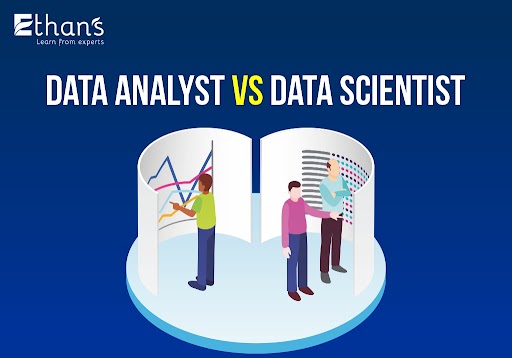
Often used interchangeably, data analyst and data scientist are two different terms and career streams with unique importance. Of course, both deal with data – a priceless asset for every business in the modern context. However, they contribute in different ways to help businesses harness the power of data and drive meaningful and actionable insights from it.  As a fresh technology graduate or an experienced professional looking for a data analyst course in Pune or data science classes in Pune, this blog is for you. It highlights some differences between data analysts and data scientists to strengthen the basic concepts and make an informed career choice. Who is a Data Analyst? A data analyst gathers, processes, and interprets data to help companies make informed decisions. Their role usually involves, Gathering data from different sources like databases, spreadsheets, etc. Cleaning the data to ensure accuracy and removing errors or inconsistencies. Analyzing data with Python, R, Excel, SQL, or other specialized software. Presenting findings through graphs, charts, and dashboards through Power BI, Tableau, etc., to make it clear, straightforward, and understandable. Preparing reports and presentations summarizing the insights and actionable recommendations based on the analysis. Data analysts closely work with other teams and departments, including marketing, finance, HR, operations, etc., as each generates data and requires accurate analysis. Example: Retail is a highly data-driven sector that evolves continuously and adapts to changing consumer needs and demands. Data analysts help retailers analyze data concerning sales, customer behavior, preferences, inventory statistics, market trends, etc. Their role extends to analyzing data to track sales performance, make revenue forecasts, segment customers, create personalized marketing strategies, provide data to optimize inventory levels, perform competitive pricing analysis, etc.  Who is a Data Scientist? A data scientist uses various scientific methods, algorithms, processes, and systems to extract insights from structured and unstructured data. Their expertise includes programming, mathematics, statistics, and domain knowledge to analyze massive datasets, identify patterns, and develop complex problem-solving models. Data analysts handle various responsibilities while performing their core jobs. These include, Gathering relevant data from multiple and diverse sources. Preparing the data by cleaning, organizing, and formatting it for analysis. Analyzing the data initially to understand its structure and explore hidden trends and patterns. Using statistical techniques and ML algorithms to build predictive models or data-driven insights for the business. Evaluating the model’s accuracy and performance and refining them. Creating visual representations of the data through graphs and dashboards Assisting companies in making informed decisions concerning product launches, strategies, marketing, etc., based on data-driven insights. Example: In the healthcare sector, data scientists leverage data to enhance patient outcomes, streamline operations, and improve the decision-making process. Their role covers various critical responsibilities like integrating, cleaning, and structuring datasets, ensuring safe data handling, building models to predict disease progression, predicting patient inflows, and much more. Data Analyst vs Data Scientist – Key Differences While you now have a basic understanding of what data analysts and data scientists do, let’s look at some key factors distinguishing them. Aspect Data Analyst Data Scientist Primary Responsibility Analyze data and provide insights to enable informed decision-making Solve complex problems with various advanced statistical and computational methods Routine Tasks Cleaning and organizing data, creating various reports, building dashboards and doing descriptive analytics  Developing algorithms, creating predictive models, performing A/B testing and conducting exploratory data analysis Tools Used Excel, Power BI, Google Analytics and SQL Hadoop, Python, R, Spark, SQL, Google Cloud Platform, Amazon Web Services and TensorFlow Programming Skills Needed Limited coding proficiency Extensive coding expertise with proficiency in R, Scala and Python Educational Background Bachelor’s degree in business, statistics, or a related stream Data analytics courses in Pune or other places Master’s or Ph.D. in data science, computer science, or other similar streams Should have attended data science classes in Pune or anywhere else Skills Required – Data Cleaning and Preparation – Data Visualization – Statistical Analysis – Solid Analytical Capabilities – SQL – Excel – Domain Knowledge – Problem-Solving – Communication – Attention to Detail – Continuous Learning – Machine Learning – Data Visualization – Data Cleaning and Preprocessing – Deep Learning – Experiment Designing – A/B Testing – Time Series Analysis – Communication – Presentation – Natural Language Processing (NLP) With data, the importance of data scientists and analysts will also increase. Speaking of the growth of data analytics, for example, it will surpass the 100-billion-dollar mark in the next 3-4 years. Even when it comes to data science, its platform market size fared between USD 95 billion – USD 98 billion last year. The growth prospects are as promising as they can be! Besides, since every sector generates data and wants to drive optimal value from it, data analysts and data scientists can seek employment in almost any sector. Of course, domain knowledge and understanding will play a crucial part while looking for opportunities. So now the question is from where will you learn the skills you need to become a data analyst or data scientist. The answer is Ethan’s Tech. We are one of Pune’s leading technology training institutes with a flair for and purpose of empowering the industry with comprehensively trained talent. Explore our course curriculum and learning methodologies if you’ve been looking for the terms data analytics or data science course near me. We will be happy to shape your career.

Full Stack Developer: Skills and Responsibilities

Full Stack Developer Skills

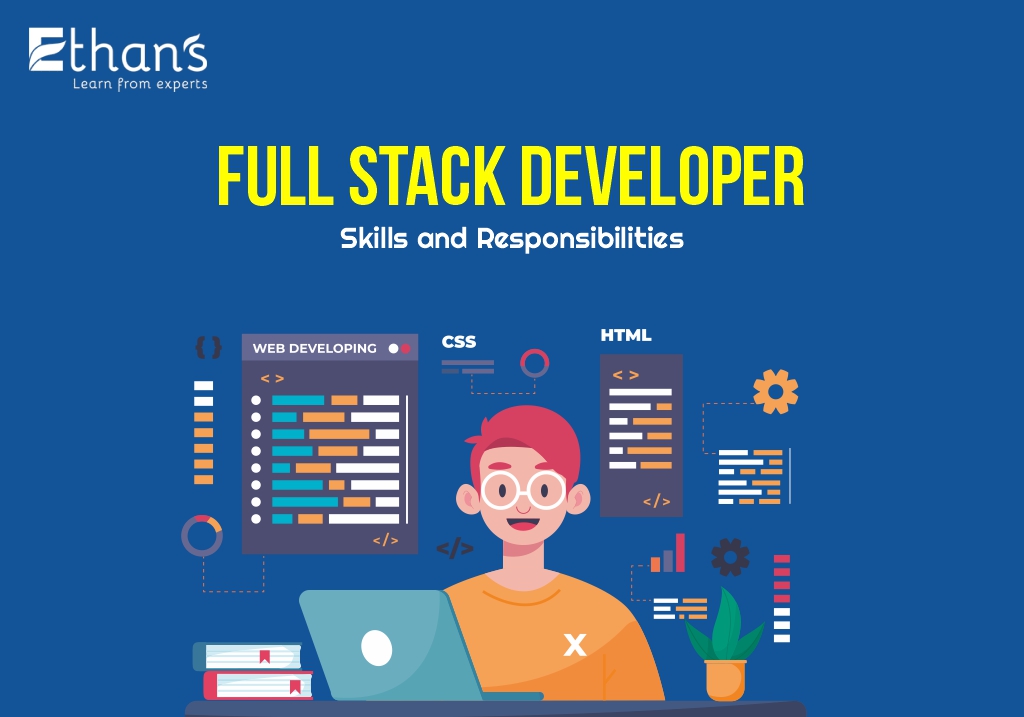
Full stack development refers to two skill sets, front-end development, and back-end development, rolled into one! It is a unique qualification assuring employers of smooth and seamless front and back-end application development. So, if you are looking for full stack developer training in Pune to become one, you’ve made the right career choice. It is a lucrative position that packs exciting career opportunities and handsome remuneration. However, these benefits call for developing various skills and handling different responsibilities as well. Let’s overview each. Who is a Full Stack Developer? Front-end developers create the user interface of an application. It involves designing graphics, layout, and various visual elements users will usually interact with. Accordingly, their skill set includes using programming languages like CSS, JavaScript, and HTML, and frameworks like Angular, React, or Vue.js to develop an incredible and highly experience-driven user interface. On the other hand, back-end development involves building an application’s server-side logic and databases. Developers working on the back-end use Python, Java, Ruby, or PHP and frameworks like Django, NodeJS, etc., to build a functional back-end. Full stack developers cover both of these skill sets. They work on the front-end and back-end of an application. Thus, their work extends to different areas like servers, databases, architecture, etc., to make an application fully functional, dynamic, and interactive. Hence, full stack developers serve as a single contact point for the project’s stakeholders, simplifying and expediting communication and development. Working and succeeding as a full stack developer requires developing various foundational skills. Besides, they shoulder different responsibilities making them crucial in every project’s progress and its outcomes. Let’s look at both.  Skills Needed to Become a Full Stack Developer Full stack developer skill set is a combination of various hard and soft skills. These include but aren’t limited to the following. Technical Skills A full stack developer is expected to have the following technical skills. Front-end web development technologies like HTML, CSS, and JavaScript and those related to back-end like Python, Java, Node.js, Ruby on Rails Frameworks like React, Angular, or Vue.js. Software development principles Databases like MySQL, MongoDB, or PostgreSQL.  Frameworks like Ruby on Rails, Express.js, Django, or Laravel to build server-side applications and APIs Apache and Nginx (web server technologies) User-centric design principles Version control systems like Git and expertise in command-line interfaces. Server-side languages like PHP or ASP.NET. Web security and best practices to develop a safe and secure application Practices like testing, debugging, and code optimization. Application performance optimization techniques like caching, code optimization, and database indexing. Agile techniques and experience working in agile development environments Of course, the list extends to many other skills, given evolving technologies, user demands, and business environment. Soft Skills Full stack development is a challenging position. It requires you to work with different team members, departments, stakeholders, etc., while ensuring everything stays on track and progresses towards completion and delivering the desired outcomes. Thus, while technical skills matter, one cannot discount the significance of the following soft skills that contribute to a developer’s success. Effective communication Ability to work and perform under pressure and stringent timelines Problem-solving skills Solid analytical abilities Adaptability to new technologies and evolving situations and environments Continuous learning and improvement Time and project management Resource management Understanding of non-functional aspects like automation, testing, etc. Team playing and collaborative approach Open to feedback, suggestions, and criticism Full Stack Developer Roles and Responsibilities Full stack developers handle a diverse set of responsibilities, ensuring timely project completion and intended product quality. So, as a full stack developer, some of your most important roles and responsibilities will include the following. Understanding the client’s requirements, providing vital and coherent recommendations, and communicating them clearly to the team. Designing and implementing features of the software application by using various front-end and back-end technologies. Writing clean, custom, and maintainable codes, developing user interfaces, and incorporating different components contributing to the user experience. Applying the right design patterns and architectural principles to make the application more robust, scalable, and maintainable Participating in code reviews, providing constructive feedback, checking coding standard compliance, and ensuring excellent code quality. Taking part in the testing process by writing unit tests and enhancing the quality assurance process to ensure the application meets quality expectations. Working closely with other team members like back-end developers, front-end developers, designers, testers, etc.  Conducting daily stand-up meetings to discuss updates, operational issues, and communication concerns and addressing all of them promptly. Developing a culture of continuous learning and prompt communication. Discussing best practices, acquainting team members with different technologies, and ensuring continuous knowledge sharing. Reviewing project progress, identifying bottlenecks, and driving process improvements. What Next? Enroll With Ethans for Comprehensive Full Stack training in Pune Full stack development resonates with every business’s need to hire comprehensive technical experts, and leaders bundled into a single package. No wonder you will find millions of job opportunities for full stack developers at any given point.  Besides, full stack developers enjoy an extensive range of employment opportunities. Organizations across IT, software development, healthcare, retail and eCommerce, BFSI, etc., constantly look for full stack developers to develop and manage large applications, helping them grow their business. So, now that you know what a full stack developer does and the skills you must develop to become one, prepare to pursue a full stack developer course in Pune.  Ethan’s is here to help you become a qualified and skilled full stack development professional. Our comprehensive full stack training in Pune, career-oriented approach, and seasoned faculty members contribute to a more meaningful learning experience. Additionally, our placement assistance and record speak to lengths about our commitment to shaping careers. Call us at +91 95133 92223 to learn more.
Ethical AI and Bias Mitigation: Importance of the AI Practitioner Certificate

Importance of the AI Practitioner Certificate

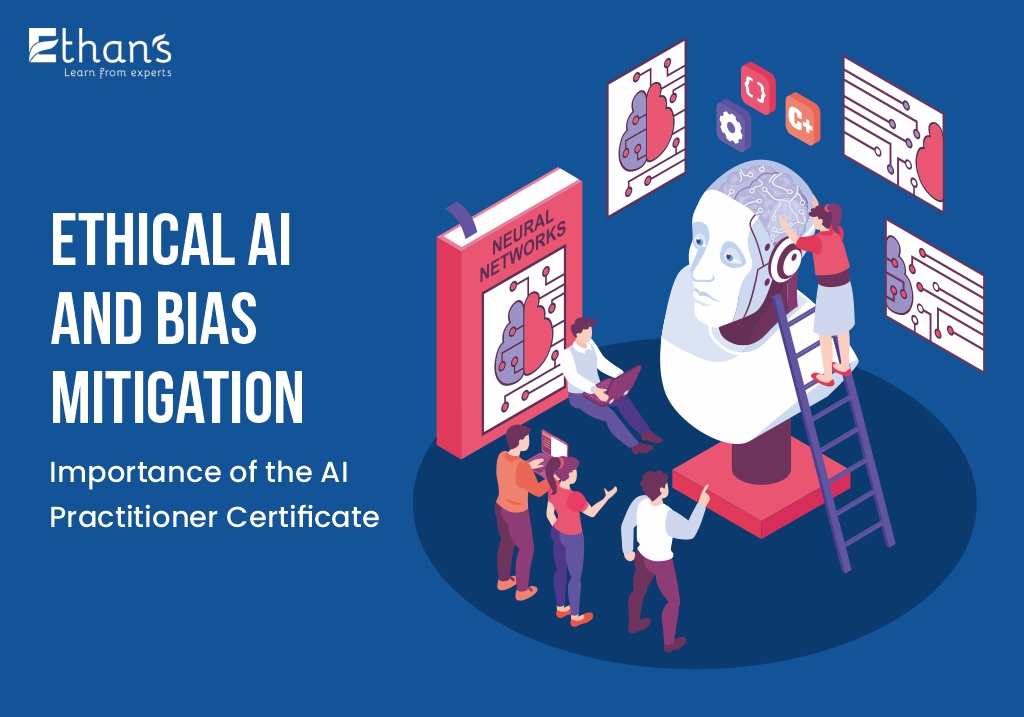
AI is undoubtedly one of the hottest technologies around. While evolving rapidly, it is also expanding, covering every aspect of business and our lives. And yes, the countless benefits it offers make it a crucial breakthrough of the 21st century. So, a promising career in AI has become a piece of the pie – everyone wants it! However, like every other technology, AI also has some serious concerns. As someone looking for an Artificial Intelligence course in Pune, you must stay aware of what they are as that’s another area where your role as an AI practitioner will come into play. What is Ethical AI and Why is it Vital? Ethical AI refers to guiding principles to help stakeholders develop and deploy transparent, fair, and accountable AI systems. It fundamentally ensures responsible development and use of AI. In other words, it also means taking up a humane, secure, safe, and sustainable approach to AI. Developing a robust AI ethical code ensures data privacy, prevents bias, and reduces environmental risks. Even for businesses, ethical AI is critical as it ensures value-based and ethical use of the technology. Furthermore, implementing ethical AI helps enhance client trust, strengthen brand reputation, and avoid legal concerns.  On a broader scale, ethical AI proves crucial for various reasons. In addition to the above factors, some include mitigating unintended outcomes and ensuring public trust and confidence in AI systems. One of the examples of unethical AI is using Generative AI chatbots to unintentionally regenerate copyrighted material without appropriate attribution. AI Bias and the Significance of Mitigating It In AI, bias is systematic errors or prejudices emerging from ML algorithms. These biases can result from different sources, including biased result interpretations, training data, or algorithms. AI systems rely upon historical data that might have social biases and prejudices. As AI practitioners, if you do not address them thoughtfully, they might lead to social indiscrimination, and inequality and create a potential social imbalance! Mitigating AI bias is thus crucial for the following reasons. Ensuring Fairness: Identifying and mitigating AI biases can help AI systems ensure equal treatment to every individual. It isn’t merely an ethical concern but a legal need. Avoiding Bias Reinforcement: AI systems can amplify existing social biases. However, bias mitigation helps prevent AI from doing it and promotes social inclusion and equality. Establishing Trust: Mitigating bias can help AI make more fair and unbiased recommendations, instilling confidence and trust amongst its users. Ensuring Ethical AI and Mitigating AI Bias – Vital Tips Using AI responsibly and mitigating bias can help the world at large, helping us make it a better place to live. While you will learn its technicalities during your Artificial Intelligence course in Pune, here are some generic tips for both. Use Diverse Data: Using diverse and representative datasets can help avoid biased AI outputs. You must also ensure the data reflects the socioeconomic, geographic, and demographic diversity of the target audience. Perform Bias Audits: Experts must conduct audit AI systems regularly to ensure algorithms ensure equality amongst all groups and proportionate benefits to each group. Furthermore, maintaining detailed logs of how AI systems make decisions can enable accountability in case of concerns. Ensure Inclusive Development: Include people from different backgrounds during the development and testing stages to prevent unconscious bias. Involve Human Oversight: AI supports human beings in different ways. However, we must maintain human oversight and review AI decisions, particularly across high-stake realms like finance or healthcare. Protect Sensitive Data: As a general practice, AI practitioners must also use strong encryption and anonymization techniques to safeguard user data. Keep Data Use to Minimal: Collect only necessary data and use it to build the AI model. Besides, avoid storing critical data for longer than required. Assess and Update AI Systems Regularly: Evaluate AI systems for performance, compliance, and fairness. Additionally, it is necessary to update AI systems regularly to fix bugs, address ethical concerns, and adapt to new regulations or societal changes. Perform Scenario Testing: Dealing with unintended results can be challenging, considering the potential damage they might cause! Accordingly, you must also test AI for various real-world scenarios to identify unintended consequences. AI is a technology developed by humans. Hence, it isn’t perfect. Nor can you expect it to be so even in the future! However, this is where you, as AI practitioners, step in. Expert AI practitioners perform various tasks and responsibilities. One of them is ensuring ethical AI and mitigating AI bias to every extent possible with an inclusive approach and implementing the best measures learned during the AI practitioner certification course. Here’s why the course is important.  Unlock the full potential of Generative AI by optimizing its efficiency! Learn how cutting-edge techniques can streamline processes and enhance outcomes for your business. Ready to revolutionize your AI strategy? Contact us today for expert guidance! Importance of the AI Practitioner Certification AI is slated to produce millions of new jobs soon. However, job opportunities merely do not define the significance of an AI practitioner certification. The importance of working as a professional AI expert extends to making vital contributions to the world.  The course helps you master the techniques, measures, practices, and strategies to maintain the AI code of ethics and mitigate bias while developing AI models and systems. It also helps you develop the approach it takes to build fair, transparent, and ethical AI systems that benefit society as much as businesses.  Final Words AI is a continuously evolving technology. Hence, although one cannot expect it to be perfect, one can expect it to improve with time and become more inclusive and meaningful with its thoughtfully designed models. As an AI practitioner, you will have a significant role to play here! As one of the leading technology institutes, Ethan’s Tech empowers you with its comprehensively designed Artificial Intelligence course in Pune. With a competent syllabus, seasoned trainers, and an experimental learning environment, Ethan’s Tech allows you to explore, discover, and learn AI more effectively. Call us at +91 95133 … Read more

Data Analyst Career Scope in Pune

Data Analyst Career Scope in Pune

Home to a thriving business sector, Pune hosts thousands of startups, SMEs, and global enterprises across different industries. These organizations demand a constant talent supply to tap into diverse business opportunities and resolve challenges.  The talent needs vary with the industry. However, almost every company, particularly those that understand the significance of data, needs data analysts. As a novice or an existing professional looking to pursue a data analytics course in Pune, you must be wondering about the scope of working as a data analyst in Pune. So, let’s look at it. Data Analytics – What is it and why is it Significant in the Modern Business World? Lately, data has become more valuable than gold. Many people consider it the new oil as well, given the insights you derive from it and the business growth it fuels. Data analytics precisely steps in here. It involves examining, cleansing, transforming, and interpreting data to discover valuable insights, trends, and patterns.  Data analytics involves various statistical and computational techniques to derive useful information from massive datasets. The insights received from the analytical process help companies make informed decisions, identify opportunities, make predictions, and optimize the operations of various business areas. Data analysts, who perform data analytics, play a crucial role in the above process. But what do these professionals do and what are their responsibilities?  What Does a Data Analyst Do? Here’s what data analysts typically do, although their significance, particularly considering the value they deliver, goes beyond their usual call of duty. Gather and collect data from different sources like spreadsheets, databases, and external datasets to ensure accurate and comprehensive data. Clean the data and preprocess it to address inconsistencies. Use various statistical and data analysis techniques to interpret data, identify trends, recognize patterns, and draw useful inferences from it. Visualize data via graphs, dashboards, charts, etc., to present insights in an easily comprehensible way to all the stakeholders. Generate regular or ad-hoc reports based on analytics. Deliver actionable recommendations that aid the decision-making process. Build and maintain various data models like clustering models, regression models, or ML models to make predictions or address business concerns. Fulfilling the above responsibilities requires data analytics to have a certain level of qualification and key skills. Let’s look at them. Qualifications and Key Skills of a Data Analyst A data analyst’s role is crucial in every organization, considering the insights they help derive and the sequence of actions that take place thereafter. If you are seriously considering taking up a data analyst course in Hyderabad, Pune, or anywhere else, you must have the following qualifications and key skills. Graduation in Statistics, Economics, IT, Mathematics, or Computer Science Post-graduation in Business Analytics, Data Science, or related fields Certificate in Tableau, or MS Excel, programming languages like Python, and R Comprehensive data analytics course Read Full Blog – How Much Coding is Required for a Data Analyst? Industry-Based Scope of Data Analytics in Pune Data is vital for every industry. Hence, each one requires data analysts. Here’s an industry-oriented view into the scope of a data analyst career in Pune. Retail Pune is a thriving market for the retail sector. The city has hundreds of retail brands operating across various parts of the city. The highly competitive sector requires data analysts for different tasks. Some of them include understanding customer behavior, optimizing inventory and supply chains, improving sales strategies, analyzing buying patterns, personalizing marketing efforts, forecasting demand and trends, and understanding the market situation Education Pune is known for its education quality and the many educational institutions it is home to. Given the competition, these institutions need data analysts to analyze student performance, determine course improvements, assess the institution’s marketing efforts and performance, examine the number of leads generated, analyze enrolments, and optimize administrative and operational efficiency. Healthcare The city has a developed healthcare infrastructure with many domestic and global brands operating centers in the city. Pune’s growing healthcare demands need the sector’s players to be competitive. It is possible through a robust data analytics ecosystem. Data analysts help analyze patient data to identify disease trends, examine treatment outcomes, analyze administrative data to enhance operational effectiveness, improve patient care, and make informed decisions. Manufacturing Pune is equally reputed for being a manufacturing hub. It has a massive manufacturing sector contributing significantly to the country’s economy. As the city’s manufacturers are now broadening their horizons and eyeing global projects, they need to be competitive enough. Data analysts play a critical role by helping manufacturers leverage data analytics and use it for various tasks. These include but aren’t limited to analyzing production patterns, optimizing inventory levels, assessing planning efficiency, understanding market trends, monitoring production data in real-time, identifying quality assurance gaps, forecasting demand, and much more.  BFSI BFSI is another burgeoning sector in Pune. It requires financial data analysts who cover various areas with their analytical capabilities. These include risk management, financial forecasting, fraud detection, market trends analysis, customer data assessment, financial record evaluation, and more. Of course, the list doesn’t end with the above. It also includes sectors like real estate, advertising, technology, interior design and architecture, logistics, etc., as Pune is a hotbed of opportunities across these domains as well. Final Thoughts Data analytics isn’t merely a job but a comprehensive career option. It is also because the need for data analytics will only grow in the future. In an ever-growing business market like Pune, startups, SMEs, SMBs, and global enterprises will continue requiring qualified data analysts.  Becoming one is possible with Ethan’s Tech. We are a trusted institute for a data analytics course in Pune. Our key features include a comprehensive and continuously updated curriculum, emphasis on practical training, learning under expert data analysts, and placement assistance to help you kickstart your career. Call us at +91 95133 92223 to explore our courses and pedagogy.

AWS Classes in Pune for freshers

AWS Classes for Freshers in Pune

In today’s fast-paced technological world, cloud computing has become the backbone of countless industries. Amazon Web Services (AWS) has pioneered cloud service-providing platforms and thus stands at the center of this revolution. This is very helpful for newcomers entering the tech industry as AWS skills help them achieve valuable employment prospects and excellent paid jobs. As a developing IT city, it offers various AWS classes that cater to fresh graduates. Concerning these choices, Ethans Tech has emerged as the best organization offering AWS classes in Pune for freshers Why AWS Course is a Great Choice for Freshers Before diving into why Ethans Tech is the best, it’s essential to understand why AWS class is a great skill for freshers. AWS offers a wide range of cloud services that are widely used by organizations for data storage, machine learning, computing power, and more. Here are some reasons why learning AWS is beneficial: Worldwide implementation and High Availability AWS prides itself in having the most extensive cloud infrastructure in the world which currently has 102 Availability Zones across 32 Different Regions. This also increases availability, and fault tolerance and has less uncontrollable or unplanned downtime. Any novice who joins AWS gets exposure to how to create fault-tolerant, highly-available systems; systems that can scale across the world to meet the demand of businesses across the world. AWS’s extensive coverage enables users to host applications from one region, enhancing their speed and availability of data in compliance with local laws.  Diverse Service Offerings for Specialization Every organization serves different targets and markets to work on specialization. AWS hosts over two hundred services within computing, storage, networking, artificial intelligence, machine learning, and the Internet of Things domains. Freshers get a chance to decide on the specific areas of their focus for job preferences based on their choices. For instance, services such as EC2 and Lambda assist in learning about server management and serverless computing, respectively whereas S3 and Glacier provide storage services. Moreover, AWS’s new-age services like AI and machine learning services like Sagemaker offer freshers a competitive edge that is gripping the market presently.  Comprehensive Security and Compliance  The AWS offers customers a very secure infrastructure that is compliant with various regulatory requirements of different industries. When starting with AWS, the freshers know about IAM, encryption, and compliance to handle the security of the cloud for sensitive data. Freshers benefit from AWS’s compliance with the regulations such as HIPAA and GDPR allowing them to know how to position cloud infrastructure for compliance when working for data-sensitive companies.  Flexible and Cost-Effective Pricing Models One of AWS’s standout features is its pay-as-you-go pricing model, which allows businesses to scale resources according to demand. Freshers learning AWS gain an understanding of cost optimization through services like on-demand instances and reserved instances. AWS’s cost management tools, such as Cost Explorer and Budgets, provide insights into resource usage and costs, teaching freshers how to efficiently manage budgets in cloud environments. Scalability and Elasticity for Dynamic Workloads Users can also automatically scale the resources available to him/her through services such as Auto Scaling and Elastic Load Balancing (ELB). These features are very important, especially in handling large traffic as it is required to maintain the performance of the application. The fresher who understands how to configure these tools will acquire important knowledge on organizing cost and performance for multiloop workloads, which are highly appreciated by employers on the construction of sustainable cloud infrastructure. Automation and DevOps Integration For freshers, automation is the key component of AWS infra management as one can design as well as orchestrate cloud infra through code using AWS CloudFormation. AWS also provides industry-leading DevOps services that include; CodePipeline, CodeDeploy, and CodeBuild which are used to streamline the SDL process. Operating in cloud environments, freshers with hands-on experience in AWS automation and DevOps tools can make a considerable difference in terms of overall efficiency and thus, sought after when it comes to automation and continuous integration/continuous delivery (CI/CD).  Serverless Computing and Modern Architecture With the increase in the adoption of serverless computing, AWS has serverless computing services such as Lambda, API Gateway, and DynamoDB. These services enable developers to pay more attention to writing codes than to the underlying infrastructure. Students learning AWS Lambda and serverless for the first time as freshers are in a good position to create event-driven applications at scale that are very much needed in today’s development world. AWS orientations to microservices and containerization through Services like ECS and EKS provide freshers with highly technical intensive skills in developing optimum scale systems.  Big Data and Analytics Opportunities AWS provides facilities like Redshift, Athena, and Glue for big data and analytics that are very effective while working with a large amount of data. They can plan data ingestion processes at organizations that require big data analytical solutions by mastering these services during their fresher years. AWS also provides tools such as the Lake Formation and QuickSight, and this enables the freshers to venture into the actively advancing sector of data analytics such as creating data lakes and visualizing data.  Why Ethans Tech is the Best AWS Classes in Pune for Freshers If you are in search of the best AWS classes in Pune for freshers, then Ethans Tech comes with the best reasons. Ethans Tech has emerged as one of the most popular training institutes as it provides the best quality education, infrastructure, and trainers. Here’s why Ethans Tech is the top choice for AWS training for freshers Comprehensive Curriculum  The AWS training provided by Ethans Tech is quite comprehensive and comprehensive as it meets the needs of the newcomers rightly. The curriculum ranges from the basic usage of cloud computing to the utilization of AWS services, and therefore it is good for a student who has no or less understanding of AWS. The course is developed such that the learners who are new to the subject can have a good view of cloud computing and prepare them for the AWS certification exams.  … Read more