Cloud Security Essentials Covered in Cloud Computing Courses

Picture this – A global company with 95% of its data on the cloud suffers a cloud security breach and goes offline for hours. The attack restricts millions of users from accessing their accounts or data. In the end, it is revealed that the company has lost millions of dollars in revenue and its priceless reputation! Scenarios like these aren’t hypothetical but real and happen every year.  Nearly 45% of all data breaches today are cloud-based and cloud-focused attacks continue to rise by 10-15% annually.  Migrating to the cloud undoubtedly benefits organizations in various ways. But with benefits come some threats. Thus, in an era where 90% of companies use cloud services in some form, you cannot underestimate the significance of cloud security. Even a single cloud-related breach can cost an average loss of USD 4.7-4.8 million! Now, if you are someone looking to pursue a cloud computing course in Pune, you must choose the one that covers cloud security essentials. Learning them will help you become a more knowledgeable and prepared cloud professional. However, which cloud security essentials does cloud computing training in Pune cover? Here’s a blog that highlights some of the most important ones. What is Cloud Security? At the outset, let’s understand what cloud security is. Cloud security refers to the various technologies, policies, controls, and procedures that help safeguard data, applications, and infrastructure that operate in cloud environments. In simpler words, cloud security helps keep data safe and secure in the cloud. Cloud security addresses threats such as unauthorized access, data breaches, and cyberattacks. It ensures cloud-based systems remain confidential, available, and trustworthy by managing aspects like data protection, network security, threats, and compliance. Key Cloud Security Essentials Covered by a Cloud Computing Course In Pune The most comprehensive cloud computing training in Pune is designed to meet the industry’s expectations from cloud experts. Therefore, it also covers various cloud security essentials that include, but are not limited to, the following. Identity and Access Management (IAM) IAM is at the core of each cloud security environment. This involves learning who can access what and implementing least privilege access, multi-factor authentication, and role-based permissions across various platforms. Data Protection and Encryption Data protection and encryption cover learning how to encrypt data at rest and in transit. It ensures sensitive information stays unreadable even if intercepted. The courses usually include practical training on KMS in Azure, AWS, and GCP. Network Security and Firewalls While learning cloud computing, understanding Virtual Private Clouds (VPCs), security groups, and network access control lists (ACLs) is also critical. In this section or module, you will learn how to design secure network architectures that work as a defense against unauthorized traffic and external threats. Continuous Monitoring, Threat Detection, and Incident Response Cloud environments are under perpetual security threats. Hence, they need continuous monitoring. This module teaches you how to use Security Information and Event Management (SIEM) tools to analyze log data and detect threats in real-time. Some courses also train you to configure cloud-native tools such as AWS CloudTrail, Google Chronicle, or Azure Security. These are vital tools that help detect anomalies early and provide automated responses to potential breaches. Shared Responsibility Model In this section, you learn about your responsibilities and those of the cloud provider. A clear understanding of this can help you prevent expensive misconfigurations. Security Automation and DevOps Learning security automation and DevOps lets you integrate security into the development pipeline. It helps you address vulnerabilities early through techniques like scanning, automated testing, and compliance checks. Compliance and Governance Cloud computing also has a legal angle. Cloud compliance and governance should be covered in your cloud computing course. Accordingly, from GDPR to HIPAA, the module helps you explore global regulations, helping you ensure your company’s cloud practices stay compliant. Final Words! While companies understand the significance of cloud security, unfortunately, many of them are flying in the cloud inadequately protected. Your role as a cloud computing expert with a certain level of proficiency in cloud security will thus be crucial.  You will help companies navigate the complex cloud security landscape and keep them fortified against modern cyberthreats, particularly those that take the cloud route. Thus, the cloud computing certification in Pune that you choose must also include cloud security essentials we discussed above. One of the best places in Pune to pursue such a course is Ethan’s Tech. Our comprehensive cloud computing training in Pune covers cloud security and its practicalities. It trains you to become a cloud professional who can help companies reap the benefits of the cloud and keep their cloud environment secure. So, why wait? Millions of lucrative and promising job opportunities in cloud computing await you! Call us at +91 95133 92223 to enroll in our course and embrace a bright future in cloud computing!

Best Cloud Certifications for Freshers and Experienced in 2025

Looking for the perfect career in the cloud but struggling to choose the right cloud computing course that does justice to your aspirations?  Then, you’ve come to the right place! Amidst the maze of options, we understand just how challenging choosing the right cloud certification could be.  So, whether you are a fresher taking baby steps in cloud computing or an experienced professional looking to switch to the cloud, here are five certifications to consider! Ethan’s Tech Microsoft Azure Classes in Pune This course can be your passport to an enthralling career in cloud computing! Yes! It is meticulously designed and curated by some of the industry’s most renowned experts.  Besides, Ethan’s Tech offers this course in partnership with E&ICT Academy, Guwahati and has FutureSkills Prime as its certification partner.  The certification program covers a comprehensive curriculum that covers various aspects, some of which include;  Cloud Computing & Microsoft Azure Fundamentals Installation of Azure cmdlets on Windows PowerShell Azure Virtual Machines Introduction to Azure Virtual Network and Services Create a VET-to-VNET virtual network Load Balancing using Azure Traffic Manager. Microsoft Azure Storage Provisioning Azure Storage services Manage Azure Active Directory (AD) Azure AD Identity Protection Integrating SaaS Applications with Azure AD Azure Domains and Tenants Azure Users and Groups Azure Roles Azure SQL Database Azure SQL Data Warehouse Migrate a database from on-premises to SQL Azure Azure Backup and Site Recovery Introduction to Azure Vaults Site Recovery of a VM Azure ARM Template Configure Serverless Computing Manage App Services Introduction to Azure Data Factory Azure Container Service Azure Kubernetes Services Introduction to Azure Cosmos DB Create an Azure Cosmos DB account in the Azure portal Run queries in the Azure portal The carefully designed program transforms you into a skilled Microsoft Azure professional by involving you in real-life case studies, assignments, personalized attention, exclusive Q&A sessions, expert interactions, workshops, and more. It is a career-oriented course that focuses on helping you become a learned cloud computing professional, prepared to take real-world challenges and be a problem-solver. Ethan’s Tech AWS Training Classes in Pune This is another course on the list of cloud computing certifications. For those interested in learning AWS, this course proves to be a comprehensive learning program, featuring an extensive curriculum, abundant practical exposure, challenging assignments on real-world challenges, and more. The course is curated by an AWS expert from a learning and industry perspective. After completing the course, students can expect to take up various challenging roles across the AWS spectrum. Ethan’s AWS course covers the following. Setting Up and Using the Cloud Mastering VPC: Networking in AWS Mastering EC2: Detailed Insights Real-Time Alerts and Monitoring in AWS The Ultimate Guide to AWS IAM Mastering Amazon RDS for Relational Databases AWS Elastic Beanstalk – Application Deployment Amazon S3: Scalable and Reliable Cloud Storage Important Services for Developers & Enterprises Mastering Serverless Architecture in AWS Certified Cloud Security Professional (CCSP) The widespread adoption of the cloud brings some inevitable security concerns to the table. It makes the need for CCSPs evident! CCSP certification is a carefully designed program that equips you with expertise in cloud security, focusing on compliance, risk management, and data protection across cloud infrastructures. The course covers topics such as cloud data security and compliance models, identity and access management in cloud environments, risk assessment and incident response, cloud platform and infrastructure security, as well as legal and security governance in the cloud. Google Professional Cloud Architect Want to work on Google Cloud Platform (GCP)? You can go for the Google Professional Cloud Architect. The course involves learning how to design, develop, and manage GCP resources and acquaints students with Google’s advanced AI and ML technologies. It includes learning how to develop cloud infrastructures, configure network and storage, Kubernetes cluster and compute engine management, and tool-based logging and monitoring with GCP. Microsoft Certified: Azure Administrator Associate The program focuses on implementing, managing, and monitoring Microsoft Azure offerings. As an administrator, you would manage the scalability, availability, capacity, and operations of your company’s Azure deployment. The certification encompasses learning cloud computing resources, storage, networking, security, etc. The related examination that you take after the course is AZ-104 Microsoft Azure Administrator. Begin Your Cloud Career Journey Confidently with Ethan’s Tech! We hope the above helps you begin your journey to searching for the best cloud certifications in 2025. However, if you are looking for a course that covers techniques and professional aspects, Ethan’s Tech courses have got you covered!  For years, we’ve been an institute committed to building successful careers with numerous technology-based courses that cover the latest curriculum, comprehensive learning, modern methodologies, experienced trainers, and extensive practical exposure.  To date, we’ve trained thousands of students, faring well across the industry with numerous reputed companies worldwide. We’d be delighted to see you next! So, call us at +91 95133 92223 and talk to our counselors to discover more about our courses.

Is Cloud Computing a Good Career in 2025? Insights from Pune’s Experts

Cloud Computing a Good Career

Yes. It is! Instead, in 2025, cloud computing professionals will be in more demand than ever! One can attribute many reasons to this demand. However, reports say that in 2025, 93-95 percent of companies worldwide will use cloud in some form, including public, private, and hybrid. So, in a way, this is almost all the companies in the world! Now, is that the only reason cloud computing is a good career in 2025? No! As an institute offering cloud computing classes in Pune, we consider it only the tip of the iceberg. We can give you various other reasons highlighting why cloud computing isn’t just good, but an excellent career in 2025 and beyond.  Prepared to explore? Let’s get going then! Cloud is Everywhere! Cloud is everywhere and growing with each passing day. From your favorite streaming services to advanced data analytics, the cloud is powering everything! Businesses, irrespective of their size, are increasingly switching their data, operations, and applications to the cloud faster than ever. The growth is such that global end-user spending on public cloud services will reach approximately USD 725 billion this year! Staggering, isn’t it? But this represents a 21-22 percent increase from 2024. Thanks to the rising influence and adoption of GenAI and application modernization. The cloud market is snowballing like never before! But this isn’t just a mind-boggling number. It signifies an extensive need for cloud computing professionals who will help companies accomplish their cloud goals. A Lot Depends on the Cloud Cloud computing has emerged to become the backbone of modern digital infrastructure. Hence, many factors depend on the cloud. Thus, companies, whether big or small, racing to migrate to the cloud, doesn’t come as a surprise. It is also because the cloud is scalable, affordable, secure, and enables remote working. The rise of AI, ML, edge computing, IoT, server less architectures and containers, multi-cloud and hybrid cloud strategies is contributing to the growth of the cloud. Since companies use all these technologies, migrating to the cloud becomes evident. Hence, cloud isn’t just nice to have but imperative for companies. And what does that mean for your career? Thousands of jobs! Diverse Roles Cloud computing has evolved greatly over the years. Companies require it across various areas. Hence, cloud computing offers various career opportunities. Some cloud roles and jobs you can look forward to include the following. Cloud Engineer: It involves designing, building, and maintaining cloud infrastructures. These earn an average annual salary of Rs. 6-11 lacs*. Cloud Architect: This is a senior position that involves devising high-level cloud strategies and solutions. The average annual salary range is Rs. 7-45 lakhs*.  Cloud Security Specialist: Cloud security specialists safeguard sensitive data and systems. The average yearly salary is around Rs. 8-40 lakhs*. Cloud Data Engineer: Cloud data engineers build and manage the pipelines that manage extensive datasets in cloud environments. These professionals earn an average yearly salary of Rs. 7-30 lakhs* Cloud Automation Engineer: Cloud automation engineers build, implement, and maintain automation as companies migrate to the cloud. The base pay of a cloud automation engineer ranges from Rs. 6-24 lakhs* annually. Note: Salaries are not accurate and are only for reference. Skills to Develop Cloud computing is a specialized and challenging job that requires aspirants to develop multiple skills. Alongside a cloud computing certification in Pune, here are some skills you must develop to become a successful cloud computing professional. Technical Skills: Programming languages like Java, Python, and Go, understanding of databases like SQL and NoSQL, knowledge of networking concepts, familiarity with Linux, experience in Docker and Kubernetes, proficiency in DevOps, and more. Soft Skills: Working as a cloud computing professional involves performing in a highly demanding environment. Hence, soft skills matter as much as hard ones. Accordingly, cloud computing professionals require developing skills, including problem-solving, communication, time management, collaboration, and adaptability. Why is Ethan’s Tech Your Cloud Computing Launchpad? Learning cloud computing involves a hard learning curve. It is particularly given the challenges cloud computing experts tackle and the solutions they provide. Ethan’s Tech offers comprehensive cloud computing training in Pune that covers various technical topics and prepares you for the big race in the world of cloud. Our faculty members are successful cloud professionals themselves who enrich the learning experience by sharing real-world experiences. Additionally, our cloud computing classes in Pune involve abundant practical exposure to the latest tools and technologies. Our students are exposed to real-world challenges and are taught to devise solutions so that they step out more prepared. So now that you know why cloud computing is a remarkable career option and where to pursue a cloud computing course in Pune, all you have to do is gear up to enhance your skills and kickstart your career in the cloud. Ethan’s Tech is prepared to be your guide in this journey. Call us at +91 95133 92223 to learn more about our cloud computing certification in Pune, placement record, alumni, and other factors like course fees and batch schedule.

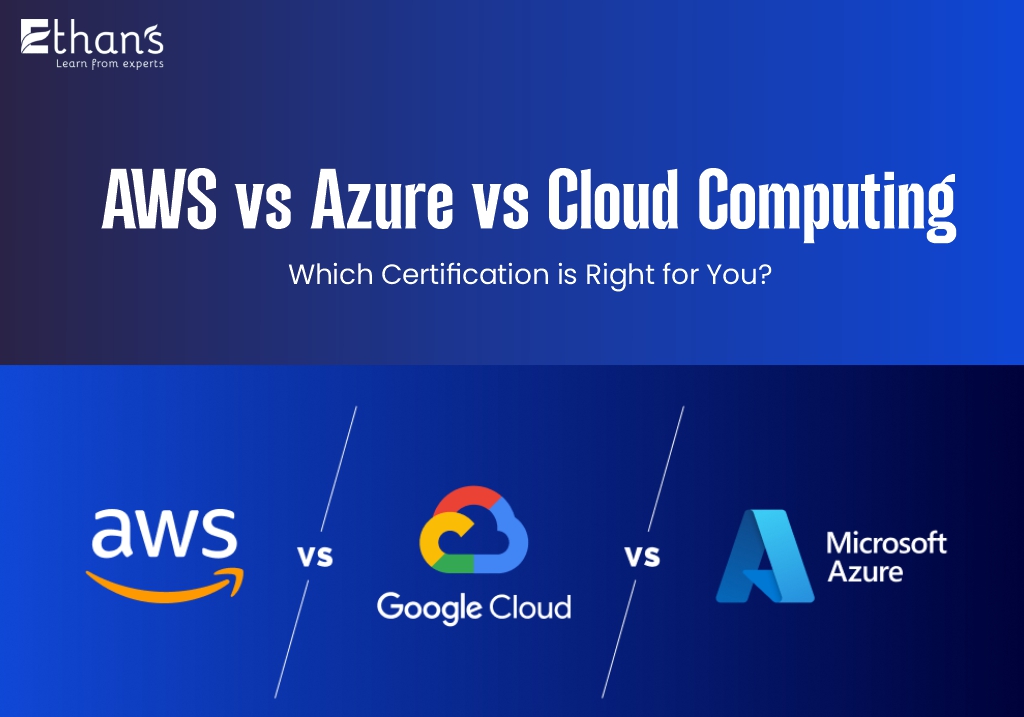
AWS vs Azure vs Cloud Computing: Which Certification is Right for You?

AWS vs Azure vs Cloud Computing

Bingo! You’ve asked the right question. Cloud computing is booming and one of the hottest technologies around. But yes, following your question, we agree that choosing the right certification matters. So, to everyone looking to pursue a career in cloud computing but confused about whether to do AWS training in Pune, join Microsoft Azure classes in Pune, or take up general cloud computing, you’ve come to the right place. We’ll provide a detailed comparison of all these options and provide unbiased insight to help you choose the right certification in your context. AWS Certifications Amazon Web Services (AWS) is a global market leader. Hence, it has a comprehensive and well-evolved certification program. AWS offers certifications across various tiers, including foundational certifications, and associate, professional, and specialty training programs. AWS certifications are profoundly technical and focus on their platforms and services. They usually require learners to have hands-on experience with the AWS console and a practical understanding of AWS’s architectural best practices. After an AWS training in Pune, you can work across various roles, including DevOps engineer, cloud architect, security specialist, and systems administrator, particularly with companies that work on AWS platforms and adopt the AWS cloud. Some key AWS certification programs include; Certified Cloud Practitioner: Entry-level certification for cloud newbies that validates a basic understanding of AWS concepts, terminologies, and services. Certified Developer – Associate: Particularly for developers, this one validates your ability to develop, deploy, and debug cloud-based apps that use AWS services. Certified SysOps Administrator – Associate: Focuses on the operational aspects of deploying and managing systems across AWS. Certified Solutions Architect – Associate: This focuses on designing and deploying scalable, highly available, and fault-tolerant systems on AWS. Professional Level Certifications: Advanced certifications that demand extensive experience and proven technical expertise in domains within the AWS cloud. Azure Certifications Second to AWS, Microsoft Azure is rapidly growing, gaining traction worldwide. Just like AWS, Azure’s certification programs have also evolved over the years. Accordingly, it offers various role-based certifications that serve different career needs and aspirations. Microsoft Azure certifications insist on gaining a broader understanding of cloud concepts and their integration with Microsoft’s ecosystem, including .NET, Windows Server, etc. The courses are technical, while also focusing on how-to aspects within Azure. Azure certifications are useful for people working in companies that use Azure and a broad array of Microsoft products. Some roles include solutions architect, Azure administrator, security engineer, and data engineer. Let’s look at some of the key Azure certifications. Azure Fundamentals: Basic certification covering basic cloud and Azure concepts Azure Administrator Associate: Focuses on implementing, managing, and monitoring a company’s Microsoft Azure ecosystem. Azure Solutions Architect Expert: Emphasizes designing and implementing robust and scalable Azure solutions. Azure Developer Associate: Validates skills in designing, developing, testing, and maintaining cloud solutions on Azure. Azure Security Engineer Associate, Azure Data Engineer Associate: Specialty certifications that focus on specific Azure areas. Generic Cloud Computing Certifications Of course, the cloud exists beyond these platforms or providers. So, you can also choose to pursue generic cloud computing certifications that focus on broader cloud concepts, best practices, and principles that you can apply across various cloud platforms. These certifications don’t focus on a single platform. This is unlike AWS and Azure which are specific to their own ecosystems. Instead, they provide a more comprehensive understanding of cloud computing, while covering topics like security, governance, cloud architecture, and cost management from a platform-agnostic viewpoint. Accordingly, these certifications benefit roles that require a broader understanding of cloud technologies and that involve working with different cloud platforms or providing consulting solutions to companies for their overall cloud strategy. AWS vs Azure vs Cloud Computing – Key Differences So, let’s make the comparison even easier for you to follow. Aspect AWS Certifications Azure Certifications Vendor-Neutral Cloud Computing Certifications Platform Focused on AWS platform and services Azure platform and services Broad concepts applicable across multiple platforms Technical Depth Technically comprehensive, insisting on hands-on skills within AWS Technically profound, with potential integration with the Microsoft environment Technical depth can vary based on the course’s objectives. Some are basic, while others are specialized Suitability For people already working with or planning to use AWS environments For individuals already associated with Microsoft-based ecosystems People who want a broader understanding of cloud and become generic experts Entry Level Certification AWS Certified Cloud Practitioner Microsoft Certified: Azure Fundamentals Google Cloud Digital Leader Industry Recognition Very high High Moderate to high Career Roles DevOps, Solutions Architect and Cloud Engineer Cloud Consultant, Data Engineer and Azure Admin Tech Generalist, Entry-Level Cloud Support So, Which Certification is Right for You? Let’s answer the core question. Which certification amongst AWS, Azure and generic cloud computing is right for you. The choice depends on various factors, including; Existing Role and Experience: If you are beginner, you can pursue a foundational certification from AWS or Azure (Cloud Practitioner or Azure Fundamentals) or a vendor-neutral alternative. But if you are experienced, you can take up speciality certifications in your area of focus or interest. Career Objectives: If AWS interests you and you want to work with companies using AWS, you can pursue AWS training in Pune. And so, it is with Azure. But if a generic role that involves working with multiple cloud platforms intrigues you or you want to enter a strategic cloud role, you can go for generic cloud certifications. Employer’s Requirements: If your company uses Azure, you can pursue Microsoft Azure classes in Pune. But if your employer uses Azure, you should enroll in AWS classes in Pune and work towards the certification you want to obtain. Final Thoughts! Cloud computing is on the rise. Hence, any choice is great, whether AWS, Azure or generic cloud computing course. However, individual situations and choices may vary. We hope the above helps you make an informed choice. Nevertheless, for a detailed and specific discussion, we recommend calling us at +91 95133 92223. Our course experts will help you navigate our course offerings and also answer various other questions concerning … Read more

How Cloud Computing Can Fast-Track Your Career in Data Science and AI?

Cloud Computing Career in Data Science and AI

Are you looking for a data science course in Pune or AI classes in Pune? While acquiring these in-demand skills, you must also consider learning cloud computing. Why? Cloud computing is a unique skill that can complement your data science and AI skills, accelerating your career and broadening the spectrum of opportunities. However, in what ways cloud computing benefits your career in data science and AI? That’s precisely what we will be looking at in this blog. What is Cloud Computing? Cloud computing enables you to access and store data, applications, and services over the web, instead of a local server or machine. The technology lets you access scalable resources like applications, storage, processing power, etc., without requiring you to build physical infrastructure. 5 Ways Cloud Computing Classes in Pune with Data Science and AI Prove Advantageous for Your Career Learning cloud computing can offer various technical advantages, enhancing your employability value. Companies look for people with combined skill sets. Here’s how proficiency in cloud computing can benefit your data science and AI career. Access to a Scalable Ecosystem Leading cloud service providers like Google Cloud, AWS, and Azure offer need-based access to performant computing services. It refers to empowering data scientists with the ability to work with massive datasets without investing in expensive hardware. Further, cloud storage also provides scalable storage solutions, allowing you to scale up as your data grows and pay only for what you use. Next-Level ML and AI Support The pre-trained models that cloud platforms provide enable AI professionals to experiment and integrate AI into their projects without reinventing the wheel. Besides, AWS SageMaker, Google Cloud AutoML, and Azure Machine Learning help you streamline model building and deployment. These services prove useful for you if you want to focus on experimentation and application instead of infrastructure. Productive Collaboration Cloud-based notebooks enable real-time collaboration, simplifying it for you to work with teams or seek guidance. It enables you to quickly share and reproduce work, facilitating team-based research and development. Furthermore, tools like MLflow, DVC, and cloud-native experiment management solutions help you track dataset and model versions, letting you build solid and reproducible ML pipelines. Integration with Big Data Tools and IoT Besides, cloud platforms integrate seamlessly with big data tools like Hadoop, Spark, and IoT services, ensuring real-time data ingestion and analysis. Learning cloud computing helps you leverage these capabilities that prove useful for industries like healthcare, finance, and manufacturing, where AI-driven insights form the core of decision-making and operational transformation. Continuous Evolution and Experimentation Cloud computing platforms provide innumerable resources, extensive documentation, and free credits to help you get started. These resources enable experimentation, learning new techniques, and stay abreast of the latest developments in AI. Furthermore, various prominent cloud providers provide certifications aligned with and customized to data science and AI. Final Words Cloud is a technology as important as data science and AI. All of them are here to stay. Hence, while learning data science and AI skills through a data scientist course in Pune and AI classes in Pune, acquiring cloud computing proficiencies can accelerate your career. Ethan’s Tech covers all these skills with its cloud computing classes in Pune and AI and data science courses. Together, our holistic approach, paired with practical exposure and the opportunity to learn under proven technology experts, refer to a competitive career and employment advantage. Call us at +91 95133 92223 to discover more about our courses and offerings.

Future of Cloud Computing in India

Future of Cloud Computing

Cloud computing isn’t merely a trend but a strategy or an approach here to stay. Initially considered disruptive, it has become a necessity worldwide. And we say it for a reason. A leading organization says cloud computing will shift from a technology disruptor to an essential component helping businesses stay competitive. Speaking of global statistics, the worldwide end-user public cloud service spending is projected to reach nearly USD 680 billion this year and exceed the trillion-dollar mark in the next three years! While these statistics seem impressive, what drives the future of cloud computing, particularly in India? Is it its benefits? Yes, of course. But the cloud offers many. So, what is likely to propel cloud computing’s future in the country? And what makes it a remunerative and promising career choice. Let’s seek answers to these questions. The Soul of Cloud – Elasticity! While most people would bank upon the cloud’s security, ease of data access, and cost savings, we look at its other side. It is the cloud’s elasticity. Businesses have multiple concerns to resolve. Conventional approaches can help address them; but only to an extent. This is where the cloud’s elasticity comes into play.  The elasticity of the cloud essentially refers to how elastic your cloud setup is when it comes to covering multiple problems, and for many problems, it can be a solution. To prove this elasticity, the cloud is divided into three parts – IaaS (Infrastructure as a Service), SaaS (Software as a Service), and PaaS (Platform as a Service). These categories allow infinite scalability. This has something to do with AI. As we’ve said in our earlier blogs, AI-Driven Data Analytics and Predictive Modeling, the value of AI will not be calculated by how many jobs it will create or the revenue it might help companies generate. Instead, it is about the energy AI consumes.  AI is operated and managed through massive server farms that consume substantial energy and electricity. For example, OpenAI server farms consume as much electricity as the Vatican City!  Take ChatGPT for example. Convenient to use and so useful! But here are some facts less discussed. A Google search query consumes an estimated of 0.0003 kWh (1.08 kJ) of energy. However, the estimated energy consumption of a ChatGPT-4 query is 0.001-0.01 kWh (3.6-36 kJ), which also depends on the model size and number of tokens it processes. Thus, a single GPT query consumes nearly 15 times more energy than a Google search query. A 60W incandescent light bulb uses 0.06kWh in an hour! So, it isn’t about how ChatGPT is simplifying lives but about the energy it consumes and how sustainability continuing using it would be. This is where we highlight the future of cloud computing. Managing and scaling the data received and processes from these servers and the country’s 1.4 billion people requires infinite scalability and flexibility. That refers to the viability of the future of cloud computing in India. With our ever-increasing population, growing data volumes, and the requirements from the tech industry, we need a seamlessly scalable infrastructure.  Cloud computing can make it possible with its highly flexible and scalable nature. In simpler words, when leveraged appropriately, it can further strengthen India’s position across the global technology spectrum. India-Specific Industry and Career Statistics of Cloud Computing Although in its nascency, India is quickly scaling its cloud adoption and economy. How? Per reports, with a CAGR faring between 40 and 45 percent, the Indian cloud market has grown much quicker than the global market. Some factors responsible for it include enterprise digitization, investments, a growing digital population, and conducive government policies. Reports also suggest the Indian cloud market reach approximately USD 11 billion by next year! As reports project cloud computing to become a significant GDP contributor by 2026, the sector is expected to create 10-15 million new job opportunities. It is also projected to witness significant investments worth thousands of crores from global tech giants like AWS by this decade-end, supporting nearly 50,000 full-time jobs. So, pursuing a cloud computing course will prove the right move, particularly in the years to come! Aspiring for a Cloud Computing Career & Searching for a Cloud Computing Course Near Me? The need for cloud computing and its significance in the future context make it a sustainable and promising career choice. However, you need specialized training that makes you a competent cloud computing professional capable of addressing the world’s needs. However, how do you qualify for the existing and upcoming opportunities in cloud computing? The answer is Ethan’s cloud computing classes in Pune. Recognized by industry experts and backed by a comprehensive and competent course curriculum, our cloud computing course can help you kick-start your career confidently. Explore our cloud computing courses, or connect with us to know more how we can help build your career.

Top Important Cloud Computing Terms You Must Know

Important Cloud Computing

Are you a fresher or an experienced professional looking for cloud computing classes in Pune to pursue a career in cloud computing? With millions of new job opportunities on the rise, many people are looking forward to it. So, you aren’t alone and you’ve made the right career choice. However, before you begin the course, you must know some basic cloud computing terms and terminologies. It is because cloud computing has had its journey of evolution, during which many new concepts emerged and helped transform it. Knowing these can help you begin your cloud computing course and career more confidently. So, let’s look at ten important ones in this blog. Cloud Computing Cloud computing refers to delivering computing services, including databases, servers, storage, networking, intelligence, etc., over the web. Cloud benefits companies in various ways. Some prominent benefits include increased agility, elasticity, and quick deployment. Furthermore, it allows user companies to pay for what they use (pay-as-you-go pricing), thus also saving costs considerably.  Unlike the yesteryears, when companies had to buy every service and support physically, the cloud enabled them to do it through the web, thus saving the effort involved in maintaining physical services, hardware, etc. Private, Public, Hybrid and Multi Cloud Cloud is classified into four categories, including private, public, hybrid, and multi-cloud. Here’s a basic understanding of each. Private: Highly secure cloud services customized for a single company Public: Company-owned and operated services made available to the public Hybrid: Custom-cloud services (public and private) working together Multi Cloud: Outsourcing cloud services to multiple providers for the same cloud deployment Application Programming Interface (API) These determine how two platforms or applications can communicate. They serve as a bridge linking two parts of the software and enable them to operate independently. APIs let users access information or functionality from a given service and integrate it into the user’s application. An example of this is an article you see over the web that also allows you to share it on a social media platform, say Facebook. Software-as-a-Service (SaaS) These are software applications owned and operated off-premises, provided by a cloud service provider. An example is Google Sheets, an application users can access and use remotely. Accordingly, SaaS allows remote accessibility, instant access, and nearly no data loss. Infrastructure-as-Service (IaaS) This is a service package that includes resources like data centers, database management, storage servers, and various other network elements. IaaS providers often provide it as a package. Hence, users aren’t required to install or buy separate hardware or purchase upgrades to maintain competence and optimal functioning. Platform-as-a-Service (PaaS) Custom-made applications require efficient platforms to operate on. PaaS offers the right environment to deploy cloud-based applications. It eliminates the need to purchase separate software, hardware and hosting as PaaS does everything.  Load Balancing Digital networks handle massive traffic loads. Load balancing helps spread the traffic to multiple servers, reducing the process time and distributing responsibility evenly. It helps improve the responsiveness and performance of various cloud applications. A few common load balancing techniques include Least Connection, Round-Robin, and Weighted Response Time. Google Cloud Google Cloud Platform (GCP) is a set of services offered by Google. These services provide server space on internal networks, virtual machines, disk storage, VPN connections, and more. In addition, GCP offers IaaS, PaaS, and serverless computing environments similar to AWS and Azure, two other leading cloud service providers.  Amazon Web Services (AWS) AWS is Amazon’s cloud computing platform that offers 200+ services. These include storage, database, analytics, ML, security, networking, etc. Leveraged by thousands of companies, including enterprises, startups, and government agencies, AWS is the world’s most comprehensive and widely used cloud. Microsoft Azure Azure is Microsoft’s cloud platform, offering over 600 services, using large-scale use of its data centers. It is designed to serve businesses of various sizes. The platform provides support for multiple programming languages, including NodeJS, Java, and C#. Besides, it offers 99.95 availability (the time it stays available for) and round-the-clock technical support. Wrapping it Up! So, that was about ten popular terms and terminologies of cloud computing. Of course, there are many more. But you can learn them while pursuing a comprehensive cloud computing course like that of Ethans. We are a seasoned technology training center, offering recognized and competent courses across various technologies, including cloud computing. Up until now, we’ve trained hundreds of students and shaped their careers, helping them thrive amidst the competitive technology horizon confidently. Call us at +91 95133 92223 if you have been searching for the term cloud computing course near me.

Future scope of Cloud Computing 2024

scope of Cloud Computing

In the ever-evolving landscape of technology, few innovations have had as profound an impact as cloud computing. As businesses worldwide embrace digital transformation and seek to optimize their operations, the demand for cloud services continues to skyrocket. In this SEO-friendly guide, we’ll explore the future scope of cloud computing, uncovering the trends, opportunities, and challenges that lie ahead. Understanding the Evolution Cloud computing has come a long way since its inception, evolving from a novel concept to a cornerstone of modern IT infrastructure. Today, cloud services encompass a wide range of offerings, including infrastructure as a service (IaaS), platform as a service (PaaS), and software as a service (SaaS). This evolution has democratized access to computing resources, enabling organizations of all sizes to leverage scalable, cost-effective solutions. Trends Shaping the Future Several key trends are shaping the future of cloud computing, each presenting unique opportunities for businesses and IT professionals alike: Hybrid and Multi-Cloud Adoption: As organizations seek to balance performance, security, and cost-effectiveness, hybrid and multi-cloud architectures are becoming increasingly prevalent. This trend reflects the growing realization that a one-size-fits-all approach to cloud adoption may not be optimal, prompting businesses to leverage multiple cloud providers and deployment models. Edge Computing: With the proliferation of Internet of Things (IoT) devices and the need for real-time data processing, edge computing is gaining traction as a complement to centralized cloud infrastructure. By bringing computation closer to the data source, edge computing reduces latency, enhances privacy, and enables new use cases across industries such as manufacturing, healthcare, and transportation. AI and Machine Learning Integration: Cloud providers are increasingly integrating artificial intelligence (AI) and machine learning (ML) capabilities into their offerings, empowering businesses to extract insights from vast datasets and automate decision-making processes. Whether it’s predictive analytics, natural language processing, or image recognition, AI-powered cloud services are poised to drive innovation across sectors. Serverless Computing: Serverless computing, also known as Function as a Service (FaaS), is revolutionizing the way applications are developed, deployed, and scaled in the cloud. By abstracting away infrastructure management and billing based on actual usage, serverless platforms enable developers to focus on writing code and delivering value without worrying about underlying infrastructure concerns. Opportunities on the Horizon The future scope of cloud computing presents a myriad of opportunities for businesses and IT professionals to thrive: Scalability and Flexibility: Cloud computing enables businesses to scale their infrastructure up or down on-demand, allowing them to adapt to changing market conditions and customer demands with ease. Cost Optimization: By leveraging pay-as-you-go pricing models and avoiding upfront infrastructure investments, organizations can reduce capital expenditures and optimize operational costs in the cloud. Innovation and Agility: Cloud computing fosters a culture of innovation by providing access to cutting-edge technologies and services, enabling businesses to experiment, iterate, and bring new products and services to market faster. Global Reach: With cloud providers operating data centers in multiple regions around the world, businesses can reach customers and users globally while ensuring compliance with local regulations and data sovereignty requirements. Navigating the Challenges Despite its immense potential, cloud computing also presents certain challenges that must be addressed: Security Concerns: As data moves to the cloud, ensuring robust security measures to protect sensitive information from cyber threats becomes paramount. Cloud providers and businesses must collaborate to implement best practices for encryption, access control, and threat detection. Data Privacy and Compliance: With the rise of data protection regulations such as GDPR and CCPA, businesses must navigate complex compliance requirements when storing and processing data in the cloud. Implementing privacy-enhancing technologies and adopting a proactive approach to compliance are essential. Vendor Lock-In: While cloud computing offers unparalleled flexibility, businesses risk vendor lock-in if they become too dependent on a single provider’s proprietary services and APIs. Adopting open standards and architectures can mitigate this risk and preserve flexibility. Conclusion In conclusion, the future scope of cloud computing is vast and promising, driven by technological advancements, evolving business needs, and a growing demand for scalable, cost-effective solutions. By embracing key trends such as hybrid and multi-cloud adoption, edge computing, AI integration, and serverless computing, businesses can unlock new opportunities for innovation, growth, and competitive advantage in the digital age. With careful planning, strategic partnerships, and a commitment to continuous learning, organizations and IT professionals can harness the full potential of cloud computing to shape a brighter future for themselves and their customers.

Is Cloud Computing Course Worth It?

Cloud Computing

Cloud computing has become an integral part of modern businesses and technological advancements. It refers to the delivery of various services over the Internet, including storage, databases, software, analytics, and more. The convenience and efficiency offered by cloud computing have made it a vital component of numerous industries. As a result, many individuals are considering enrolling in cloud computing courses to enhance their skills and explore new career opportunities. Advantages of Cloud Computing Courses Flexibility and Accessibility One of the key advantages of enrolling in a cloud computing course is the flexibility it offers. These courses are often available online, allowing learners to study at their own pace and convenience. Whether you are a working professional or a student, you can access the course materials from anywhere, making it convenient for those with busy schedules. Cost-Effectiveness Investing in a cloud computing course can be a cost-effective decision in the long run. The knowledge gained from these courses can significantly reduce a company’s reliance on external cloud service providers, resulting in cost savings. For individuals, this expertise can lead to higher-paying job opportunities, making the initial investment worthwhile. Enhanced Career Opportunities The demand for skilled cloud computing professionals is rapidly increasing. By completing a cloud computing course, individuals can acquire the expertise required by various industries. This opens up a plethora of career opportunities, from cloud architects and engineers to cloud security specialists. Key Skills Taught in Cloud Computing Courses Cloud Infrastructure Management Cloud computing courses focus on teaching students how to manage and optimize cloud infrastructures. This includes understanding different cloud service providers, deploying applications, and effectively utilizing resources to meet business needs. Security and Compliance Security is a critical aspect of cloud computing. Courses in this field emphasize the best practices to secure data, applications, and networks in the cloud environment. Compliance with industry standards and regulations is also covered. Cloud Service Models Cloud computing offers different service models such as Infrastructure as a Service (IaaS), Platform as a Service (PaaS), and Software as a Service (SaaS). Understanding these models and their applications is crucial for cloud professionals. Future of Cloud Computing Growing Demand for Cloud Professionals The global cloud computing market is projected to continue its rapid growth. As businesses increasingly adopt cloud solutions, the demand for skilled professionals will soar. Enrolling in a cloud computing course positions individuals to capitalize on these opportunities. Evolving Job Roles and Specializations: As technology advances, new job roles and specializations in cloud computing will emerge. Professionals with up-to-date knowledge gained from cloud computing courses will be well-equipped to adapt to these changes and remain relevant in the job market. Factors to Consider Before Enrolling in a Cloud Computing Course Previous Knowledge and Experience Before enrolling in a cloud computing course, individuals should assess their existing knowledge and experience in the field. Some courses cater to beginners, while others require a certain level of proficiency. Accreditation and Quality of Course It is essential to choose a reputable course offered by a recognized institution or provider. Accreditation ensures that the course meets industry standards and imparts valuable knowledge. Career Goals and Aspirations Consider your career goals and how a cloud computing course aligns with them. Whether you seek a career change or want to advance in your current role, the course should cater to your specific aspirations. Unlock your potential in the tech industry—explore the possibilities with our Cloud Computing Course and see how it complements your journey in the Data Analytics course. Start your learning path today! Top Cloud Computing Certifications AWS Certified Solutions Architect Amazon Web Services (AWS) is one of the leading cloud service providers globally. The AWS Certified Solutions Architect certification validates a professional’s expertise in designing and deploying scalable systems on AWS. Microsoft Certified Azure Administrator For those interested in Microsoft’s cloud platform, the Microsoft Certified Azure Administrator certification is valuable. It demonstrates proficiency in implementing, managing, and monitoring Azure solutions. Google Cloud Certified Professional Cloud Architect Google Cloud offers its certification for professionals who demonstrate the ability to design and manage dynamic cloud solutions using Google Cloud Platform. Real-Life Success Stories Include real-life anecdotes or testimonials of individuals whose careers were transformed by completing cloud computing courses. Cloud Computing Course vs. Self-Study Benefits of Formal Education Formal cloud computing courses provide structured learning, access to industry experts, and hands-on experience through practical exercises and projects. These benefits can accelerate the learning process and provide a comprehensive understanding of the subject. Self-Study Challenges and Limitations While self-study is an option, it comes with challenges such as lack of guidance, limited access to practical exercises, and the risk of incomplete or inaccurate knowledge. Conclusion Enrolling in a cloud computing course can be a game-changer for individuals aiming to enter or advance in the world of cloud technology. These courses offer valuable knowledge and skills that align with the growing demand for cloud professionals. It’s essential to choose a reputable course that suits your needs and aspirations, ensuring a rewarding and successful career in the dynamic field of cloud computing.

Cloud Computing Can Benefit Your Small Business

Cloud Computing services

In today’s digital age, small businesses are constantly seeking ways to optimize their operations and enhance their productivity. One such solution that has revolutionized the business landscape is cloud computing. Cloud computing offers a wide range of benefits that can significantly impact the growth and success of small businesses. This article will explore the various advantages that cloud computing brings to small businesses, enabling them to thrive in a highly competitive market. Understanding Cloud Computing Cloud computing refers to the practice of storing, managing, and accessing data and applications over the internet instead of using local servers or personal computers. It involves the use of remote servers that are hosted on the internet to store and process data, allowing businesses to access their resources from anywhere with an internet connection. Cost Savings and Scalability One of the primary benefits of cloud computing for small businesses is the potential for cost savings. Cloud services typically operate on a pay-as-you-go model, allowing businesses to only pay for the resources they need. This eliminates the need for upfront hardware and software investments, reducing capital expenditure. Additionally, cloud computing offers scalability, enabling businesses to easily scale up or down their resources based on their fluctuating demands. Enhanced Collaboration and Accessibility Cloud computing facilitates seamless collaboration among team members, regardless of their geographical location. Cloud-based tools and applications enable real-time document sharing, co-authoring, and version control, promoting efficient teamwork and improving productivity. Moreover, cloud services provide remote access to data and applications, allowing employees to work from anywhere, anytime, using any device with an internet connection. Data Security and Disaster Recovery Small businesses often face challenges in ensuring robust data security and implementing effective disaster recovery measures. Cloud computing addresses these concerns by offering enhanced data security features, such as encryption, regular backups, and access controls. Cloud service providers also have redundant data centers, ensuring data availability even in the event of hardware failures or natural disasters. Increased Flexibility and Mobility Cloud computing provides small businesses with unparalleled flexibility and mobility. With cloud-based solutions, employees can access their work-related files and applications using any internet-enabled device, eliminating the need for a specific physical location or device. This flexibility allows businesses to embrace remote work arrangements, attract top talent from anywhere in the world, and respond quickly to changing market demands. Improved Efficiency and Productivity By leveraging cloud computing, small businesses can streamline their operations and improve overall efficiency. Cloud-based applications automate manual tasks, such as data backups, software updates, and system maintenance, freeing up valuable time for employees to focus on core business activities. The scalability of cloud services also ensures that businesses can quickly scale their resources to meet increased demand, avoiding bottlenecks and delays. Streamlined IT Management Traditional IT infrastructure requires significant investments in hardware, software licenses, and maintenance costs. Cloud computing reduces the burden of managing complex IT infrastructure by shifting the responsibility to cloud service providers. This allows small businesses to focus on their core competencies while relying on experienced professionals to handle their IT needs. Competitive Edge and Innovation Cloud computing empowers small businesses to compete on a level playing field with larger enterprises. By leveraging advanced cloud-based technologies, such as artificial intelligence, machine learning, and big data analytics, small businesses can gain valuable insights, make data-driven decisions, and enhance their offerings. Cloud services provide the necessary infrastructure and computing power to support innovative initiatives, enabling small businesses to differentiate themselves in the market. Integration with Existing Systems Small businesses often have legacy systems and applications that are critical to their operations. Cloud computing offers seamless integration capabilities, allowing businesses to connect their existing systems with cloud-based solutions. This integration enables smooth data exchange, eliminates data silos, and enhances overall operational efficiency. Regulatory Compliance and Data Governance Complying with industry regulations and ensuring data governance are crucial for small businesses. Cloud service providers adhere to stringent security and compliance standards, such as GDPR and HIPAA, ensuring that data is handled in a secure and compliant manner. By leveraging cloud computing, small businesses can mitigate the risks associated with data breaches and regulatory non-compliance. Sustainability and Environmental Impact Cloud computing promotes sustainability by reducing the carbon footprint of small businesses. With cloud-based infrastructure, businesses can eliminate the need for physical servers and data centers, which consume significant energy and resources. Cloud service providers optimize their data centers for energy efficiency, enabling small businesses to contribute to environmental conservation while reducing operational costs. Training and Support Transitioning to cloud computing requires proper training and support for employees. Cloud service providers offer comprehensive training programs and ongoing technical support to assist small businesses in adopting and maximizing the benefits of cloud computing. This ensures a smooth transition and minimizes disruptions to daily operations. Potential Challenges and Considerations While cloud computing offers numerous benefits, small businesses should also be aware of potential challenges. These include data security concerns, reliance on internet connectivity, vendor lock-in, and potential downtime. It is crucial for businesses to evaluate their specific needs, conduct thorough research, and choose reliable cloud service providers to mitigate these challenges. Best Practices for Adopting Cloud Computing To maximize the benefits of cloud computing, small businesses should follow best practices, such as conducting a thorough cost-benefit analysis. Selecting the appropriate cloud deployment model (public, private, or hybrid), implementing strong security measures, regularly monitoring. And optimizing cloud resources, and establishing backup and disaster recovery plans. Conclusion Cloud computing has emerged as a game-changer for small businesses, offering a wide range of benefits that enhance productivity, reduce costs, and promote growth. By embracing cloud-based solutions, small businesses can leverage advanced technologies, improve collaboration, enhance data security, and gain a competitive edge. In today’s digital landscape. With careful planning, adoption, and ongoing optimization, small businesses can harness the power of cloud computing to propel their success in the long term.