Best Full Stack Developer Course in Pune: Key Factors to Consider
Key Factor of Full stack developer

Riddled with numerous choices available for a full stack developer course in Pune? Whether you are a tech student aspiring to launch your career or a working professional looking to enhance your skills, you must make the right choice. So, why wait? Let’s get to the point and look at the key factors you must consider while choosing a course for full stack training in Pune. What is Full Stack Development? Since you’ve been searching for a full stack developer course in Pune, most of you would already know the concept of full stack development. However, for those new to this space, let’s quickly overview to understand what it means. Full stack development refers to developing the front and back end of an application. Professionals specializing in it are called full stack developers. They are proficient in working on front (client-side) and back (server-side) technologies. Thus, their role encompasses a broad spectrum of activities. These include conceptualization, designing, development, implementation, testing, and deployment. In other words, full stack developers are involved in developing an application from start to finish, while working on numerous tools, technologies, and platforms. Employers prefer hiring full stack developers given the dual role they play, the expertise they bring to the table, and the outcomes they deliver. Considering the critical role of full stack developers, you cannot just choose any average full stack training in Pune – you need the best! So, let’s see how to choose one. 7 Factors to Consider While Choosing a Full Stack Developer Course in Pune From course curriculum to alumni and student feedback, here are seven crucial factors you must evaluate while selecting full stack training in Pune. Course Syllabus A comprehensive full stack course must go beyond dealing with just CSS and HTML.  It must delve into the various aspects of full stack development, helping you develop the skills to become a confident and in-demand full stack developer. Some must-haves include frontend (JavaScript, Angular or ReactJS), backend (ExpressJS, NodeJS, and RESTful APIs), databases (MySQL, MongoDB, and PostgreSQL), and version control (Git and GitHub), deployment (CI/CD, cloud platforms). Even better if the course covers Docker, DevOps, and Agile practices, given the demand they are in these days. Practical Exposure Next on the list is real-world exposure. You must check if the course provides abundant practical experience and exposure to real-world projects and technologies in use. Practicing real-world projects and technologies will help you gain a valuable first-hand understanding of the industry. The portfolio that this will develop you – priceless! Explore Your Path: Start Your Journey in Full Stack or DevOps Today! Faculty Expertise and Experience Trainers are at the core of every course curriculum.  While enhancing learning experiences, they also shape careers.  Accordingly, while evaluating other aspects of the course, you must also see who’s teaching you. The course must have trainers with field experience in application development, expertise in the latest tech stacks, a good track record, and openness to questions. Learning Environment Learning is a critical process. Hence, it must be joyous while gratifying.  Thus, while assessing a full stack developer course in Pune, you must also consider evaluating the learning environment of the institute. The environment must be supportive, encourage self-learning, provide access to useful educational resources, and include expert sessions and interactions. Placement Assistance Full stack development is a professional course. So, at the course’s end, every student expects a decent and remunerative placement in a reputed organization. Thus, you must check if the institute offers placement assistance – even better if it has a dedicated placement cell that works towards enhancing the placement experience. But don’t stop there. Tech interviews are often challenging and extensive. While technical skills matter, confidence and approach also play a pivotal role. Hence, you must see if the institute conducts mock interviews, conducts soft skills training sessions to build confidence, and helps you cut through the competition and intricate rounds easily. Learning Flexibility Professional courses usually train aspirants from various backgrounds, including students, beginners, mid-level working professionals, etc. Each has a unique learning need and schedule to adhere to. Therefore, the course you choose should offer flexibility in terms of batch schedules and learning methods, including online, offline, and hybrid. It will help you learn at your pace while keeping your current schedules unperturbed. Student Feedback Hear what the institute’s students say. Check the course’s alumni and placement records. Besides, look for online student testimonials and offline feedback. Speak with some students if possible. Try to gain specific feedback on the institute’s learning methodologies, course competence, trainers, post-learning support, and more. All Set to Become a Full Stack Developer? Join Ethan’s Tech for comprehensive full stack training in Pune! Our full stack developer course in Pune covers technology, practical exposure, real-world exposure, expert interactions, great trainers, and placement assistance. Want to know more for a complete evaluation of our course? Call us at +91 95133 92223.

Full Stack Development vs DevOps: Key Differences and Career Paths

Full Stack vs DevOps

Want to become a developer but are confused between full stack development and DevOps? Both involve working with codes and infrastructure but serve different purposes across the software development lifecycle! Thus, knowing the differences is evident, particularly if you are about to join DevOps training or a full stack developer course in Pune. It will help you make an informed choice and select the right path for your career. So, let’s understand the differences between both in this blog. What is Full Stack Development? It involves developing and maintaining the front end (user interface) and back end (server and database) of a web application. Full stack developers can work on both these aspects of an application, thus serving as comprehensive leaders of the development aspect of a particular project. Some key responsibilities include the following. Frontend interface development with HTML, CSS, JavaScript, and React or Angular Writing backend logic with Ruby, Java, Python, or Node.js Managing databases with SQL or NoSQL solutions like MongoDB and PostgreSQL Working with UI/UX designers and DevOps engineers for seamless deployment Addressing application performance and troubleshooting concerns Full Stack Development Career Opportunities After undergoing full stack training in Pune, you can pursue several career paths. These include frontend development, backend development, full stack development, software engineering, cloud engineering, API development, mobile app development, network architecture, computer programming, and many others. While some, like frontend, backend, and full stack development are core career paths, the rest are specialized roles. What is DevOps? DevOps blends development and operations. It focuses on automating, accelerating, and streamlining the software development lifecycle. The key principles of DevOps include collaboration, automation, continuous integration, continuous delivery (CI/CD), and infrastructure as a code. DevOps helps ensure quicker time to market, enhances software quality, increases reliability, and improves collaboration between the teams. Some key responsibilities of DevOps professionals include, Managing CI/CD pipelines Monitoring application performance and resolving server issues Automating infrastructure with Ansible, Kubernetes, and Terraform Optimizing the deployment process and minimizing downtime Implementing security best practices across cloud environments DevOps Career Paths and Opportunities After DevOps training, you can embrace a range of career opportunities based on your expertise, experience, and the positions available in the market. Some of them include, Entry-Level Roles: Junior DevOps Manager, and Release Manager Mid-Level Roles: Site Reliability Engineer (SRE), DevOps Engineer, DevOps Automation Engineer, and Cloud Engineer Advanced Roles: DevOps Consultant, DevOps Architect, DevSecOps Engineer, Automation Architect, and Reliability Engineer Quick Comparison Between Full Stack Development and DevOps Let’s quickly compare full stack development and DevOps to understand the key differences between both. Aspect Full Stack Development DevOps Primary Focus Frontend and backend application development Deployment, automation and infrastructure Skills Required React, Node.js, SQL, Python, and JavaScript Kubernetes, Docker, CI/CD, cloud (Azure, AWS and GCP) Objective Developing the frontend and backend of web applications Ensuring seamless deployment and infrastructure management Collaboration Full stack developers work closely with designers and product managers DevOps professionals work with developers and IT and security teams of an organization Salary Rs. 3.5 lakhs to Rs. 15 lakhs per annum Rs. 5 lakhs to Rs. 14 lakhs per annum Note: Salaries may vary depending on your experience, expertise, the paying capacity of your employer, the projects available, and work location. Full Stack Development or DevOps – What to Choose as a Career? The choice depends on what resonates with you the most. For instance, if you prefer coding, designing user interfaces, and creating comprehensive applications, you can go for full stack development. However, if you love to work in the field of automation, cloud technologies, and infrastructure management, you can choose DevOps. Remember, both these are exciting and promising career options. They have bright prospects, given the value they bring to the table. However, if you are still confused and need an expert to handhold you through the decision-making process, we recommend visiting Ethan’s Tech. We are a technology partner with years of experience shaping careers and delivering professionals in the field of full stack development and DevOps to the industry.  Our comprehensive course curriculum, handpicked faculty members, supportive learning environment, and abundant practical exposure help you qualify yourself as a learned and prepared professional ready to take up real-world challenges. Want to know more or book an appointment with our counselors? Call us at +91 95133 92223 and explore more about DevOps and full stack training in Pune.

Full Stack Development Roadmap: How to Start and Succeed in Your Journey

Full Stack Development Course

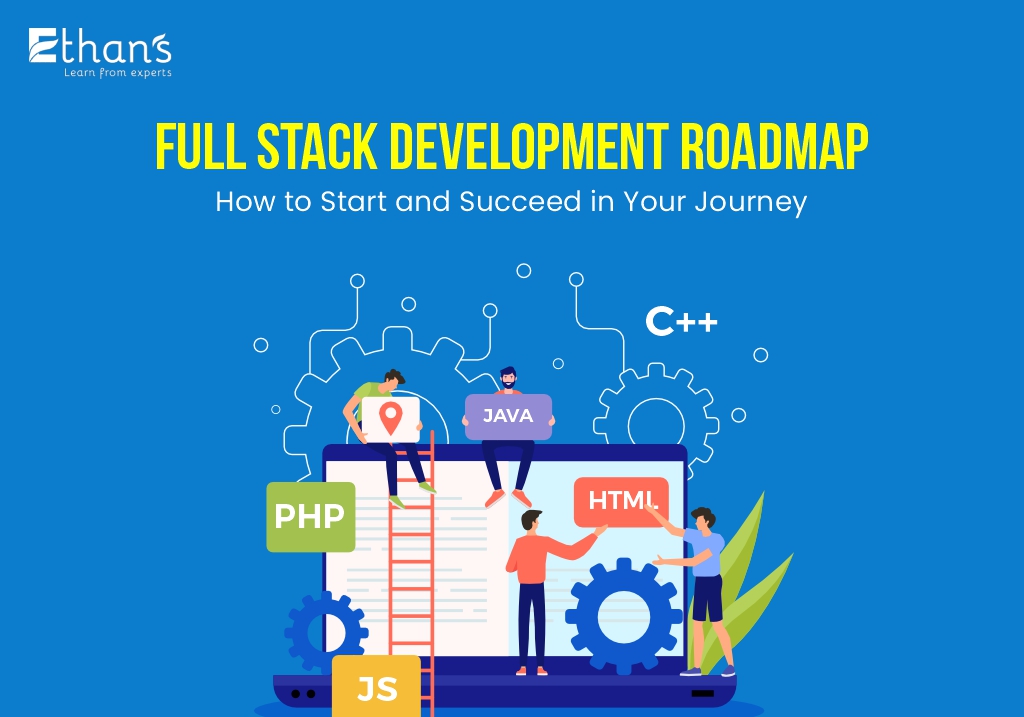
The world of software development offers endless opportunities, and one of the most rewarding career paths is full stack development. A full stack developer is a professional proficient in both front-end and back-end technologies, enabling them to build end-to-end web applications. If you’re considering stepping into this field, this roadmap will guide you on how to start and succeed in your journey. What is Full Stack Development? Full-stack development means working on both the front-end (what users see) and the back-end (how things work behind the scenes) of applications. It requires knowledge of multiple technologies and tools to create dynamic and fully functional websites or applications. Full stack developers can handle the entire development process, from designing user interfaces to managing databases and server-side programming. Why Choose Full Stack Development? The need for full-stack developers is growing. Companies value professionals who can handle multiple roles, making them versatile and indispensable in software projects. Here are some reasons to pursue full stack development: High demand: Businesses are actively seeking skilled full stack developers. Better career opportunities: Proficiency in both front-end and back-end opens doors to varied roles. Competitive salaries: Full-stack developers earn good pay because of their wide range of skills. Creative freedom: Work on diverse projects and build complete applications from scratch. Step-by-Step Roadmap to Become a Full Stack Developer Step 1: Master the Basics of Programming You can start by learning a simple programming language like Python, Java, or JavaScript. Python is beginner-friendly, while JavaScript is essential for front-end development. Understanding programming fundamentals such as data types, variables, loops, and functions is critical. Step 2: Dive into Front-End Development Front-end development is all about designing how a website or app looks and how users interact with it. Key technologies include: HTML: The backbone of web pages, used to structure content. CSS: Makes the HTML look good by adding styles and arranging the layout. JavaScript: Enables interactivity, such as animations and dynamic content. Additionally, learn front-end frameworks like React.js, Angular, or Vue.js to simplify the development process and create responsive designs. Step 3: Explore Back-End Development Back-end development involves server-side programming and database management. Learn the following: Languages: Python (Django, Flask), Java (Spring Boot), or JavaScript (Node.js). Databases: Understand how to use SQL databases like MySQL and PostgreSQL, as well as NoSQL databases like MongoDB. APIs: Learn to create and use RESTful APIs to connect the front-end with the back-end. Step 4: Learn Version Control Systems Version control systems like Git are crucial for tracking changes in your code and collaborating with other developers. Platforms like GitHub and Bitbucket are widely used for code sharing and project management. Step 5: Understand DevOps and Deployment DevOps skills ensure that your applications are smoothly deployed and maintained. Learn: Hosting platforms: Familiarize yourself with cloud platforms like AWS, Azure, or Heroku. Containerization: Tools like Docker are essential for deploying applications consistently across environments. Step 6: Work on Real-World Projects Hands-on experience is essential to becoming skilled in full stack development. Begin with small projects and slowly take on bigger ones. Examples include: A personal portfolio website. A blog application with user authentication. An e-commerce platform. Step 7: Stay Updated with Trends The tech industry evolves rapidly. Stay updated with the latest tools, frameworks, and practices by following blogs, attending webinars, and joining developer communities. Benefits of Full Stack Developer Training Enrolling in a structured full stack developer course in Pune can accelerate your learning process. Such courses provide: Comprehensive curriculum: Covering front-end, back-end, and deployment. Expert guidance: Learn from experienced instructors. Hands-on projects: Work on industry-relevant projects to build your portfolio. Placement assistance: Many institutes offer job support post-completion. Skills Required for Full Stack Development To excel as a full stack developer, focus on developing the following skills: Problem-solving: Ability to debug and fix issues efficiently. Attention to detail: Ensuring your code is clean and optimized. Communication: Working effectively with teams and clients. Time management: Meeting deadlines while balancing multiple responsibilities. Full Stack Training in Pune: Why It’s Essential The journey to becoming a full stack developer can be overwhelming without proper guidance. Joining a full stack training in Pune equips you with the right tools, techniques, and mentorship to achieve your goals. Pune is a hub for IT professionals, offering abundant learning resources and job opportunities. Tools and Technologies You Need to Know Here’s a list of must-know tools and technologies for full stack developers: Front-End: HTML, CSS, JavaScript, Bootstrap, React.js Back-End: Node.js, Express.js, Django Databases: MySQL, MongoDB Version Control: Git DevOps: Docker, Jenkins Others: Webpack, Babel, Postman Challenges in Full Stack Development The journey to mastering full stack development isn’t without challenges. Common hurdles include: Learning curve: Keeping up with multiple technologies can be daunting. Debugging complex issues: Fixing problems across the stack requires patience and expertise. Time management: Balancing learning and practical implementation. Overcoming Challenges To overcome these challenges, follow these tips: Break your learning into manageable chunks. Practice consistently by building projects. Seek mentorship or join a full stack developer course in Pune for expert guidance. Kickstart Your Career with Ethan’s Tech If you’re ready to embark on your journey as a full stack developer, Ethans Tech in Pune is the perfect place to start. Renowned for its industry-aligned curriculum and hands-on training, Ethans Tech offers one of the best full stack training in Pune. With experienced instructors, real-world projects, and dedicated placement assistance, Ethans Tech ensures you’re job-ready upon course completion. Enroll today and take the first step toward a thriving career in full stack development!

Best Institutes for Full Stack Developer Courses with placement in Pune

Full Stack Developer Course in Pune

Pune, the Apple of the East has many hidden attributes apart from being an Educational Hub, this city is a developing IT destination as well. As business requirements have evolved, so too has the need for versatile professionals such as Full Stack Developers who are capable of handling both front-end and back-end development. No matter whether you are a fresh graduate, changing to improve the tech skills or learning want to sharpen their skills a proper slate of training may offer you a new path to incredible opportunities. Use the best institutes which provide Full Stack Developer courses in Pune with placement assistance and industry oriented training. What is Full-Stack Development? Full-stack has a breadth of knowledge technically in order to also talk the same lingo on the front end and back end, A full-stack developer is an expert at creating web apps that are both frontend and backend. Full-Stack Developer Skill Set: Front End Tech: HTML, CSS and JavaScript Back-end Technologies: Node. JavaScript, Python, Ruby on Rails, Java Databases Management System: SQL, NoSQL Frameworks and Libraries: React, Angular, Vue, Express, Django Cloud Platforms: AWS / Azure / GCP Version Control: Git Why Pune is the Right Place for Full-Stack Development Pune, also known as the ‘Oxford of the East’, has developed into a bustling tech center. There are a few reasons behind its popularity as a full-stack development: IT Industry Hub: Numerous IT firms and start-ups provide attractive opportunities. Quality Institutions — Top engineering colleges & training institutes offer good courses. Thriving startup ecosystem: A prime area for innovation-driven enterprises. Low Cost of Living: Live at a low cost, compared to other metro cities. Best Full Stack Developer Courses in Pune with Placement Assistance Ethans Tech Ethans Tech emerges among the best Full Stack Developer training institutes in Pune. The institute not only provides students a comprehensive theoretical background but also practical skills through expert trainers. E&ICT, IIT-Guwahati has also partnered with Ethans Tech to add more credibility by providing certification in Full Stack Development Course and other related technologies. Not just that, but LIKE also has a separate placement team which prepares the students for different kinds of jobs. Key Features of Ethans Tech Industry-relevant curriculum covering front-end, back-end and databases. Work on Practical examples and exercises with real-life projects. A robust tie-up with the leading IT companies for placement assistance. In-person and online alternatives Course Details Duration: Five Months (Weekdays/Weekend) (Batches in week between Monday-Friday, on Weekend). Full Stack Developer Courses Fees: 50,000-75,000 (EMI options available) Type of Class: Offline and online live class Placements Assistance: More than 90% students placed in IT companies such as Infosys, Wipro, TCS and startups in Pune tech ecosystem. 2. UpGrad UpGrad is one of the best options for fresh graduates or inexperienced candidates as it provides a detailed Full Stack Development Bootcamp. The course is practice oriented with live projects and mentoring throughout. Course Details Duration: 13 weeks (full-time, online boot camp) Full Stack Developer Courses Fees: ₹99,000 + GST (EMI options available) Learning Mode: Online (Live classes) Placement Record: Good industry linkages; Placements made through the years in IT firms and startups across India. 3. Simplilearn Become a Full Stack Web Developer course by Simplilearn — For Beginners It covers both front-end and back-end fundamentals along with projects relevant to the industry. Key Features Certification based on industrial needs Live classes and masterclasses conducted by industry professionals. Course Details Duration: 9 months Full Stack Developer Courses Fees: ₹99,999 (Inclusive of GST, EMIs available) Learning Method: Online (Asynchronous + Some Live Classes) Placement Record: Works with recruitment partners to assist students in obtaining employment. 4. Codecademy Full Stack Engineer Codecademy’s full stack engineer program is suitable for someone with a little web development experience under their belt. This course is all about the MERN (MongoDB, Express, React, Node. js) stack. Course Details Duration: 8 months, 15–20 hours per week (self-paced and online with weekly live sessions) Full Stack Developer Courses Fees: $6,808 Mode of Learning: Remote (asynchronous with synchronous components) Placement Record: Provides career services, including portfolio reviews and interviews. 5. EdX Of those, EdX is a good place for beginner friendly self paced programs. The development of their Full Stack Development programs is at a minimal cost and recognized all around the globe. Key Features Certification fee fully waived for students unable to pay due to financial need. It comes with a preparing career guidance to help you transition into the industry. Course Details Length: 6-8 months (at your own pace) Cost: Free for audit; $99 per course for certification Method of Implementation: Online (on your own) Placement Record: It is focused on creating a good portfolio for a good job & it displays passato out pupil placements wise level.Task of interview practices record. 6. Udacity Well, the Udacity Nanodegree — Here Full Stack Development course is a hands-on, short-term program for novices and working professionals. It also features mentorship and career services. Key Features Projects based on industry and portfolio building Development/mentorship from experienced developers Course Details Length: 4 months (recommended completion up to a 10 hours/week commitment) Cost: $1,356 (or 4 monthly payments of $339) Delivery Mode: Online (Self-Paced) Enhanced Placement Record: Career assistance and alumni network are two key areas this university can never compromise on. How and where to find the best institute  Here are some of the factors you should consider when choosing your Full Stack Developer course, Curriculum: It should include HTML, CSS, JavaScript, React, Node. js, and databases. Mode of Learning: Select an online or offline mode according to your availability. Placement Assistance: Go for institutes with a strong placement history. Budget: Be aware of your finances and check if an EMI or financial aid is available. Practical Exposure: Acquiring practical experience is important to prepare your portfolio for hands-on projects. Full Stack Developer Courses FAQs Q1. Pune Full Stack Developer Average Salary The average salary of a Full Stack Developer in Pune is around ₹4-7 LPA for freshers and crosses ₹10 … Read more

Why Take a Full Stack Development Course in Pune? Top Benefits and Opportunities

Full Stack Development Course in Pune

Full stack development has become one of the most sought after skills in today’s digital world. If you want to learn how to build applications that are easy to use, work with servers and other back-end processes, or even databases—any full stack dev will be able to do all of this and more so the possibilities in your career will be endless. In a Full Stack Development Course in Pune, you will learn to build your profile with both front-end and back-end technologies that are the top skills set for today and become job-ready. This article discusses the full stack developer course in Pune, its advantages, career opportunities of a full-stack developer in Pune, and why this is an investment for your future. What is Full Stack Development? Working on both the front end (client side) and back end (server side) of web apps is called full stack development. Full stack developer manages end-to-end application development cycle including layout/design, database/ DB design and Application functionality. This expertise includes but is not limited to an understanding of different programming languages, frameworks and databases such as HTML, CSS, JavaScript, Node. js, Express, MongoDB among others. Why should you go for Full Stack Development Course Pune? Pune is a tech-heavy city, with plentiful job openings relating to the field of IT development that makes it great to learn full stack development in Pune. Reasons to choose Full Stack Development Course in Pune: Increasing Demand for Full Stack Developers in Pune city is on the way to become the next biggest place for tech companies and startups, demand recently increased for full stack developers in Pune. Finishing a course here lands you amongst thousands of job opportunities. Holistic Skill Building — Full stack development programs include learning a variety of technologies and tools, so you learn front end, back end & database management. These core skills prepare you to be a flexible developer to work on different projects. Practical Learning Real projects are at the core of most full stack development courses in Pune. You gain the experience to create a portfolio and acquire real-world problem-solving skills. Higher Starting Salaries and Secure Jobs — Due to their wide-ranging skill set and proficiency in administering whole projects, full stack developers demand among the highest starting salaries in tech. Taking a Full Stack Development Training in Pune is a great investment for your career opportunities with high salary potential. Networking Opportunities in Pune Tech Scene: Pune’s tech community has a wide variety of networking events, conferences, and meetups. Learn Full Stack Development From Pune to Network with Professionals and Look for Mentor and a chance of Internship or a Job too. Full Stack Development Course in Pune — Top Benefits One can expect the following benefits of enrolling in a Full Stack Development Course in Pune: Explore the latest trends in Front-End and Back-End technologies: Full stack development courses touch on popular programming languages such as JavaScript, React, Angular (for front-end), Node. js and., the latter being a back-end. These skills help in managing the different projects on your own. Better Problem Solving Skills: Being on both sides of development demands strong analytical ability. In order to analyze and implement creative solutions for different technical problems, Critical thinking and Problem-solving skills are vital. That is why several full stack courses help you in developing these necessary skills. Opportunity to have a domino effect in multiple industries: Full stack development skill is such that it can be applied in different sectors like finance, healthcare, retail and others. This adaptability gives you plenty of room for movement in terms of your career and great projects across different sectors. Freelance and Build Your Own Business: Full stack is a very strong skillset which allows you to work as a freelance developer, build your own agency, or start working on your own projects. Being a freelancer or entrepreneur gives full stack developers more exposure to challenges and hence rewards. Fast Career Advancement: Due to their diversified skills, full stack developers are preferred for fast career advancement — from a senior developer to a technical lead and then to project manager. Scope Of Career After Full Stack Development Course In Pune There are several career options available after completing a full stack development course, including: Full Stack Developer: Build and maintain both front-end and back-end of applications, delivering complete user experiences, as well as managing complex server-side processes Front-End Developer: Focus on client-side development to build visually appealing, interactive websites with amazing user experience. Back-End Developer: Concentrate on server-side coding to control data transfer, database management, and reliability and performance of applications for solid web solutions that can grow scalably. DevOps Engineer: Use your knowledge of development and server management to simplify the deployment process of an application by automating workflows. Product Manager or Technical Lead: Full stack developers with years of experience can move into managerial positions where he/she will oversee the development project, work with both teams and channel the project from its conception to completion. Why take Full Stack Development Course in Pune from Ethans Tech? Ethans Tech has a complete Full Stack Development Course for beginners to advanced learners. Contemporary technologies and industry standards, offered through real-world concepts and projects Backed with seasoned trainers, robust placements, and industry-oriented training Ethans Tech empowers you with the skills required to become a successful professional in Pune tech. And for you to not worry about your future in full stack development, our placement team helps graduates get good jobs.  FAQS: Full Stack Development Course in Pune How long is a full stack development course in Pune? Complete courses on complete pile advancement are from experience to 3 months or total tuition fee from 4 to six months. Many of them provide part-time options for working professionals as well. Am I required to have the basics of programming before signing up for Full Stack development training? Although some programming skills are a plus point, most of the courses start from … Read more

Full Stack Developer: Skills and Responsibilities

Full Stack Developer Skills

Full stack development refers to two skill sets, front-end development, and back-end development, rolled into one! It is a unique qualification assuring employers of smooth and seamless front and back-end application development. So, if you are looking for full stack developer training in Pune to become one, you’ve made the right career choice. It is a lucrative position that packs exciting career opportunities and handsome remuneration. However, these benefits call for developing various skills and handling different responsibilities as well. Let’s overview each. Who is a Full Stack Developer? Front-end developers create the user interface of an application. It involves designing graphics, layout, and various visual elements users will usually interact with. Accordingly, their skill set includes using programming languages like CSS, JavaScript, and HTML, and frameworks like Angular, React, or Vue.js to develop an incredible and highly experience-driven user interface. On the other hand, back-end development involves building an application’s server-side logic and databases. Developers working on the back-end use Python, Java, Ruby, or PHP and frameworks like Django, NodeJS, etc., to build a functional back-end. Full stack developers cover both of these skill sets. They work on the front-end and back-end of an application. Thus, their work extends to different areas like servers, databases, architecture, etc., to make an application fully functional, dynamic, and interactive. Hence, full stack developers serve as a single contact point for the project’s stakeholders, simplifying and expediting communication and development. Working and succeeding as a full stack developer requires developing various foundational skills. Besides, they shoulder different responsibilities making them crucial in every project’s progress and its outcomes. Let’s look at both.  Skills Needed to Become a Full Stack Developer Full stack developer skill set is a combination of various hard and soft skills. These include but aren’t limited to the following. Technical Skills A full stack developer is expected to have the following technical skills. Front-end web development technologies like HTML, CSS, and JavaScript and those related to back-end like Python, Java, Node.js, Ruby on Rails Frameworks like React, Angular, or Vue.js. Software development principles Databases like MySQL, MongoDB, or PostgreSQL.  Frameworks like Ruby on Rails, Express.js, Django, or Laravel to build server-side applications and APIs Apache and Nginx (web server technologies) User-centric design principles Version control systems like Git and expertise in command-line interfaces. Server-side languages like PHP or ASP.NET. Web security and best practices to develop a safe and secure application Practices like testing, debugging, and code optimization. Application performance optimization techniques like caching, code optimization, and database indexing. Agile techniques and experience working in agile development environments Of course, the list extends to many other skills, given evolving technologies, user demands, and business environment. Soft Skills Full stack development is a challenging position. It requires you to work with different team members, departments, stakeholders, etc., while ensuring everything stays on track and progresses towards completion and delivering the desired outcomes. Thus, while technical skills matter, one cannot discount the significance of the following soft skills that contribute to a developer’s success. Effective communication Ability to work and perform under pressure and stringent timelines Problem-solving skills Solid analytical abilities Adaptability to new technologies and evolving situations and environments Continuous learning and improvement Time and project management Resource management Understanding of non-functional aspects like automation, testing, etc. Team playing and collaborative approach Open to feedback, suggestions, and criticism Full Stack Developer Roles and Responsibilities Full stack developers handle a diverse set of responsibilities, ensuring timely project completion and intended product quality. So, as a full stack developer, some of your most important roles and responsibilities will include the following. Understanding the client’s requirements, providing vital and coherent recommendations, and communicating them clearly to the team. Designing and implementing features of the software application by using various front-end and back-end technologies. Writing clean, custom, and maintainable codes, developing user interfaces, and incorporating different components contributing to the user experience. Applying the right design patterns and architectural principles to make the application more robust, scalable, and maintainable Participating in code reviews, providing constructive feedback, checking coding standard compliance, and ensuring excellent code quality. Taking part in the testing process by writing unit tests and enhancing the quality assurance process to ensure the application meets quality expectations. Working closely with other team members like back-end developers, front-end developers, designers, testers, etc.  Conducting daily stand-up meetings to discuss updates, operational issues, and communication concerns and addressing all of them promptly. Developing a culture of continuous learning and prompt communication. Discussing best practices, acquainting team members with different technologies, and ensuring continuous knowledge sharing. Reviewing project progress, identifying bottlenecks, and driving process improvements. What Next? Enroll With Ethans for Comprehensive Full Stack training in Pune Full stack development resonates with every business’s need to hire comprehensive technical experts, and leaders bundled into a single package. No wonder you will find millions of job opportunities for full stack developers at any given point.  Besides, full stack developers enjoy an extensive range of employment opportunities. Organizations across IT, software development, healthcare, retail and eCommerce, BFSI, etc., constantly look for full stack developers to develop and manage large applications, helping them grow their business. So, now that you know what a full stack developer does and the skills you must develop to become one, prepare to pursue a full stack developer course in Pune.  Ethan’s is here to help you become a qualified and skilled full stack development professional. Our comprehensive full stack training in Pune, career-oriented approach, and seasoned faculty members contribute to a more meaningful learning experience. Additionally, our placement assistance and record speak to lengths about our commitment to shaping careers. Call us at +91 95133 92223 to learn more.

Full Stack Developer Interview Questions and Answers

full stack interview question and answer

Introduction Full-stack developers are in high demand as they have the skills to work on both the front-end and back-end of web applications. However, to secure a job as a full-stack developer course in pune, you need to be well-prepared for the interview process. In this article, we have compiled a list of common full-stack developer interview questions and answers to help you prepare.  What is a full-stack developer? A full-stack developer is a programmer who has knowledge of both front-end and back-end web development. They can work on all aspects of web development, including designing, coding, and maintaining web applications. What skills are required for a full-stack developer? To be a successful full-stack developer, you should have knowledge of programming languages such as HTML, CSS, JavaScript, Java, Python, and PHP. You should also be familiar with front-end frameworks such as Angular, React, and Vue.js, as well as back-end frameworks such as Node.js, Django, and Ruby on Rails. Additionally, you should have experience with databases such as MySQL, MongoDB, and PostgreSQL, as well as version control tools like Git. What is the difference between front-end and back-end development? Front-end development involves designing and developing the user interface of a web application. It includes languages such as HTML, CSS, and JavaScript. On the other hand, back-end development is concerned with server-side programming and involves languages such as Java, Python, and PHP. It includes managing databases, server configuration, and application programming interfaces (APIs).  What is MVC architecture? MVC stands for Model-View-Controller, which is an architectural pattern used in software engineering. It separates the application into three interconnected components: the model, which represents the data and business logic; the view, which displays the data to the user; and the controller, which handles user input and manages the interaction between the model and view.  Read More : Don’t Just Read the Trends, Build Your Career: Enroll at Ethans Today. What are RESTful web services? REST stands for Representational State Transfer, which is an architectural style used in web development. RESTful web services provide a standard way for web applications to communicate with each other using HTTP methods such as GET, POST, PUT, and DELETE.  What is the role of a full-stack developer in a project? A full-stack developer is responsible for designing and developing both the front-end and back-end aspects of a website or application. This includes everything from creating user interfaces to setting up databases and server-side programming. How do you optimize a website’s performance? Optimizing a website’s performance involves several steps, such as minimizing the number of HTTP requests, optimizing images and other media, reducing server response time, and implementing browser caching. Additionally, using a content delivery network (CDN) can help improve website speed and reliability. How do you handle errors and debugging in your code? Debugging code is an essential part of the development process. A full-stack developer should be able to identify errors and bugs in their code and use debugging tools like console logs and breakpoints to fix them. Additionally, using error tracking and monitoring tools like Sentry can help identify and fix errors more efficiently. What is your experience with databases? Databases are a crucial aspect of web development, and a full-stack developer should have experience with database technologies like MySQL or MongoDB. This includes designing database schema, writing queries, and optimizing database performance. What is full-stack development, and what are its advantages? Full-stack development refers to the practice of developing both the front-end and back-end of a web application. The advantages of full-stack development include faster development time, greater control over the entire software stack, and the ability to identify and fix issues across the entire application. The role of a full-stack developer is critical in modern web development, and job seekers need to prepare themselves for the interview process to succeed. By studying the questions provided in this article and preparing well-crafted answers, you can demonstrate your knowledge, skills, and experience to potential employers. Conclusion Preparing for Full Stack Developer interviews requires a solid understanding of both front-end and back-end technologies. Along with problem-solving and coding skills. By going through these commonly asked interview questions and answers. You will be better equipped to showcase your expertise and land your dream role. For structured learning, hands-on projects, and expert guidance, consider enrolling in the Full Stack Developer course at Ethans Tech. Our comprehensive curriculum and placement support will help you confidently crack interviews and kickstart a successful tech career.