Must-Learn Programming Languages for IT Professionals in 2025
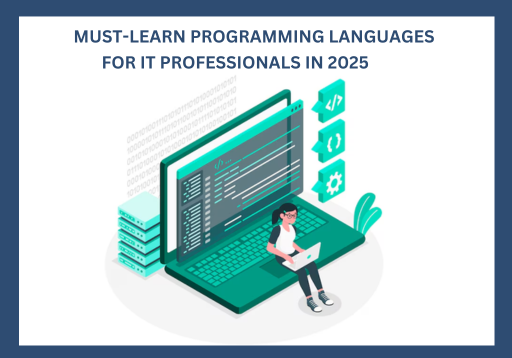
Programming Languages for IT Professionals in 2025

It seemed that the hour of technology was growing, and new tools, frameworks, and programming languages were being released for the functioning of the industry. As we approach 2025, IT professionals need to stay ahead of the curve by mastering key programming languages that will be instrumental in shaping the future of technology. Whether you are a coder, statistician, data scientist, or IT administrator, which languages to choose is crucial to your position. If you are planning to pursue a career in the IT industry in the year 2025 then here’s what programming languages you should know: Python Python programming language is still prevailing in the programming world and is expected to be one of the most demanded programming languages in 2025. This particular language is very simple and used almost in every field such as web development, data science, AI, ML, automation, etc. Why Learn Python? Extensive libraries and frameworks for AI and ML. Easy syntax, making it beginner-friendly and highly adaptable for seasoned professionals. Excellent support for automation, data manipulation, and big data applications. JavaScript Being one of the key fundamentals of web development JS is still a widely used programming language. With the introduction of scripts such as React, Angular, and Node. js, JavaScript plays a huge role in front-end development along with back-end development as well as the creation of full-stack applications. It is forecasted that in 2025 JavaScript will remain in the same status because more and more users require interactive and dynamic web applications. Why Learn JavaScript? Used for both front-end and back-end development. Extensive ecosystem with a vast number of libraries and tools. Plays a crucial role in mobile app development via frameworks like React Native. SQL Although not a standard programming language, SQL (Structured Query Language) is basic for managing and querying all databases. In the analytics era of 2025, Every IT professional who deals with Database, Big data, and Data Analytics must need SQL. Why Learn SQL? Essential for interacting with relational databases. Vital for data analytics, business intelligence, and big data applications. SQL knowledge is foundational for integrating back-end services with front-end applications. Rust Rust is gradually trending and is believed to be one of the prominent languages in the year 2025 because of the concentration on factors like Speed and Security. Famous for not having the problem of memory safety while not coming with garbage collection, Rust is slowly starting to take the throne as the language of system programming, embedded systems, and even applications that require high performance. Why Learn Rust? High performance and safety make it ideal for system programming. Increasing adoption in industries requiring low-level control and high-speed applications. Strong support for concurrency, making it efficient for modern multi-core processors. Go (Golang) Go, created by the Google company, has increased significantly after its release and IT experts believe that it will continue to dominate cloud computing and backend systems in 2025. It is an optimal solution for developing rapidly-scaled applications because it provides concurrent and simple ways of computation and is conducive to DevOps and microservices. Why Learn Go? Excellent for cloud computing and distributed systems. Simple and efficient syntax, making it easy to write and maintain. Superior performance in multi-threaded and concurrent environments. Kotlin Kotlin is already used as the primary language in developing Android applications and is increasingly being adopted more for other uses as well such as in server-side applications and web development. Thus, with increased mobile device usage, Kotlin’s demand will also rise, which is why developers aiming at mobile applications should consider mastering it. Why Learn Kotlin? Official language for Android app development. Fully interoperable with Java, making it versatile for various applications. Modern syntax and powerful features improve developer productivity. Swift Swift is the language of choice for iOS and macOS app development. With Apple’s ecosystem continuing to grow, Swift remains a critical language for developers targeting these platforms. Swift’s modern features and safety mechanisms ensure high-performance applications, making it a must-learn for 2025. Why Learn Swift? Official language for iOS app development, widely supported by Apple. Safe and fast, making it a go-to for high-performance applications. Growing demand for iOS and macOS applications in the mobile and wearable tech space. TypeScript TypeScript is JavaScript, but with the bonus of being a strongly typed language, and is quickly gaining popularity at the time of writing this article. It expands the JavaScript environment by adding static types to allow developers to have an easy time handling large complex applications. By the year 2025, TypeScript will be the language to be used by major web applications because of its tooling and support. Why Learn TypeScript? Builds on JavaScript with additional features, making it ideal for large-scale applications. Excellent tooling support for modern IDEs. Growing adoption in both web development and backend services. Conclusion Over the years technological advancement has increased the importance of proper utilization of the right programming languages to increase informativeness and competitiveness in the current market for IT specialists. Web and mobile applications, data science, cloud, and blockchain sectors will no longer be able to exist without such languages as Python, JavaScript, Rust, Go, Kotlin, and others in 2025. It’s thus important to select an appropriate language that will define one’s career and prospects. To get the best skills, Ethans Tech in Pune is the best place to be if one wants to gain these skills. Ethans’ trainers, choice of programs that align with the technological industry, and practical project experience guarantee you fit the technological world in 2025 and beyond.

Top 15 Technologies to Learn in 2024

Top 15 technologies 2024

In the fast-paced realm of technology, staying ahead of the curve is not just advantageous; it’s imperative for professionals seeking to thrive in today’s digital landscape. As we step into the year 2024, the tech horizon is ablaze with innovation, presenting a plethora of cutting-edge technologies poised to reshape industries, revolutionize workflows, and unlock new realms of possibility. Here, we delve into the top 15 technologies that are set to dominate the tech landscape in 2024, offering insights into their significance, applications, and potential impact on the future of work and society. 1. Artificial Intelligence (AI) and Machine Learning (ML) AI and ML continue to lead the charge as transformative technologies, powering advancements in automation, predictive analytics, natural language processing, and computer vision. From virtual assistants and recommendation systems to autonomous vehicles and predictive maintenance, AI and Machine learning are ubiquitous, driving innovation across industries. 2. Blockchain Technology Blockchain technology, renowned as the backbone of cryptocurrencies like Bitcoin and Ethereum, is poised to disrupt traditional industries by offering decentralized, immutable systems for secure data exchange, digital identity management, and transparent supply chain tracking. As organizations seek enhanced security and trust, proficiency in blockchain development and implementation is increasingly prized. 3. Internet of Things (IoT) The Internet of Things (IoT) ecosystem continues to expand, interconnecting an ever-expanding array of devices and sensors, enabling real-time data collection, analysis, and control. From smart homes and connected factories to precision agriculture and smart cities, IoT technologies are driving efficiencies and reshaping the way we interact with the world around us. 4. Cybersecurity In an era of escalating cyber threats and sophisticated attacks, cybersecurity remains paramount. Professionals adept in threat detection, incident response, encryption, and ethical hacking play a critical role in safeguarding digital assets, protecting sensitive data, and fortifying defenses against evolving threats. 5. Quantum Computing Quantum computing, with its potential to solve complex problems exponentially faster than classical computers, is on the brink of revolutionizing fields such as cryptography, optimization, drug discovery, and materials science. Despite being in its nascent stages, quantum computing holds immense promise for tackling some of humanity’s most pressing challenges. 6. Augmented Reality (AR) and Virtual Reality (VR) AR and VR technologies are blurring the boundaries between the physical and digital worlds, offering immersive experiences for gaming, entertainment, training, education, and remote collaboration. With applications ranging from virtual prototyping and architectural visualization to medical simulations and immersive storytelling, AR and VR are transforming industries and shaping new realities. 7. Edge Computing Edge computing brings computation and data storage closer to the data source, enabling real-time processing, low-latency communications, and bandwidth optimization for IoT devices and edge devices. By decentralizing data processing and analysis, edge computing enhances scalability, reliability, and responsiveness, making it indispensable for applications requiring rapid decision-making and localized intelligence. 8. 5G Technology The advent of 5G technology heralds a new era of connectivity, offering unprecedented speed, bandwidth, and low latency for mobile devices, IoT devices, and autonomous vehicles. With its transformative potential, 5G technology is set to fuel innovation across various sectors, from healthcare and manufacturing to entertainment and transportation. 9. Robotic Process Automation (RPA) RPA is revolutionizing business processes by automating repetitive tasks, data entry, and rule-based workflows through software robots or “bots.” With RPA, organizations can streamline operations, enhance efficiency, and reduce human error, freeing up employees to focus on higher-value tasks and strategic initiatives. 10. Renewable Energy Technologies Amid growing concerns about climate change and environmental sustainability, renewable energy technologies such as solar power, wind power, and battery storage are gaining momentum as viable alternatives to fossil fuels. As governments and businesses prioritize clean energy initiatives, professionals with expertise in renewable energy systems, energy storage solutions, and sustainable infrastructure are in high demand to drive the transition to a greener, more sustainable future. 11. Biotechnology and Bioinformatics Advancements in biotechnology and bioinformatics are revolutionizing healthcare, agriculture, and environmental conservation. From gene editing and personalized medicine to bioinformatics-driven drug discovery and precision agriculture, biotechnology is unlocking new frontiers in science and medicine, offering solutions to some of humanity’s most pressing challenges. 12. Extended Reality (XR) Extended Reality (XR), encompassing AR, VR, and mixed reality (MR), is reshaping the way we perceive and interact with digital content. With applications spanning entertainment, education, training, and healthcare, XR technologies are creating immersive experiences that blur the lines between the physical and digital realms, driving innovation and transforming user experiences. 13. Nanotechnology Nanotechnology, the manipulation of matter on an atomic and molecular scale, holds immense promise for revolutionizing materials science, electronics, medicine, and energy. With applications ranging from nanoelectronics and nanomedicine to nanomaterials and environmental remediation, nanotechnology is driving breakthroughs in diverse fields, offering unprecedented control over matter at the nanoscale. 14. Space Exploration Technologies The burgeoning space industry is experiencing a renaissance, driven by advancements in space exploration technologies, satellite technology, and commercial spaceflight. With renewed interest in lunar exploration, Mars colonization, and space tourism, the space sector offers exciting opportunities for innovation, entrepreneurship, and scientific discovery, pushing the boundaries of human exploration and knowledge. 15. Human-Machine Collaboration As automation and AI continue to reshape the workforce, the concept of human-machine collaboration is gaining prominence. Rather than replacing humans, emerging technologies are augmenting human capabilities, enabling synergistic collaboration between humans and machines in areas such as healthcare diagnostics, creative design, and decision-making, unlocking new levels of productivity and innovation. Conclusion In conclusion, mastering the top 15 technologies outlined above is essential for professionals looking to thrive in the tech-driven landscape of 2024 and beyond. By embracing a culture of lifelong learning, staying abreast of emerging trends, and honing relevant skills, individuals can position themselves at the forefront of innovation, driving positive change and shaping the future of work and society.

Understanding Front-End vs Back-End Development

Front-End vs Back-End

Introduction In today’s digital age, the role of a web developer is in high demand. However, it is important to note that web development is not a one-size-fits-all profession. There are two main types of web developers: front-end and back-end. In this article, we will explore the differences and similarities between front-end and back-end development and help you understand which path may be right for you. What is a Front-End Developer? A front-end developer, also known as a client-side developer, is responsible for the user interface (UI) and user experience (UX) of a website or web application. A front-end developer is responsible for creating the look, feel, and functionality of a website’s or application’s front end using technologies such as HTML, CSS, and JavaScript. Skills Required for Front-End Development Proficiency in HTML and CSS Knowledge of JavaScript and its libraries, such as jQuery Experience in UI and UX design Knowledge of responsive design Familiarity with cross-browser compatibility issues Experience with version control tools like Git What is a Back-End Developer? A back-end developer, also known as a server-side developer, is responsible for the server-side development of a website or web application. A back-end developer works behind the scenes, creating and maintaining the server side of a web application. This includes creating and managing databases, writing server-side scripts, and integrating with third-party services. Skills Required for Back-End Development Proficiency in server-side languages like PHP, Ruby, Python, or Java Knowledge of databases such as MySQL, MongoDB, or Oracle Understanding of web servers such as Apache or Nginx Experience with server-side frameworks like Node.js or Django Knowledge of API integration and development Familiarity with version control tools like Git Differences Between Front-End and Back-End Development The main difference between front-end and back-end development is the area of focus. While front-end developers focus on the user interface and user experience, back-end developers focus on the server side of a web application. Collaboration Front-end developers often work closely with UX designers to create a visually appealing and user-friendly interface. On the other hand, back-end developers often work closely with database administrators to ensure that the server side of the application is secure and scalable. Tools and Technologies Front-end developers use tools such as Adobe Photoshop, Sketch, and Figma to create mockups and designs. They also use technologies such as HTML, CSS, and JavaScript to create the front end of a website or web application. Back-end developers, on the other hand, use languages like PHP, Ruby, Python, or Java to write server-side scripts, manage databases, and integrate with third-party services. User Interaction Front-end developers focus on the user interface and user experience, making sure that the website or application is easy to navigate and visually appealing. Back-end developers focus on the server side of the application, making sure that the website or application is fast, secure, and scalable.  Final Thought While front-end and back-end development share some similarities, there are fundamental differences between the two. Front-end developers focus on the user interface and user experience, while back-end developers focus on the server side of a web application. To become a successful web developer, it’s important to understand the differences and similarities between front-end and back-end development and to choose the path that suits your interests and skill set. Whether you choose to specialize in front-end development, back-end development, or become a full-stack developer, there are ample opportunities in the growing field of web development. Remember, becoming a web developer requires continuous learning and updating of your skills as new technologies emerge. With dedication and hard work, anyone can become a skilled web developer and contribute to the ever-growing digital world.

Hashmap vs. Hash Table: Understanding the Differences

Differences Between HashMaps and Hash Tables

Introduction Hashing is a technique used in computer science to store and retrieve data in a fast and efficient manner. Hashing involves converting a key into an index in an array, where the data associated with that key can be stored. The two most commonly used hash-based data structures are hash table and hashmap. Both these data structures have their own unique set of features and trade-offs. What is a HashMap? A HashMap is a data structure that is used to store key-value pairs. It uses a hash function to compute an index into an array of buckets or slots, from which the desired value can be found. A HashMap is also known as a hash map, map, dictionary, or associative array. In a HashMap, keys are unique, but values can be duplicated. What is a Hash Table? A Hash Table is a data structure that uses a hash function to map keys to index values in an array. It stores key-value pairs in a bucket, where the index of the bucket is determined by the hash code of the key. Hash Tables are also known as hash maps, maps, dictionaries, or associative arrays. In a Hash Table, keys are unique, but values can be duplicated. Differences Between HashMaps and Hash Tables Data Structure The main difference between HashMaps and Hash Tables is their underlying data structure. HashMaps are implemented using an array of linked lists, where each element in the array is a linked list of key-value pairs. Hash Tables, on the other hand, use an array of buckets, where each bucket is a key-value pair. Performance When it comes to performance, both HashMaps and Hash Tables offer constant-time search, insertion, and deletion operations on average. However, the performance of both structures can degrade in the case of collisions. In HashMaps, collisions are handled by chaining, where multiple key-value pairs are stored in the same bucket using a linked list. In Hash Tables, collisions are handled by open addressing, where a different bucket is selected for the key-value pair using a secondary hash function. Collision Handling As mentioned earlier, both HashMaps and Hash Tables can suffer from collisions. The main difference in collision handling lies in the method used to resolve them. In HashMaps, collisions are resolved using chaining, where multiple key-value pairs are stored in the same bucket using a linked list.  In Hash Tables, collisions are resolved using open addressing, where a different bucket is selected for the key-value pair using a secondary hash function. Order of Keys  In a hash table, the keys are stored in sorted order, which means that iteration over the keys will always return them in the same order. In contrast, the keys in a hash map are not stored in any particular order. Memory Consumption Hash tables typically require more memory than hash maps, as each bucket needs to store both a key and a value. In contrast, hash maps only store the value in an array, which results in less memory consumption. Thread Safety Hash tables are typically thread-safe, which means that they can be accessed by multiple threads concurrently without causing data corruption. In contrast, hash maps are not inherently thread-safe, and additional synchronization is required to prevent data corruption. When to Use Hash Tables vs Hash Maps Use Hash Tables When: You need the keys to be stored in sorted order You need thread-safe access to the data structure Use Hash Maps When: You need faster performance You have memory constraints You don’t require the keys to be stored in sorted order Both hash tables and hash maps are valuable data structures that can be used to efficiently store and retrieve key-value pairs. While they have some similarities, they also have some key differences that set them apart. When deciding which to use, it is important to consider the specific requirements of your use case. Unlock the key differences between HashMap and HashTable in our in-depth guide! Whether you’re a seasoned developer or just beginning your data science journey, understanding these essential concepts is crucial for efficient data handling. Want to dive deeper into such technical topics and elevate your career? Join our Data Science Course in Pune and master the skills needed to excel in the world of data science. Enroll now at Ethans Tech to gain hands-on experience with real-world projects and industry-leading tools!

Key Difference Between High-Level And Low-Level Language

Key Difference Between High-Level And Low-Level Language

Introduction Programming languages are essential tools for developers to write software programs. These languages help developers communicate with computers and instruct them on what tasks to perform. However, not all programming languages are created equal. There are high-level and low-level programming languages, each with its own strengths and weaknesses.  Understanding the key differences between these two types of languages is crucial for developers, as it can significantly impact the efficiency and effectiveness of their programming projects In this article, we will delve into the key differences between high-level and low-level programming languages and discuss their respective pros and cons. What are Programming Languages? Programming languages are sets of rules, symbols, and instructions that enable humans to communicate with computers. They are designed to provide specific functionalities, and they vary in their levels of abstraction. Programming languages are classified into two main categories: high-level and low-level languages. What are High-Level and Low-Level Programming Languages? Before we delve into the differences between high-level and low-level programming languages, let’s first define what these two terms mean.  High-Level Programming Languages High-level programming languages are programming languages that are designed to be easy to use and understand for humans. These languages use natural language constructs to make it easier for developers to write and read code. High-level programming languages are also known as third-generation languages. Examples of High-Level Programming Languages  Examples of high-level programming languages include Python, Java, JavaScript, PHP, Ruby, and many others. These languages are usually platform-independent, meaning that they can run on multiple operating systems and hardware architectures without needing to be recompiled.  Low-Level Programming Languages Low-level programming languages, on the other hand, are designed to be used by computers. These languages are closer to machine code and provide developers with more control over the hardware. Low-level programming languages are also known as second-generation languages. Examples of Low-Level Programming Languages Examples of low-level programming languages include C, C++, Assembly, and others. These languages are usually platform-dependent, meaning that they need to be recompiled for different operating systems and hardware architectures. Differences Between High-Level and Low-Level Languages Now that we have a better understanding of what high-level and low-level programming languages are let’s delve into the key differences between these two types of languages. Abstraction One of the main differences between high-level and low-level programming languages is the level of abstraction they provide. High-level programming languages offer a higher level of abstraction, making it easier for developers to write code quickly and efficiently. In contrast, low-level programming languages offer a lower level of abstraction, which means that developers have to write more code to perform the same task. Readability Another significant difference between high-level and low-level programming languages is their readability. High-level programming languages are designed to be easy to read and understand, with natural language constructs that make the code more readable. In contrast, low-level programming languages can be difficult to read and understand, as they often use complex machine language constructs.  Portability High-level programming languages are generally more portable than low-level programming languages. This means that code written in a high-level programming language can run on different platforms and operating systems without the need for significant modifications. Low-level programming languages, on the other hand, are often hardware-specific and require significant modifications to run on different platforms. Speed Low-level programming languages are generally faster than high-level programming languages. This is because low-level languages provide developers with more control over the hardware, which means that they can optimize their code for maximum performance. In contrast, high-level programming languages offer less control over the hardware, which can lead to slower code execution. Development Time High-level programming languages can significantly reduce development time, as they offer a higher level of abstraction and are generally easier to read and understand. Low-level programming languages, on the other hand, require more code to perform the same task, which can increase development time. Explore the key differences between high-level and low-level languages in programming and discover their impact on data science projects. Learn how choosing the right language can optimize your data analysis and machine learning workflows. Time to Break High-level languages and low-level languages are two distinct programming languages that have unique features and benefits. High-level languages are easier to learn and use, more portable, and less prone to errors.  Low-level languages are faster and more efficient, offer greater control over the computer’s hardware, and are ideal for developing system software. Programmers should choose one over the other based on their specific needs and goals. Understanding the differences between high-level languages and low-level languages is essential for any aspiring programmer.

Why Python is Famous Among Freshers?

Why Python is famous among freshers?

In this dynamic world in which the whole thing adjustments at a speedy rate, the recognition of Python by no means appears to cease. Today, Python Certification is one of the maximum sought-after capabilities in the whole programming domain. Python has modified the IT sector with its ease-of-use and effective libraries, and its considerable packages and productivity. Python jobs pay nicely and developers are in demand. And due to the fact that Python is easy, many select to move for a moneymaking activity in Python. Python, as a programming language is simple and easy to learn. Python cuts improvement time in 1/2 of with its easy to study syntax and clean compilation feature. Also, it has masses of libraries that guide facts analysis, manipulation and visualization. Therefore, it has advanced because the maximum desired language and taken into consideration to be the “Next Big Thing” and a “Must” for Professionals. Today, we are able to talk diverse Python profession possibilities to be had for a Python programmer. Inclination toward being curious and hands-on is favored as Python needs that we get our hands grimy and prefer to mess around across the machine for mistakes and different issues. In this blog, we might be looking all such solutions to the questions concerning what is python all about, which are the industries considering python, Python Career Opportunities, scope of python and the boom it presents you. so, let’s get into it: What is PYTHON All About? Python is an interpreted, object-oriented, high-stage programming language with dynamic semantics. Its high-level constructed in data structures, blended with dynamic typing and dynamic binding, make it very appealing for Rapid Application Development, in addition to be used as a scripting or glue language to attach current additives together. Python is a general-motive coding language—this means that, not like HTML, CSS, and JavaScript, it is able to be used for different kinds of programming and software program improvement except web development Python may be used for matters like: Back end (or server-side) web and cellular app improvement Desktop app and software program development Processing big data and acting mathematical computations Writing system scripts (growing commands that inform a computer device to “do” something) Python is a growing star in the programming world for 2 foremost reasons: the large variety of responsibilities it may handle, blended with the reality that it’s virtually a completely beginner-friendly language. Python code syntax makes use of English keywords, and that makes it smooth for anybody to recognize and get began out with the language. Python’s syntax looks, it’s used for initiatives as complex sounding as artificial intelligence and machine learning. That approach Python is a extremely good healthy for a huge variety of users, including: Beginning coders Web and mobile app developers Software engineers Data Scientists AND anyone else working with or learning about computer programming Why are Freshers More Inclined Towards this Course? We have written plenty about how Python has a neat and clean syntax making it pretty likable amid the data science community. The constructs of this language make it simpler for a non-technical individual to seize it and is absolutely one of the simplest programming languages to learn. Even the newcomers from technical and non-technical backgrounds are taking a liking to the language. For instance, there are numerous MBAs and those from the e-commerce and finance background who latched onto Python to do BI and data analysis. There also are some who’ve taken as much as data science as a full-time activity constructing such things as fraud detection algorithms and different complex algorithms with Python. There are many that absorb to gaining knowledge of Python to enhance a hold close of data analysis or cope with different technical needs in their career. Python comes as a rescue for the ones who’ve continually cherished computer systems however gave up on the sector because of the complexity of different programming languages along with C++. Many of folks who gave up wondering that programming became too technical, are actually taking lower back to coding, way to Python. Today, with Python turning into the de facto industry preferred in financial analysis, e-commerce, retail biz, many determined the roles required it as a center competency and charted a learning route with YouTube videos and online courses. They ought to learn how to now no longer best code fluently however construct solutions locating them a area in analytics organizations as data analysts. Many have grew to become to be full-stack developers and business analysts as Python spoke to them evidently and efficiently. Python is a programming language that may be learned through – students, non-technical persons, working professionals, programmers, and entrepreneurs. As we’ve already acknowledged by now that Python is simple to comprehend – it’s miles excellent suitable to all. Python has a massive scope and it has end up a modern tool for survival in today’s world. If you understand Python then you’ll have the chance to work on your favorite organization because the excellent HRs and recruiters are continuously seeking out professionals who’re talented and prolific in Python. PYTHON Career Opportunities and Scope: In an independent 3rd party survey, it’s been observed that the Python programming language is presently the most famous language for Data Scientists worldwide. This declare is substantiated through IEEE, which tracks programming languages by popularity. According to them, Python tops the listing of the most popular programming languages. Python gives flexibility and simplicity for beginners like no different programming language. There are plenty of projects that may be constructed with Python and it suggests up everywhere even on embedded devices and on each server ever. Once learnt, Python permits possibilities in web development, data science, machine learning, game development, scientific and numeric computing and more. Python has witnessed large increase as one of the most famous languages amongst developers and organizations in India. Python has a prime position in the new-aspect technology of present day and upcoming instances like Machine Learning and Artificial Intelligence. It is probably … Read more

Top Technical Skills to get hired in 2023

Top-Technical-Skills-to-get-hired-in-2023

The technological industry is developing quickly. Technology abilities that were once thought to be evergreen are now out of date. Technology’s ongoing development is creating new job opportunities that are in high demand for people with technical expertise. The projections predict a 12% increase in IT employment by 2024, which means that IT experts will have access to an increasing number of jobs.  Even though there is a tonne of job openings and few qualified professionals, there is fierce competition for high-paying positions. To stand out and land high-paying tech jobs in 2023, one needs to have some of the most in-demand tech skills. After graduation, when you begin to map out your career alternatives — what industry you want to work in, what further certifications you’ll need for it, etc. — is one of the most important periods in one’s professional life. Nowadays, there are so many options available that it’s normal to feel confused about which course is best for you to take and will help you land one of the highest-paying professions available. Money, career advancement, and work security are the main factors influencing people’s career decisions. And if these are significant considerations for you as well, this essay will assist you in choosing your next course of action. Here is a selection of the best career-focused programmes you might want to look into! Let’s discuss the top qualifications needed to land the best jobs in India. Tech skills that are hot commodities among employees Programming The process of designing and creating a computer programme to carry out a given task is known as programming. Coding, commonly referred to as programming, has always been a crucial tech skill in the world of technology and can help you take advantage of a plethora of job prospects. JavaScript, Java, and Python are the three most popular coding languages on the market today.  Compared to C and C++, Python is a high-level language that is fairly simple to learn. Python’s user-friendly design has helped it become incredibly popular. It is perfect for both beginners and experienced. According to the TIOBE index, it was ranked third on the popularity chart. A Python specialist typically makes around 5 lakh rupees per year in compensation.  There are no prerequisites that must be met before beginning a Python course. It is regarded as being simpler than c and c++, making it a great option for beginners in both IT and non-IT sectors.  One of the top universities in Pune offering python courses is EthansTech. The course material is structured so that it begins with the fundamentals of Python programming and progresses to more complex ideas. Following the completion of the programme, Ethan’s also offers 100% placement support. Data Science Data science is the process of extracting information and practical insights from the mind-boggling amount of data that an organisation has access to, utilising a variety of tools and algorithms to enable data-driven decision-making. Businesses increasingly rely on data to guide their decision-making because they don’t want to fall behind. Nearly every industry, including banking, finance, and healthcare, needs data scientists. Data-driven talents are highly valued, which is why the demand for professions such as business analysts, database administrators, data analysts, and related positions is on the rise. According to LinkedIn, data science will have the fastest job growth in 2017. From 2022, data scientists and analysts will be in high demand, according to a forecast by Future of Jobs. Since the beginning of 2019, the demand for data scientists has increased by almost 40%. Data science occupations are here to stay and are one of the most in-demand IT skills, as seen by the enormous growth in data science jobs. One of the highest-paying professions in data science, and in India, data scientists make an average salary of 7,57,190 annually. Fundamentals of data analysis, data intuition, data storage, and data interpretation to other domains, such as finance, sales, and marketing, are essential for these positions to derive meaningful patterns and information for the firm. Data scientists with strong data visualisation abilities are in high demand.  To begin a career in data science, no coding knowledge is necessary. In Pune, some schools provide precisely crafted data science courses to enable students to pursue profitable careers in the field. Cloud Computing The transmission of computing services such as servers, storage, software, analytics, and intelligence on an as-needed basis over the Internet (the “cloud”) results in widespread accessibility, more inexpensive resources, and quicker operation. The number of businesses moving to the cloud has increased dramatically, demonstrating the enormous expansion in the potential for the cloud computing sector. In 2020, cloud computing will likely be one of the most lucrative IT industries. Engineers who can plan, create, manage, maintain, and support cloud computing will find employment prospects there. The firms provide lucrative packages to cloud computing professionals because they are in charge of managing crucial applications on the cloud platform. According to PayScale, the average annual compensation for a cloud computing engineer in India is about INR 1,830,766.  Google Cloud Platform (GCP), Microsoft Azure, Amazon Web Services (AWS), Java, and Kubernetes are the most in-demand cloud computing technologies. EthansTech provides all the prominent cloud computing courses in Pune. For more info, you can visit AWS course in pune- AWS Training in Pune | AWS Classes in Pune-Course by Experts (website.ethans.co.in/) Azure course in pune- Microsoft Azure Training in Pune | Best Azure classes in Pune by Ethans Tech GCP course in pune- Google Cloud Platform Training in Pune – Ethans Tech Kubernetes course in pune- Kubernetes Course | Training Certification in Pune – CKA|CKD (website.ethans.co.in/)   Internet of things The internet of things (IoT) is a concept that envisions everyday physical objects becoming connected to the internet and having the ability to recognise other devices as their own. IoT is a young area of technology that has the potential to generate a lot of jobs in the future.  Electrical and electronics students would be very helpful in … Read more