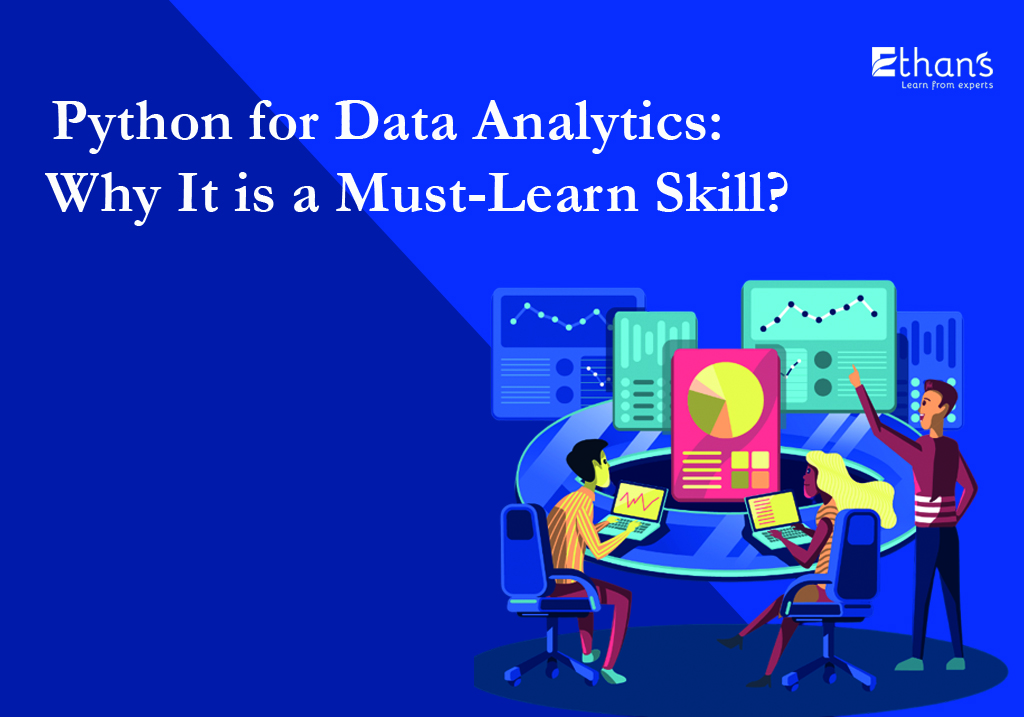
Python for Data Analytics: Why It is a Must-Learn Skill?
Python and its Role in Data Analytics

Dealing with a massive dataset or a crowded spreadsheet may often feel overwhelming. The numbers may seem meaningless and dancing as they don’t make any sense to you! Enter Python, the hero that does the heavy lifting when it comes to data analysis, helps make more sense, and derives actionable insights. So, learning Python is integral to the data analyst course in Pune. But is that the only reason? No. We must explore various aspects of Python and data analytics to establish its importance in the latter and why you must learn it. What is Python and its Role in Data Analytics? Python plays a multi-dimensional role in data analytics. Some include; Data Collection and Preprocessing: Python can help gather data from multiple sources like APIs, databases, etc. Further, libraries like Panda and NumPy help clean, manipulate, and preprocess data efficiently. Data Analysis and Exploration: Pandas provides structured data handling tools, performing operations like filtering, grouping and aggregations. NumPy supports numerical computing, expediting large dataset operations. Data Visualization: You can also create insightful visualizations with libraries, including Plotly, Seaborn, and Matplotlib. Handling Big Data: Python integrates with Apache Spark to process large datasets. It works with PostgreSQL, MySQL, and NoSQL for efficient data storage. Statistical Analysis: Statsmodels and SciPy help with statistical tests and modeling. The reasons Python is used in data analytics include its open-source nature, a rich ecosystem of libraries, seamless integration with other tools, and scalability. Why Acquire Python Skills During Your Data Analyst Course in Hyderabad? Python is an imperative skill to develop, particularly given the crucial role it plays across various processes involved in data analytics. Simplicity Python has a clean, easy-to-learn, and intuitive syntax. Other languages require complex lines of code. However, Python enables analysts to perform data manipulation effortlessly. Thus, even people without a conventional programming background like domain experts and business analysts can use Python. Must Watch – Master in Tableau Dashboards in 90 Minutes | Webinar Recording Rich Ecosystem of Libraries Python is known for its extensive range of libraries that help perform several tasks. Some robust ones include the following. Statsmodels: Statistical analysis NumPy: Numerical computing and working with massive datasets Scikit-learn: ML and predictive analytics Matplotlib and Seaborn: Data visualization and insights Pandas: Structured data handling and advanced manipulations Scalability Python can help you handle data projects of varying sizes efficiently. Thanks to its scalability! It allows you to integrate with databases, AI frameworks, and big data platforms, making it ideal for a broad range of analytical applications. Automation Manual data processing can take time. Let alone the errors involved in it. Python enables analysts to automate repetitive tasks like data cleaning, transformation, and reporting. While helping enhance efficiency, it also delivers consistent outcomes. Industry Demand Python helps data analysts handle various data analytical tasks easily. Thus, while hiring, companies look for analysts with working knowledge of Python. Pursuing separate Python classes in Pune or learning Python as part of your data analyst course in Pune can help unlock the doors of opportunities to various sectors like healthcare, fintech, IT, manufacturing, retail, and many others. Python: More than a Programming Language – Your Key to Success as a Data Analyst Of course, data analysis isn’t just Python. It is much more! However, Python plays an integral and significant role in the entire process. So, while choosing a data analyst course in Hyderabad, Pune, or anywhere else, you must ensure the course has learning Python and practical exposure to its applications as part of the syllabus. It can help you enhance your competence as a data analyst and qualify you for professional opportunities. Now, where to train yourself? The answer is Ethan’s Tech. We are a data analyst institute in Pune with a reputation for a comprehensive curriculum, abundant practical exposure, seasoned faculty members, top-tier learning infrastructure, and placement assistance. The thousands of students we’ve trained and placed to data speak for our credibility and capability to shape careers. So, do you want to be next and embark on the exciting journey of working as a data analyst? Then, call us at +91 85510 13133 and take the first step to becoming a qualified, competent, and prepared data analyst.

10 Must-Have Features to Look for in a Python Training Program

Look for in a Python Training Program

Do you aspire to become a Python professional and want the right Python course in Pune to kickstart your career? Your urge to choose the best is appreciable!  However, choosing what’s right for your career involves a considerable effort in evaluating different Python courses across various parameters. So, let’s get straight to the point and look at ten features you must look for in classroom or online Python training in Pune. 10 Factors to Consider While Choosing a Python Course in Pune Amidst Pune’s competitive environment, qualifications and the type of course you pursue matter! Python training isn’t an exception.  Thus, you must ensure you make the best possible choice that grooms you as a Python professional and unlocks career opportunities. Here are ten essential aspects to assess a Python course on. Course Content and Syllabus The course content should cover essential topics like the basic and advanced aspects of Python alongside other technologies like data science, automation, web development, etc. The curriculum should also focus on the practical application of each technology, enabling you to work in the industry more confidently. Library Exposure Library exposure refers to the numerous libraries Python offers. These include NumPy, Pandas, Django/Flask, Git, Jupyter Notebook, etc. Exposure to these libraries will help you use Python better and transform you into a more learned Python professional. Mode of Learning Although classroom courses have returned post-COVID, the course should also offer online learning to enable distant students or working professionals to learn conveniently. Some institutes also offer blended learning, allowing students to learn in both environments and interact with faculty members in person.  Faculty Expertise Faculty expertise and experience prove key while pursuing Python classes in Pune. Learning under seasoned specialists helps you learn from their experiences and enhance your value as a Python expert. Practical Experience The course must emphasize practical learning and provide abundant practical exposure to help you use Python technologies efficiently. The institute you choose should provide you the opportunity to work on tools and technologies to help you get first-hand experience of the industry. Value of Certification The Python course should be recognized in the industry and by its experts. Furthermore, the certification must have value from the viewpoint of employability. Batch Size Look for courses with a limited batch size. Trying to coop more and more students in a cluttered space affects the learning experience. In such situations, it becomes challenging for faculty members to pay individualized attention to every student. A limited batch size simplifies learning and focuses on every student.  Alumni Feedback Past-student feedback matters a lot. Hence, you must insist on reviewing it before you finalize your choice. It will help you learn how the course has helped its students and how they are faring in the market. Overall, it will help you make informed decisions.  Internship Opportunities Working as an intern helps you gain basic industry knowledge and experience. It prepares you for industry challenges and lets you step out as a more knowledgeable professional. Besides, in many cases, internships pave the way to employment.  So, if you perform well, you might as well have a job before you finish the course. Thus, a course with internship opportunities should be preferable. Placement Support Whether you pursue a Python course in Pune or any other, everything boils down to two things – the technical expertise you build and the course’s placement. Accordingly, you must choose a Python course with placement across various reputed organizations in different domains where Python is used. Such a course can provide a solid head start to your career! Embrace a Broader Python Career Spectrum with Ethan’s Python Classes in Pune Ethan’s Tech is your passport to a thriving career in Python. We provide Python courses that ensure comprehensive technical education, professional grooming, practical exposure, experienced faculty members, and yes, placements! So, if you are considering a career in Python, you need a course offered by an institute like Ethan’s Tech. Explore our Python course in Pune and call us at +91 95133 92223 to learn more about other details like Python course fees in Pune, batch timings, etc.

Why are Python Courses Essential for Your Career Growth in India?

Python developer salary in India

First released in 1991, Python has emerged as one of the most useful and popular programming languages worldwide. However, while being useful technically, Python holds significance from a career viewpoint as well. But what drives the importance of Python from the career perspective? Answering this will help you have a clear vision while pursuing Python classes in Pune and work your way in a better direction. 7 Reasons to Pursue a Python Course in Pune Here’s why taking Python classes in Pune is the right choice, helping you drive comprehensive and promising career growth.  Perpetual High Demand As stated earlier, Python is one of the most used programming languages. It is a versatile language that offers utility across various applications in AI, data analysis, and web development. The language powers applications across different domains, including healthcare, education, retail, finance, entertainment, etc., paving the way to exciting and remunerative career opportunities in various fields including these. Data Science and AI Applications As data science and AI continue to evolve and become more important, the demand for Python, as a skill, will grow in parallel. It is because Python is the preferred language for ML and data science applications. Libraries like NumPy, Pandas, TensorFlow, and Scikit-learn make it possible. Besides, businesses nowadays emphasize making data-driven decision-making. Thus, your Python skills, helping companies build efficient applications facilitating informed decision-making, will help you stand out. Automation and Scripting Automation accelerates work pace. One of the elements that works behind the scenes for it is Python. Every business uses it to some extent to expedite tasks and do more in less. For instance, marketing professionals use automation to automate email marketing campaigns. These applications that increase productivity and efficiency are built on Python. Additionally, Python’s has incredible scripting capabilities, helping you enhance your worth by offering capabilities that help your employer enhance their productivity and efficiency. Entrepreneurial Opportunities While employment is one aspect, entrepreneurship or freelancing are a couple of equally important ones. With Python skills, you can consider working as a freelancing Python expert or developer, capable of handling diverse projects. Once you amass enough experience and develop the entrepreneurial spark, you can enter application development helping companies build economical and quick prototypes or MVPs. Lucrative Salaries! Yes. We understand you must have been waiting for this to come. But here we are! Exciting remuneration is another reason that makes Python a fantastic choice for career growth. Python developers often command higher salaries than many other programming language professionals. Of course, Python’s abilities are a reason for it. However, the fact that you can drive development projects and deliver phenomenal value with Python, makes learning the language more enticing.  For information, the average annual Python developer salary in India ranges between Rs. 5-6 lakhs. Nevertheless, Python salary depends on various factors, including the employer’s paying capacity, your knowledge, experience, work location, and more. Extensive Community Support Python has been around for over three decades. As a result, Python developers enjoy extensive community support providing access to documentation, discussion forums, etc., simplifying and enhancing the use of Python. New developers can use insights from Python communities to improve their skills, find solutions to complex problems, and offer a higher value to their employers. Career Opportunities Python unlocks a range of career opportunities. With everything it offers, including its libraries, frameworks, scripting capabilities, etc., Python opens the doors to opportunities, including web development, ML engineering, software development, DevOps engineering, automation engineering, and more.  Of course, working for these domains also requires you to have the relevant skills. However, Python skills can complement the basic prerequisites helping you leverage these career opportunities. Final Words! Each skill you learn benefits you in some way with Python being no exception. Hence, acquiring Python skills through a Python course in Pune can broaden your skill base, widen your career horizon, and make you a more valuable candidate. However, from where do you give your career the head start it deserves?  The answer is Ethan’s Tech. We are one of the most reliable names for a Python course in Pune with placement. Our competent Python courses, end-to-end training, modern training methodology, and seasoned faculty members help you become a standout Python professional. Call us at +91 95133 92223 to learn more.

Python: The Key to High-Paying IT Jobs For the Next Decade.

The key to high-paying IT jobs

Introduction Python is a high-level programming language known for its simplicity, versatility, and readability. It is widely used across various industries and domains due to its rich ecosystem of libraries, ease of learning, and broad applicability. Let’s explore how Python’s qualities contribute to high-paying IT jobs opportunities and the types of roles you can land with Python skills. Python stands out as a versatile and robust programming language celebrated for its simplicity, clarity, and adaptability. Crafted by Guido van Rossum and unveiled in 1991, Python prioritizes readability, empowering developers to articulate concepts concisely compared to other coding languages. What sets Python apart is its ability to transcend boundaries. It serves as the backbone for an array of applications, spanning web development, data analytics, AI, machine learning, automation, and scientific computations. This vast applicability owes much to its expansive standard library and an extensive repository of third-party tools and frameworks. Python’s syntax is elegantly uncomplicated, akin to everyday language, fostering accessibility even for novices. Its user-friendly nature has fostered widespread adoption across industries and educational institutions alike. Moreover, Python’s dynamic typing and automatic memory management lend themselves to swift prototyping and iterative refinement. In recent times, Python has emerged as a frontrunner in data science and machine learning realms. This ascent is fueled by powerhouse libraries such as NumPy, Pandas, Matplotlib, and TensorFlow, empowering developers with formidable capabilities for data manipulation, exploration, and model creation. Why Python is Easy to Understand Python is renowned for its simplicity and readability, making it an ideal choice for beginners and experienced developers alike. Here are some reasons why Python is considered good and easy to understand: Simple Syntax Python’s syntax is straightforward and easy to understand, resembling pseudo-code more than other programming languages. This simplicity reduces the learning curve for new developers and makes the code easier to read and maintain. Readable Code Python emphasizes readability, with clean and concise code that is easy to follow. The language enforces indentation to denote code blocks, which enhances code clarity and structure. Rich Standard Library Python comes with a comprehensive standard library that provides a wide range of modules and functions for various tasks, from file I/O to networking to data manipulation. This extensive library reduces the need for external dependencies and simplifies development. Dynamic Typing Python is dynamically typed, meaning variable types are determined at runtime rather than explicitly declared. This flexibility allows developers to focus on solving problems rather than worrying about type declarations, making the code more expressive and concise. Interpreted Language Python is an interpreted language, which means code execution occurs line by line, allowing developers to quickly test and iterate on their code. This immediate feedback loop speeds up development and debugging processes. Community Support Python has a large and active community of developers who contribute to open-source projects, share knowledge, and provide support through forums, tutorials, and documentation. This vibrant community makes it easy for developers to find resources and solutions to common problems. Versatility Python is a versatile language that can be used for a wide range of applications, including web development, data analysis, machine learning, artificial intelligence, automation, and more. This versatility makes Python a valuable skill for developers across various industries. Structure of Python Overall, Python’s simplicity, readability, rich ecosystem, and community support make it an excellent choice for beginners and experienced developers alike, contributing to its popularity and widespread adoption in the software development industry. Here I am sharing structure of Python: 1. Simplicity and Readability Python’s syntax is designed to be intuitive and easy to understand, making it an ideal language for beginners and experienced developers alike. Its clean and concise code structure enhances readability, making it easier to maintain and debug codebases. This quality of Python attracts employers looking for developers who can write efficient and maintainable code. 2. Versatility and Broad Applicability Python’s versatility allows it to be used in various domains, including web development, data science, machine learning, artificial intelligence, automation, and more. Its extensive standard library and third-party packages provide solutions for a wide range of tasks, from building websites to analyzing large datasets. This broad applicability ensures that Python developers have a diverse range of job opportunities across industries. 3. Strong Community Support Python boasts a vibrant and active community of developers, contributors, and enthusiasts who collaborate on open-source projects, share knowledge, and provide support. The Python community contributes to the continuous improvement and evolution of the language, ensuring that it remains relevant and up-to-date with emerging trends and technologies. Access to community resources, forums, and online tutorials makes it easier for aspiring developers to learn Python and enhance their skills, thereby increasing their employability. 4. High Demand in the Job Market Python’s popularity has surged in recent years, leading to a high demand for Python developers across industries. Companies of all sizes, from startups to tech giants, rely on Python for developing software applications, conducting data analysis, implementing machine learning algorithms, and automating business processes. As a result, Python developers are highly sought after in the job market, with a wide range of job opportunities available in various roles and domains. High-Paying Jobs Available Through Python Skills In summary, Python’s qualities such as simplicity, versatility, community support, and high demand in the job market make it an excellent choice for aspiring developers looking to kickstart their careers or advance their existing skills. By mastering Python programming and exploring its diverse applications, individuals can unlock a wide range of job opportunities and pursue rewarding careers in the dynamic field of technology. Are you passionate about programming and looking to carve out a successful career in the tech industry? Python, one of the most versatile and widely-used programming languages, offers a plethora of exciting job opportunities across various domains. Whether you’re a seasoned developer or a fresh graduate, there’s a role in Python that could be the perfect fit for you. Let’s delve into some of the lucrative career paths available in the world of Python. Python Developer As a … Read more

How Much is the Python Course Fee in India?

Python Course Fee in India

While looking to become a Python developer, are you searching for a Python course and wondering how much is the Python course fee in India? Then, you’ve come to the right place! Ethans, one of the most trusted Python classes in Pune, overviews Python course fees and the various factors that drive them.  A Little About Python! Introduced in 1991, Python, one of the world’s first programming languages, has been around for years. It is an interpreted, high-level, object-oriented programming language with semantic dynamics. Also, Python is straightforward, integrates seamlessly with other languages, and is free and open-source. Unlike many technologies that disappeared in the ashes of history, Python continues to thrive, and its importance doesn’t seem to sway. Rather, its popularity has been growing ever since its launch. Today, Python’s developer base ranges between eight and nine million. On the other hand, global companies like IBM, Facebook, Spotify, JP Morgan, etc., trust Python. It may also interest you to learn that Python is AI’s preferred language! With that, Python has always been a popular choice amongst budding Python developers. However, what confronts most of them is the Python course fee in India. So, let’s talk about it while also looking at the different elements that contribute to the cost of Python courses.  Python Course Fee in India – Overview Python course fee in India ranges between Rs.10,000 and Rs. 15,000. The cost breakup includes the tuition fee, curriculum fee, and administrative expenses that the institute incurs while running the course. However, the Python course fee in India varies based on many factors. Let’s look at them for a better understanding.  Factors Influencing Python Course Fee in India Beginner Python courses in pune can differ depending on different factors that collectively contribute to the price difference. Here are a few decisive ones. Course Curriculum The foremost factor driving Python course fees in India is the course curriculum. A comprehensive and competent curriculum often comes at a premium. However, it adds value to your Python skills, enhances your understanding of various subject matters and competence, and benefits your career. Accordingly, look for a course with an updated and comprehensive Python syllabus and abundant practical exposure to platforms that the industry uses. It is worth paying a little more for something that adds value to your career in the long run. Institute’s Location The institute’s city and location matter. Institutes in metropolitans usually have higher Python course fees in India. Besides, Python classes in Pune situated in the prime areas of the city are more expensive. Why?  While a specific prime location gives you the commuting advantage, learning in bigger cities creates a career edge. As for the latter, learning in a metro city like Pune can qualify you for potentially better-paying opportunities in MNCs. This is because MNCs usually are familiar institutes that operate in metro cities. Faculty Members Another significant factor is the expertise and experience of faculty members. Learning under experienced faculty members, who’ve been Python developers in the past or practice it in the present comes at a cost. These trainers have an exclusive knack for Python training. By sharing their experiences and giving students a complete download of their knowledge, they shape careers. And if that’s the case, why not pay a little more?  Value Add-Ons Value add-ons matter as much as the course curriculum, although they aren’t necessarily part of the latter. Some vital add-ons include soft skill training, interview preparation, industry expert sessions, resume development, post-course career support, and more. All these aspects come at a price. However, given the different ways they benefit, you should stay mindful of them while choosing a Python course in India.  Learning Infrastructure Learning infrastructure plays a crucial role in shaping an aspirant’s Python career. After all, how relevant would it be to learn about outdated systems, obsolete software, and an incompetent environment? Since the learning setup matters, its competence contributes to the cost of a Python course. Placements Placements also make a significant difference in the fees of any Python course in India. Courses with premium placements and guaranteed placement assistance have higher fees than courses that don’t offer these advantages or assurances.  Prefer Quality Over Cost! Education is an investment and not an expense. The better your investment, the more attractive the returns! So, never insist on the cost of the Python course. Instead, focus on the value you will receive from the course, how well the Python course will prepare you for the big race, and what kind of career opportunities it will provide after certification.  Saving on the fees will prove a temporary relief. However, focusing on the value while stretching yourself a little on the fees part will prove advantageous in the long run. You will become a more competent and prepared Python developer capable of capitalizing on remunerative opportunities. We hope the above helps you get a fair understanding of Python course fees in India and the various elements that drive them. Call us at +91 95133 92223 to learn more about our Python courses, placements, and more.

Understanding of Eli5 Python: An Overview Guide

Understanding of Eli5 Python

ELI5 python is a Python library that simplifies the debugging and visualization of various Machine Learning models through a unified API. It offers built-in support for diverse Machine Learning frameworks and offers a standardized approach to interpret black-box models. ELI5 python provides a wide array of methods for interpreting various types of machine learning models, including linear models, tree-based models, and deep learning models. Moreover, ELI5 seamlessly integrates with multiple machine learning libraries such as scikit-learn, Keras, XGBoost, and LightGBM. Why is Eli5 Python Important? Simplifying Model Inspection and Debugging with ELI5 Python: For some classifiers, inspecting and debugging may be straightforward, but for others, it can be a daunting task. ELI5 (Explain Like I’m 5) steps in to bridge this gap, offering a unified API for seamless inspection and debugging across various machine learning frameworks. Here’s how ELI5 simplifies the process: Instant Results: ELI5 provides ready-made functions that yield neatly formatted results instantly. Whether it’s interpreting coefficients of a linear classifier or unraveling predictions of a complex ensemble model, ELI5’s unified API ensures quick insights. Reusable Formatting Code: With ELI5, formatting code can be reused across different machine learning frameworks. This promotes consistency in presentation and simplifies result interpretation across diverse models. Efficient ‘Drill Down’ Code: ELI5 includes ‘drill down’ code for tasks like feature filtering or text highlighting, which can be reused across multiple frameworks. This eliminates redundant coding efforts and enhances efficiency. Handling Gotchas and Differences: ELI5 tackles numerous gotchas and small differences encountered during model inspection. By addressing these nuances, ELI5 allows developers to focus on understanding the model’s behavior without getting bogged down by technicalities. Integration with LIME Algorithm: ELI5 python seamlessly integrates with algorithms like LIME, which aim to explain black-box classifiers through locally-fit simple, interpretable models. As ELI5 expands its support for additional simple classifier/regressor algorithms, options for explaining black-box models increase automatically. In essence, ELI5 python empowers developers and data scientists to gain insights into their machine learning models with ease and efficiency. By offering a unified approach to inspection and debugging, ELI5 enhances transparency and facilitates better understanding of model behavior across different frameworks. Features of ELI5 Python Understanding ELI5 python and its Versatility in Debugging and Interpreting Machine Learning Algorithms: ELI5 is a versatile Python package designed to aid in the debugging and explanation of machine learning classifiers, providing insights into their predictions. Let’s delve deeper into the capabilities of ELI5 and how it enhances the understanding of machine learning models across various frameworks and packages. Understanding ELI5’s Framework Support ELI5 offers extensive support for popular machine learning frameworks and packages, including: scikit-learn: ELI5 enables the explanation of weights and predictions of scikit-learn linear classifiers and regressors. It can also print decision trees as text or SVG, display feature importances, and explain predictions of decision trees and tree-based ensembles. Pipeline and FeatureUnion are supported, along with text processing utilities and debugging of pipelines containing HashingVectorizer. Keras: ELI5 allows the explanation of predictions from image classifiers via Grad-CAM visualizations. XGBoost: It showcases feature importances and explains predictions of XGBClassifier, XGBRegressor, and xgboost.Booster. LightGBM: ELI5 provides insights into feature importances and predictions of LGBMClassifier and LGBMRegressor. CatBoost: Feature importances of CatBoostClassifier and CatBoostRegressor can be shown. lightning: ELI5 offers explanations of weights and predictions of lightning classifiers and regressors. sklearn-crfsuite: ELI5 facilitates checking weights of sklearn_crfsuite.CRF models. Inspecting Black-Box Models with ELI5 In addition to its framework support, ELI5 implements several algorithms for inspecting black-box models: TextExplainer: This feature allows explaining predictions of any text classifier using the LIME algorithm. While primarily designed for text data, it also supports non-text data and arbitrary black-box classifiers. Permutation Importance ELI5’s Permutation Importance method computes feature importances for black-box estimators. Flexible Explanation and Formatting ELI5 separates explanation and formatting, offering flexibility in how results are presented. Users can choose from text-based explanations for console display, HTML versions for IPython notebooks or web dashboards, JSON versions for custom rendering, and even convert explanations to pandas DataFrame objects for further analysis. In summary, ELI5 is a powerful tool for developers and data scientists alike, offering a unified approach to debugging and interpreting machine learning models across various frameworks. Its extensive framework support, coupled with robust black-box model inspection algorithms, makes it an invaluable asset in the machine learning toolkit. Whether you’re debugging classifiers or seeking to understand complex predictions, ELI5 provides the transparency and insights needed to navigate the intricacies of machine learning algorithms. What are the applications of Eli5 Python? ELI5 is essential for mathematical applications demanding high computation speed. It serves a crucial role in scenarios with dependencies on other Python packages. ELI5 facilitates the integration of newer methodologies into legacy applications across diverse fields. Conclusion In conclusion, understanding Python doesn’t have to be daunting. With the right approach, anyone can grasp its fundamentals and harness its power. Ready to level up your Python skills? Explore Ethan’s Tech Python Training for expert-led courses tailored to accelerate your journey in programming. Unlock your potential today.

Top 10 Python Libraries Dominate In 2024

Top 10 Python Libraries

Python offers a vast array of libraries serving diverse purposes, and as a Python developer, it’s essential to be well-versed in the most valuable ones. It is equipped with powerful Python libraries for data science, empowering programmers daily in problem-solving. To aid you in this endeavor, Here’s an article highlighting the Top 10 Python Libraries: Eli5 Theano NuPIC PyBrain Bokeh Ramp NLTK TaiPy SciPy Statsmodel The inaugural library featured in our Top 10 Python libraries blog is: 1. Eli5 ELI5 is a Python library that simplifies the debugging and visualization of various Machine Learning models through a unified API. It offers built-in support for diverse Machine Learning frameworks and offers a standardized approach to interpret black-box models. The importance of ELI5 Simplifying Model Inspection and Debugging with ELI5: For some classifiers, inspecting and debugging may be straightforward, but for others, it can be a daunting task. ELI5 (Explain Like I’m 5) steps in to bridge this gap, offering a unified API for seamless inspection and debugging across various machine learning frameworks. Here’s how ELI5 simplifies the process: Instant Results: ELI5 provides ready-made functions that yield neatly formatted results instantly. Whether it’s interpreting coefficients of a linear classifier or unraveling predictions of a complex ensemble model, ELI5’s unified API ensures quick insights. Reusable Formatting Code: With ELI5, formatting code can be reused across different machine learning frameworks. This promotes consistency in presentation and simplifies result interpretation across diverse models. Efficient ‘Drill Down’ Code: ELI5 includes ‘drill down’ code for tasks like feature filtering or text highlighting, which can be reused across multiple frameworks. This eliminates redundant coding efforts and enhances efficiency. Handling Gotchas and Differences: ELI5 tackles numerous gotchas and small differences encountered during model inspection. By addressing these nuances, ELI5 allows developers to focus on understanding the model’s behavior without getting bogged down by technicalities. Integration with LIME Algorithm: ELI5 seamlessly integrates with algorithms like LIME, which aim to explain black-box classifiers through locally-fit simple, interpretable models. As ELI5 expands its support for additional simple classifier/regressor algorithms, options for explaining black-box models increase automatically.   In essence, ELI5 empowers developers and data scientists to gain insights into their machine learning models with ease and efficiency. By offering a unified approach to inspection and debugging, ELI5 enhances transparency and facilitates better understanding of model behavior across different frameworks. 2. Theano Theano is a versatile Python library designed for defining, optimizing, and evaluating mathematical expressions, particularly those involving multi-dimensional arrays (numpy.ndarray). Its capabilities extend to achieving performance levels comparable to hand-crafted C implementations, especially for tasks involving large datasets. Moreover, Theano excels on CPUs, outperforming C by significant margins, thanks to its utilization of modern GPUs. Combining elements of a computer algebra system (CAS) and an optimizing compiler, Theano offers a unique approach to mathematical computation. It generates customized C code for numerous mathematical operations, leveraging both CAS and optimizing compilation techniques. This hybrid approach proves invaluable for tasks requiring the repeated evaluation of complex mathematical expressions, where speed is paramount. In scenarios involving the evaluation of many different expressions, Theano minimizes compilation and analysis overhead while still providing symbolic features like automatic differentiation. This flexibility and efficiency make Theano an indispensable tool for a wide range of mathematical computations, particularly in fields where computational speed and accuracy are critical. 3. NuPIC: Numenta, an organization focused on studying the neocortex, has developed an open-source machine learning framework known as the “Numenta Platform for Intelligent Computing,” or “NuPIC.”  This framework enables the creation of intelligent applications capable of recognizing patterns over time and predicting future outcomes from real-time data. NuPIC specializes in time series data analysis, outlier detection, and prediction, leveraging the principles of Hierarchical Temporal Memory (HTM), a biologically-inspired theory of information processing. 4. PyBrain: A Python Library PyBrain, short for Python-Based Reinforcement Learning, Artificial Intelligence, and Neural Networks Library, is a modular machine learning library in Python. It provides a comprehensive set of powerful and user-friendly algorithms designed to assist with various machine learning tasks. 5. Bokeh: A Python Library Bokeh is a Python library designed for creating interactive visualizations in web browsers. With Bokeh, developers can generate visually captivating graphics and interactive plots without the need to write any JavaScript code. One of the key features of Bokeh is its high performance, allowing for the creation of complex and dynamic visualizations efficiently. Bokeh supports various output formats, including notebook, HTML, and server, making it versatile for different deployment scenarios. Additionally, Bokeh plots can be seamlessly integrated into Flask applications, enabling the creation of interactive web-based dashboards and data visualization tools. 6. Ramp: A Python Library The Python Ramp library is a comprehensive set of tools and utilities tailored to streamline the creation and deployment of machine learning models. Its components encompass: Model Trainer: This module accommodates various machine learning models, such as Support Vector Machines (SVMs), Random Forests (RFs), and Decision Trees (DTs). It facilitates the training of these models using diverse datasets. Performance Evaluation: The library offers methods for assessing the efficacy of trained models. Users can gauge the performance and accuracy of their models in executing specific tasks. Model Predictor: This functionality empowers users to deploy pre-trained models for making predictions. It allows the utilization of trained models to generate predictions on new or unseen data samples. 7. NLTK The Natural Language Toolkit (NLTK) is a Python programming environment designed for creating applications focused on statistical natural language processing (NLP). It offers a range of language processing libraries covering tokenization, parsing, classification, stemming, labeling, and semantic reasoning. Additionally, NLTK provides a curriculum and accompanying book detailing the various language processing tasks it supports, alongside visual demonstrations and access to experimental data repositories. The NLTK Library hosts a collection of libraries and applications dedicated to statistical language comprehension. Widely recognized as one of the most powerful NLP libraries available, NLTK provides tools enabling computers to understand natural language and generate appropriate responses. 8. TaiPy: A Python Library Taipy is a free-to-use Python library accessible to anyone with basic Python … Read more

Python Programming Scope in Future

Python programming

In the ever-evolving landscape of technology, certain skills stand out as indispensable assets for professionals seeking a successful career trajectory. Among these, Python programming shines as a beacon of opportunity, offering a multitude of advantages and a promising future. As we delve into the scope of Python programming in the years ahead, it becomes evident that its relevance and demand are only poised to grow. 1. Ubiquity Across Industries Python’s versatility and ease of use have led to its widespread adoption across diverse industries, including but not limited to software development, data science, artificial intelligence, web development, scientific computing, finance, cybersecurity, and education. Its extensive library ecosystem, encompassing frameworks such as Django, Flask, TensorFlow, Pandas, NumPy, and Scikit-learn, empowers developers and data scientists to tackle a wide array of challenges efficiently. 2. Dominance in Data Science and Machine Learning In the realm of data science and machine learning, Python has emerged as the de facto language of choice. Its intuitive syntax, coupled with powerful libraries like Pandas, NumPy, Matplotlib, and Scikit-learn, streamlines the process of data analysis, visualization, and model development. As organizations increasingly harness the power of data-driven insights, the demand for Python-proficient professionals in data science and machine learning roles continues to soar. 3. Growth in Web Development Python’s web development frameworks, such as Django and Flask, facilitate the rapid creation of robust and scalable web applications. With Django’s emphasis on simplicity and flexibility, coupled with Flask’s minimalist approach, Python empowers developers to build dynamic web solutions with ease. As the demand for web applications surges in tandem with the digital transformation of businesses, Python’s role in web development is poised to expand further. 4. Expansion in Artificial Intelligence and Automation Python’s role in artificial intelligence (AI) and automation is burgeoning, driven by its extensive support for AI libraries and frameworks. From natural language processing (NLP) with NLTK and spaCy to deep learning with TensorFlow and PyTorch, Python provides the building blocks for developing sophisticated AI solutions. As industries increasingly embrace automation to enhance efficiency and innovation, Python’s prominence in AI and automation is set to grow exponentially. 5. Accessibility and Community Support One of Python’s greatest strengths lies in its accessibility to beginners and seasoned professionals alike. Its clear and concise syntax, coupled with comprehensive documentation and a vibrant online community, lowers the barriers to entry for aspiring programmers. The wealth of tutorials, forums, and open-source contributions fosters a collaborative environment where knowledge sharing thrives, further cementing Python’s position as a go-to language for developers worldwide. 6. Integration in Education and Research Python’s simplicity and readability make it an ideal choice for educational institutions and research organizations seeking to introduce programming concepts and conduct experiments. Its versatility extends to fields such as computational biology, astronomy, physics, and social sciences, where Python serves as a bridge between domain expertise and computational analysis. As academia continues to embrace Python as a tool for innovation and discovery, its role in education and research will only strengthen. 7. Adaptability to Emerging Technologies As emerging technologies such as blockchain, quantum computing, and the Internet of Things (IoT) gain traction, Python’s adaptability ensures its relevance across a spectrum of cutting-edge domains. Whether it’s developing smart contracts on blockchain platforms, orchestrating IoT devices with Micro Python, or exploring quantum algorithms with Qiskit, Python empowers developers to explore the frontiers of technology and drive innovation forward. Final Thought In conclusion, the scope of Python programming in the future is exceptionally bright, driven by its versatility, simplicity, and robust ecosystem. As industries continue to embrace digital transformation and innovation, Python’s role as a foundational technology will only strengthen, opening doors to diverse career opportunities and exciting possibilities in the years to come. For aspiring professionals and seasoned veterans alike, mastering Python programming is not just a choice—it’s a strategic investment in a future-proof skill set poised for enduring relevance and success.

10+ Interesting Python Project Ideas For Beginners [2024]

python course in pune

Introduction Welcome to website.ethans.co.in/, your premier destination for IT training courses designed for students and professionals alike. As a leading institute offering courses in data analytics, machine learning, data science, and Python programming, we're committed to empowering individuals with the skills needed to excel in today's tech landscape. In this blog post, we'll explore 10+ straightforward Python project ideas perfect for beginners to jumpstart their programming journey. Python Course in Pune: Unlock Your Potential with Ethans Are you eager to dive into the world of Python programming? At Ethan’s Tech, our Python course in Pune is crafted to equip you with the essential knowledge and hands-on experience required to thrive in the dynamic field of software development, data analysis, and more. With expert instructors and a comprehensive curriculum, you’ll build a solid foundation in Python programming while honing your skills through practical projects. Let’s explore some simple yet engaging Python project ideas suitable for beginners: 1. To-Do List Application: Develop a basic to-do list application that allows users to add tasks, mark them as complete, and delete them. This project focuses on fundamental concepts like data management and user input handling. 2. Weather App: Create a simple weather application that fetches weather data based on the user’s location using a third-party API. Users can input their city name and receive current weather conditions, such as temperature and weather description. 3. Calculator: Build a straightforward calculator application capable of performing basic arithmetic operations like addition, subtraction, multiplication, and division. This project emphasizes user interaction and mathematical operations. 4. Password Generator: Develop a password generator tool that generates random and secure passwords based on user-defined criteria such as length and character types (e.g., uppercase letters, digits, symbols). This project introduces randomization and string manipulation concepts. 5. Simple Chatbot: Design a minimalistic chatbot using Python’s built-in functionalities to engage in basic conversations and provide predefined responses to user queries. This project introduces the concept of conditional statements and string manipulation. Our readers also read – Top 2 Data Analytics Project Ideas for Freshers 6. Expense Tracker: Create a basic expense tracker application that allows users to input their expenses, categorize them, and view a summary of their spending. This project focuses on data management and basic file handling. 7. Web Scraper: Develop a simple web scraper using libraries like BeautifulSoup to extract information from a website and display it in a structured format. This project introduces web scraping techniques and data extraction. 8. Recipe Finder: Build a program that suggests recipes based on ingredients entered by the user, utilizing a predefined recipe database or API. Users can input ingredients they have, and the program will return relevant recipes. This project introduces API integration and data filtering. 9. BMI Calculator: Develop a straightforward body mass index (BMI) calculator that takes user inputs such as height and weight and calculates the BMI value. This project focuses on mathematical calculations and user input handling. 10. Text-based Adventure Game: Create a basic text-based adventure game where users navigate through a story by making choices presented to them. The outcome of the game changes based on the user’s decisions. This project introduces basic game mechanics and decision-making. Conclusion Embarking on a Python programming journey is an exciting endeavor, and these simple project ideas serve as a perfect starting point for beginners. Whether you’re aiming to become a software developer, data analyst, or machine learning engineer, mastering Python is a valuable asset in today’s tech-driven world. At Ethans, our Python course in Pune provides an excellent platform to sharpen your skills, build exciting projects, and unlock your full potential. Join us today and take the first step towards a rewarding career in technology! Don’t hesitate to contact us to learn more about our Python course in Pune and start your journey towards becoming a proficient Python programmer with Ethans.

Top 12 Fascinating Python Applications in Real-World [2024]

Python Applications in Real World

Python is a language that needs no introduction! It has been around for decades and become an integral part of the application development realm. However, for those new to Python and looking to pursue online Python training in Pune, Python is a popular, interpreted, object-oriented, high-level programming language with dynamic semantics. The language’s numerous features (that also work as its benefits) make it part of various types of applications everyone uses in the real world. So, while overviewing a few benefits of Python that constitute its popularity, let’s also look at the 12 types of routine business and domestic applications that run on Python. Benefits of Using Python for Application Development Python proves advantageous in various ways. One should attribute its popularity to its features that make it intuitive to use and effective. High-Level Language: Python’s high-level nature eliminates the need to remember its system architecture or perform memory management. Simplicity: Python has a softer learning curve. Also, it is easy to use and implement across any of the applications it runs. Besides, Python has a syntax similar to English. Hence, aspiring developers pursuing a Python course in Pune can quickly master it. Open Source: It is an open-source language freely available to the public. Besides, as Python supports the FLOSS (Free/Libre and Open Source Software) model, the Python community can tweak it and upgrade its features. Object-Oriented: Python is an object-oriented language (it can model real-world data) and also functional (having a code one can reuse). Extensivity and Embeddability: Python allows you to write certain parts of your Python code in other programming languages like C++. You can also embed your Python code in the source code of other languages. Portability: Python is a portable and flexible programming language. Thus, a Python code written for Windows or Linux can run on iOS. Interpreted Language: Unlike Java and C++, Python executes every source code line by line. Hence, one can debug a Python code while writing it. Pursing Python Course in Pune – 12 Applications You Can Build on Python Now that we’ve run through some benefits of Python, let’s look at 12 different types of applications built on Python. Business Applications Enterprise-level applications or software have more unique requirements than others. They require features like extensibility, readability, and scalability. Additionally, companies using these applications should also be able to integrate them with legacy systems for seamless and uninterrupted operations. Python serves all these needs with its features that we’ve already discussed above. Additionally, it has other tools for business application development, including Odoo (a comprehensive suite of enterprise management applications) and Tryton (a high-level, general-purpose, and three-tier application platform for building business applications). Web Development Another significant use of Python for everyone looking to take up Python classes in Pune is web development. Python offers many options for web development. It has Pyramid, Django, Bottle, and Flask to develop web frameworks and advanced content management systems like Django CMS and Plone. These frameworks have standard libraries and modules that simplify tasks like database interaction, content management, and interfacing with internet protocols like POP, JSON, XML, HTTP, and others. Desktop GUI Applications Python has a modular architecture and can work on numerous operating systems. Additionally, with efficient text processing tools, Python forms a remarkable choice for developing desktop-based GUI applications. Furthermore, the programming language offers various frameworks like WxPython, Kivy, Tkinter, PyGtk, PySide PyGUI, and PyQt that enable developers to develop functional Graphical User Interfaces (GUI). AI and ML Applications Python is the default language for AI and ML development. Thanks to its secure, flexible, and scalable nature and libraries like Keras, PyTorch, and TensorFlow with tools that help build empowering AI and ML applications. A few of the best Python packages for AI and ML include Seaborn for data visualization, SciPy for advanced computing, and Pandas for general-purpose data analysis Game Development Python also is used extensively for game development. It has various useful extensions that help develop interactive games. The two Python-based libraries used for game development include PySoy (a 3D game engine that supports Python 3) and PyGame. Some popular games built on Python include Vega Strike, World of Tanks, Frets on Fire, Freedom Force, Arcade Car Racing, and Civilization IV. Web Scraping Applications Web scraping is an automated process that helps quickly and easily extract information from websites. Python proves helpful in the process as it has a concise syntax improving readability, and also the language is easy to understand. Python simplifies the web scraping process with various tools and libraries like Pandas, Selenium, and Matplotlib. Some popular web Python-based web scraping tools like MechanicalSoup, BeautifulSoup, Scrapy, and Urliib. Mobile Application Development Having a mobile application isn’t an option anymore. It is a must for every business. People pursuing classroom or online Python training in Pune and looking to build a career in mobile app development should know why Python is popular for it. Python benefits mobile app development in various ways. For example, it has frameworks like BeeWare and Kivy that allow developers to write code once and deploy it on multiple platforms like Android and iOS. Additionally, Python enables rapid prototyping, provides access to native APIs, and has extensive community support. Operating Systems This is another significant use of Python every developer pursuing a Python course in Pune should know. Python runs behind the scenes of various operating systems, primarily those of Linux distributors. For example, Linux-based Ubuntu’s Ubiquity Installer, Fedora, Red Hat Enterprise’s Anaconda Installer, and Gentoo Linux leverage Python. Usually, developers combine Python with C to design and develop OSs. Scientific and Numeric Applications Python provides the skeleton for computing and scientific data processing applications. For example, applications like Abaqus and FreeCAD are coded in Python. A few useful Python packages for scientific and numeric computation include Pandas (data analytics library), SciPy (scientific numeric library), Natural Language Toolkit, and IPython. Academic Software and Applications Python is a straightforward language. That’s why it is the go-to choice of many pursuing a Python … Read more