Certified Data Analyst Course in Pune: Your Path to a 6-Figure Salary
Certified Data Analyst Course in Pune

Are you a technology-working professional stuck in a skillset where your salary has hit a plateau and you are feeling stagnated? Do you look at the exponentially growing digital economy and wonder how you can grab a slice of that lucrative pie?  Then, you aren’t alone!  The above is the situation of millions worldwide.  But you can do something about it. And by that something, we mean upskilling yourself with data analyst training in Pune and becoming a certified data analyst.  So, let’s see how this can be your ticket to that fat 6-figure paycheck. Why Pursue Data Analysis Courses in Pune Now? Data is an integral aspect of modern business operations. From routine functioning to strategy and high-level decision-making, everything relies on data. However, raw data doesn’t have any value, unless you make sense from it. This is where the role of data analyst comes into play.  Data analysts gather, process, and interpret data to help companies make more informed and better decisions. They identify patterns, relationships, and trends within data with statistical methods and visualization tools to present and communicate their discoveries. Thus, companies look up to data analysts as growth catalysts!  No wonder companies pay them handsomely and the demand for data analysts and scientists is at an all-time high. Ready to Become a Pro Analyst? Start Learning the 6 Phases! Data analyst’s average salary in Pune, particularly for experienced professionals, begins from Rs. 6-7 lakhs. Yes. That’s still a 5-figure monthly salary. However, with experience, it can easily increase Rs. 10-11 lakhs annually. Further, as you gain seniority, you can even command Rs. 15-20 lakhs per annum or even more based on how rich your portfolio and overall industry track record are. So, what you learn and the experience you gain matter can eventually translate into what you initially desired – a 6-figure salary! Who Can Benefit from the Certified Data Analyst Salary Bump? Wondering if the above salary hike is for you? Data analysis courses in Pune that lead you to become a certified data analyst can benefit individuals who are, Working but feel underpaid, particularly given their potential In finance, operations, marketing, sales, HR, etc. Looking to pivot to a more in-demand role without becoming a coder Professionals who want to diversify and enter more crucial roles to earn more Sounds great, right? However, what does a certified data analyst course in Pune cover? In other words, what is it that the course teaches you to become capable of a 6-figure salary? Let’s explore more about it. 5 Reasons Data Analyst Training in Pune is Worthwhile! So, let’s understand the secret sauce to the sumptuous recipe called the 6-figure salary. Course Curriculum Data analytics is a challenging domain. Hence, it requires extensive training and an in-depth understanding of various topics that you will use practically as a data analyst.  Generally speaking, a comprehensive data analyst course in the course includes; Introduction to SQL Microsoft Excel Microsoft Power BI AI Analytics Platform – Alteryx The above topics cover the various aspects of data analytics and the tools that help analysts provide and present insights useful for businesses in informed decision-making. Practical Experience While conceptual understanding matters, strengthening it and applying concepts in the real world is possible only with practical exposure. It is because companies these days are more interested in determining how well and usefully you apply your skills. Accordingly, the course provides abundant practical exposure to the latest tools and technologies. Real World Projects The course also involves working on real-world problems and challenges through projects that put your knowledge, learning, and skills to the test. Working on these projects helps you build the confidence and conviction it takes to crack interviews and work as a results-oriented data analyst – something companies want and appreciate. Seasoned Instructors The best data analytics classes in Pune nurture experienced trainers who don’t just focus on developing technical skills but strengthening the basics and preparing for challenges. They do so through their technical expertise and sharing their experiences that develop maturity and a sense of professional understanding that employers applaud. Soft Skills Development Hard skills are integral to every course. However, organizations these days don’t just look for workers but leaders who can take charge and shoulder responsibilities. Thus, comprehensive data analyst training in Pune also covers developing soft skills like leadership, team playing abilities, communication, presentation, time management, problem-solving, and more. They transform you into a professional prepared to take up challenges as a game-changer. Final Words! Remember, your journey towards a 6-figure salary with data analysis courses in Pune isn’t a get-rich quick scheme but a visionary strategy. Ethan’s Tech offers data analytics classes in Pune that help you embark on this journey with a 360-degree training approach and skill development. Call us at +91 95133 92223 to explore more about our courses.

How Data Analytics is Revolutionizing Various Industries?

Data analytics Course indutries

While some call it the new oil, some consider it a crucial asset for every business. Call it anything, the bottom line is that data has become more vital than ever! However, merely having data doesn’t help!  Think of it as wooden furniture. A log of wood doesn’t have any utility value until you shape it into a chair or table, which then becomes your asset.  Similarly, raw data is nothing but a digital burden. You must analyze it to know what it means and derive value through informed decisions. That’s precisely where data analytics comes into play. It is driving a generational shift across the business world, enabling companies to be more successful. If you’ve been looking to become a data analyst and pursuing a data analyst course in Pune, you’ve come to the right place! But before embarking on an exciting journey to becoming a data analyst, learning how it is revolutionizing industries can help you discover its power and understand the kind of career opportunities you would have as a qualified data analyst. Healthcare Data analytics plays a vital role in healthcare, helping doctors diagnose patients better, and deliver better outcomes. Thanks to data analytics, doctors can now predict diseases before the patient shows symptoms. Accordingly, hospitals, research organizations, and other healthcare players use data analytics to analyze massive patient data sets to forecast illnesses and provide more tailored treatments. AI-driven analytics also helps enhance drug development and reduce trial times. Summary – Data analytics is making healthcare more personalized and effective! Finance While technology continues to revolutionize BFSI, the sector grapples with numerous challenges, including fraudulent transactions. Data analytics help banks and financial institutions detect fraudulent transactions in real time. ML models help them analyze spending patterns and flag unusual activities instantly. Additionally, investment firms use predictive analytics to make data-driven informed decisions, reducing risks and optimizing returns.  Retail and eCommerce While visiting eCommerce websites, have you ever wondered how your favorite online store offers the right product suggestions?  The hero behind the scenes is data analytics!  Data analysts help retail stores analyze customer behavior to provide accurate product recommendations, optimize pricing strategies, maintain the right inventory levels, and amplify the marketing impact by personalizing campaigns. So yes, taking up data analytics classes near Pune or a data analyst course in Hyderabad can also help you enter the exciting and ever-growing retail sector. Manufacturing At some point, every manufacturer struggles with equipment failures, supply chain disruptions, quality control, etc. These challenges can lead to unimaginable repercussions. For instance, even a few seconds of critical equipment failure can lead to commercial losses worth millions. Let alone the loss of reputation.  Data analytics proves a game-changer amidst these challenges. Analyzing data helps manufacturers predict equipment failures, streamline supply chains, and enhance quality control. IoT sensors gather real-time data from various machines, preventing costly downtime and enabling seamless operations. Marketing Creativity drives engagement. But marketing is also about insights and numbers. Data analytics helps marketers enhance their marketing approach by tracking customer journeys, refining their strategies, and measuring campaign success. These efforts translate into smarter and more effective marketing strategies that drive tangible value. Where Do You Fit as a Data Analyst? Honestly, you can leverage opportunities as a data analyst in every industry that uses it. Pursuing a data analyst course in Pune or Hyderabad helps you understand the science of data analytics, develop analytical skills with various tools and technologies, and deliver insights that build value for the company.  Apart from the above, you can explore opportunities across sectors like real estate, logistics, media, energy, telecommunication, education and more. How Can Ethan’s Tech Help? As trusted technology training partners, we shape careers with our data analytics classes near Pune, comprehensive courses, practical training, and experienced faculty members who train you on every essential aspect of data analytics. Besides, we’ve partnered with E&ICT Academy, IIT Guwahati to enhance the value of your data analytics knowledge, skills, and certification. Thus, the association strengthens your significance as a data analytics aspirant. So, you step out as a qualified data analyst prepared to begin your journey in their exciting domain or upgrade your career by broadening the scope of opportunities. Want to discover more about our data analyst course in Hyderabad or Pune? Call us at +91 95133 92223. Our experts will help you navigate the course details, career opportunities, and how our course can help you land a job with top employers.

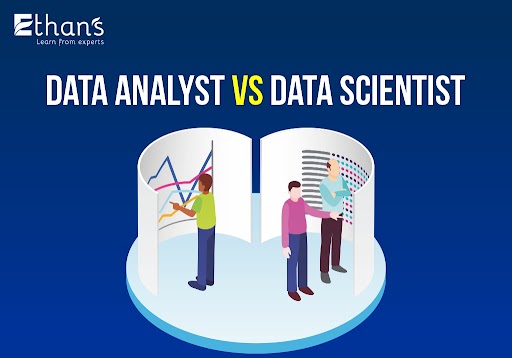
Data Analyst vs Data Scientist

Data Analyst vs Data Scientist Course

Often used interchangeably, data analyst and data scientist are two different terms and career streams with unique importance. Of course, both deal with data – a priceless asset for every business in the modern context. However, they contribute in different ways to help businesses harness the power of data and drive meaningful and actionable insights from it.  As a fresh technology graduate or an experienced professional looking for a data analyst course in Pune or data science classes in Pune, this blog is for you. It highlights some differences between data analysts and data scientists to strengthen the basic concepts and make an informed career choice. Who is a Data Analyst? A data analyst gathers, processes, and interprets data to help companies make informed decisions. Their role usually involves, Gathering data from different sources like databases, spreadsheets, etc. Cleaning the data to ensure accuracy and removing errors or inconsistencies. Analyzing data with Python, R, Excel, SQL, or other specialized software. Presenting findings through graphs, charts, and dashboards through Power BI, Tableau, etc., to make it clear, straightforward, and understandable. Preparing reports and presentations summarizing the insights and actionable recommendations based on the analysis. Data analysts closely work with other teams and departments, including marketing, finance, HR, operations, etc., as each generates data and requires accurate analysis. Example: Retail is a highly data-driven sector that evolves continuously and adapts to changing consumer needs and demands. Data analysts help retailers analyze data concerning sales, customer behavior, preferences, inventory statistics, market trends, etc. Their role extends to analyzing data to track sales performance, make revenue forecasts, segment customers, create personalized marketing strategies, provide data to optimize inventory levels, perform competitive pricing analysis, etc.  Who is a Data Scientist? A data scientist uses various scientific methods, algorithms, processes, and systems to extract insights from structured and unstructured data. Their expertise includes programming, mathematics, statistics, and domain knowledge to analyze massive datasets, identify patterns, and develop complex problem-solving models. Data analysts handle various responsibilities while performing their core jobs. These include, Gathering relevant data from multiple and diverse sources. Preparing the data by cleaning, organizing, and formatting it for analysis. Analyzing the data initially to understand its structure and explore hidden trends and patterns. Using statistical techniques and ML algorithms to build predictive models or data-driven insights for the business. Evaluating the model’s accuracy and performance and refining them. Creating visual representations of the data through graphs and dashboards Assisting companies in making informed decisions concerning product launches, strategies, marketing, etc., based on data-driven insights. Example: In the healthcare sector, data scientists leverage data to enhance patient outcomes, streamline operations, and improve the decision-making process. Their role covers various critical responsibilities like integrating, cleaning, and structuring datasets, ensuring safe data handling, building models to predict disease progression, predicting patient inflows, and much more. Data Analyst vs Data Scientist – Key Differences While you now have a basic understanding of what data analysts and data scientists do, let’s look at some key factors distinguishing them. Aspect Data Analyst Data Scientist Primary Responsibility Analyze data and provide insights to enable informed decision-making Solve complex problems with various advanced statistical and computational methods Routine Tasks Cleaning and organizing data, creating various reports, building dashboards and doing descriptive analytics  Developing algorithms, creating predictive models, performing A/B testing and conducting exploratory data analysis Tools Used Excel, Power BI, Google Analytics and SQL Hadoop, Python, R, Spark, SQL, Google Cloud Platform, Amazon Web Services and TensorFlow Programming Skills Needed Limited coding proficiency Extensive coding expertise with proficiency in R, Scala and Python Educational Background Bachelor’s degree in business, statistics, or a related stream Data analytics courses in Pune or other places Master’s or Ph.D. in data science, computer science, or other similar streams Should have attended data science classes in Pune or anywhere else Skills Required – Data Cleaning and Preparation – Data Visualization – Statistical Analysis – Solid Analytical Capabilities – SQL – Excel – Domain Knowledge – Problem-Solving – Communication – Attention to Detail – Continuous Learning – Machine Learning – Data Visualization – Data Cleaning and Preprocessing – Deep Learning – Experiment Designing – A/B Testing – Time Series Analysis – Communication – Presentation – Natural Language Processing (NLP) With data, the importance of data scientists and analysts will also increase. Speaking of the growth of data analytics, for example, it will surpass the 100-billion-dollar mark in the next 3-4 years. Even when it comes to data science, its platform market size fared between USD 95 billion – USD 98 billion last year. The growth prospects are as promising as they can be! Besides, since every sector generates data and wants to drive optimal value from it, data analysts and data scientists can seek employment in almost any sector. Of course, domain knowledge and understanding will play a crucial part while looking for opportunities. So now the question is from where will you learn the skills you need to become a data analyst or data scientist. The answer is Ethan’s Tech. We are one of Pune’s leading technology training institutes with a flair for and purpose of empowering the industry with comprehensively trained talent. Explore our course curriculum and learning methodologies if you’ve been looking for the terms data analytics or data science course near me. We will be happy to shape your career.

Data Analyst Career Scope in Pune

Data Analyst Career Scope in Pune

Home to a thriving business sector, Pune hosts thousands of startups, SMEs, and global enterprises across different industries. These organizations demand a constant talent supply to tap into diverse business opportunities and resolve challenges.  The talent needs vary with the industry. However, almost every company, particularly those that understand the significance of data, needs data analysts. As a novice or an existing professional looking to pursue a data analytics course in Pune, you must be wondering about the scope of working as a data analyst in Pune. So, let’s look at it. Data Analytics – What is it and why is it Significant in the Modern Business World? Lately, data has become more valuable than gold. Many people consider it the new oil as well, given the insights you derive from it and the business growth it fuels. Data analytics precisely steps in here. It involves examining, cleansing, transforming, and interpreting data to discover valuable insights, trends, and patterns.  Data analytics involves various statistical and computational techniques to derive useful information from massive datasets. The insights received from the analytical process help companies make informed decisions, identify opportunities, make predictions, and optimize the operations of various business areas. Data analysts, who perform data analytics, play a crucial role in the above process. But what do these professionals do and what are their responsibilities?  What Does a Data Analyst Do? Here’s what data analysts typically do, although their significance, particularly considering the value they deliver, goes beyond their usual call of duty. Gather and collect data from different sources like spreadsheets, databases, and external datasets to ensure accurate and comprehensive data. Clean the data and preprocess it to address inconsistencies. Use various statistical and data analysis techniques to interpret data, identify trends, recognize patterns, and draw useful inferences from it. Visualize data via graphs, dashboards, charts, etc., to present insights in an easily comprehensible way to all the stakeholders. Generate regular or ad-hoc reports based on analytics. Deliver actionable recommendations that aid the decision-making process. Build and maintain various data models like clustering models, regression models, or ML models to make predictions or address business concerns. Fulfilling the above responsibilities requires data analytics to have a certain level of qualification and key skills. Let’s look at them. Qualifications and Key Skills of a Data Analyst A data analyst’s role is crucial in every organization, considering the insights they help derive and the sequence of actions that take place thereafter. If you are seriously considering taking up a data analyst course in Hyderabad, Pune, or anywhere else, you must have the following qualifications and key skills. Graduation in Statistics, Economics, IT, Mathematics, or Computer Science Post-graduation in Business Analytics, Data Science, or related fields Certificate in Tableau, or MS Excel, programming languages like Python, and R Comprehensive data analytics course Read Full Blog – How Much Coding is Required for a Data Analyst? Industry-Based Scope of Data Analytics in Pune Data is vital for every industry. Hence, each one requires data analysts. Here’s an industry-oriented view into the scope of a data analyst career in Pune. Retail Pune is a thriving market for the retail sector. The city has hundreds of retail brands operating across various parts of the city. The highly competitive sector requires data analysts for different tasks. Some of them include understanding customer behavior, optimizing inventory and supply chains, improving sales strategies, analyzing buying patterns, personalizing marketing efforts, forecasting demand and trends, and understanding the market situation Education Pune is known for its education quality and the many educational institutions it is home to. Given the competition, these institutions need data analysts to analyze student performance, determine course improvements, assess the institution’s marketing efforts and performance, examine the number of leads generated, analyze enrolments, and optimize administrative and operational efficiency. Healthcare The city has a developed healthcare infrastructure with many domestic and global brands operating centers in the city. Pune’s growing healthcare demands need the sector’s players to be competitive. It is possible through a robust data analytics ecosystem. Data analysts help analyze patient data to identify disease trends, examine treatment outcomes, analyze administrative data to enhance operational effectiveness, improve patient care, and make informed decisions. Manufacturing Pune is equally reputed for being a manufacturing hub. It has a massive manufacturing sector contributing significantly to the country’s economy. As the city’s manufacturers are now broadening their horizons and eyeing global projects, they need to be competitive enough. Data analysts play a critical role by helping manufacturers leverage data analytics and use it for various tasks. These include but aren’t limited to analyzing production patterns, optimizing inventory levels, assessing planning efficiency, understanding market trends, monitoring production data in real-time, identifying quality assurance gaps, forecasting demand, and much more.  BFSI BFSI is another burgeoning sector in Pune. It requires financial data analysts who cover various areas with their analytical capabilities. These include risk management, financial forecasting, fraud detection, market trends analysis, customer data assessment, financial record evaluation, and more. Of course, the list doesn’t end with the above. It also includes sectors like real estate, advertising, technology, interior design and architecture, logistics, etc., as Pune is a hotbed of opportunities across these domains as well. Final Thoughts Data analytics isn’t merely a job but a comprehensive career option. It is also because the need for data analytics will only grow in the future. In an ever-growing business market like Pune, startups, SMEs, SMBs, and global enterprises will continue requiring qualified data analysts.  Becoming one is possible with Ethan’s Tech. We are a trusted institute for a data analytics course in Pune. Our key features include a comprehensive and continuously updated curriculum, emphasis on practical training, learning under expert data analysts, and placement assistance to help you kickstart your career. Call us at +91 95133 92223 to explore our courses and pedagogy.

6 Phases of Data Analytics Lifecycle Every Data Analyst Should Know About

6 Phases of Data Analytics Lifecycle

Are you an aspiring data analyst looking to take up a data analytics course in Pune? Then, learning about the data analytics lifecycle is fundamental to your knowledge and expertise. So, let’s look at the data analytics lifecycle and the six phases, including discovery, data preparation, model planning, model building, communication results, and operationalization that make up for it. Data Analytics Lifecycle and its Significance The data analytics lifecycle defines the roadmap of the way data is generated, collected, processed, used, and analyzed to accomplish business goals. These processes refer to an organized way of converting data into useful information to help businesses achieve project or organizational goals. The lifecycle guides and provides strategies for extracting information and moving in the right direction to achieve business objectives. Analysts use the circular representation of the lifecycle to analyze data in a forward or backward direction. The insights they receive help them decide whether to proceed with the existing research and stop or rework the analysis. Why should you learn about the data analytics lifecycle? The lifecycle aims to address big data problems and data science projects. The systematic and step-by-step methodology helps analysts plan tasks concerning data acquisition, processing, analysis, and recycling. These phases or stages help data analysts address specific big data analysis needs. 6 Stages of Data Analytics Process Before we see the phases of data analytics, let’s look at the various steps involved in data analysis with an example. Let’s say, an eCommerce portal is struggling with a massive number of cart abandonments. The decision-makers have taken cognizance of this concern and want to know what’s driving people away from the brand after creating a cart. As a data analyst, this is what you would do. 1. Define the Problem The process begins with understanding the task and the stakeholder’s expectations for the solution. It would involve asking the managers and other stakeholders questions about cart abandonments to find a solution to their problem. It would also involve finding the problem’s root cause to understand the concern. A couple of key questions that you must ask yourself include; Which problems have the stakeholders mentioned What are their expectations from the solution 2. Data Collection The next step is collecting data from multiple sources, including external and internal. Internal data is available in the company, whereas external information will have to be collected from outside the organization. Data generated from own resources is first-party data, while that collected and sold is called second-party data. On the other hand, data collected from external sources is termed third-party data. Common sources of data are feedback, questionnaires, surveys, etc. Accordingly, as a data analyst, you will have to collect cart abandonment data from the system and conduct online surveys to ask users why did they abandon the cart. 3. Data Cleanup The next process is cleaning the data collected. It might comprise redundancies, duplication, and irrelevant information. You must remove such data to ensure you have relevant and only the data you need to analyze. While helping you analyze the data effectively, it would also enable you to identify trends and patterns. Another significant part of this process is determining if the data is biased toward something. Such data wouldn’t let you drive the right inferences. 4. Data Analysis This is where the actual analysis begins. It involves analyzing the data, identifying trends, making calculations (using tools like Excel or SQL (Structured Query Language), and combining data for better outcomes. Additionally, programming languages like R and Python also help you analyze data. In the context of the eCommerce company, it would involve understanding, analyzing, and grouping the various reasons for cart abandonments. Check Out Full Blog – Data Preprocessing in Machine Learning: 7 Easy Steps to Follow 5. Data Visualization Visualizing helps non-technical people or the consumers of the data understand complex data. The transformed data has to be made into a visual, including a chart or a graph for a simpler comprehension of the data. You can leverage various tools to do that. A couple of them include Tableau and Looker. Tableau includes a simple drag-and-drop tool that helps create effective visualizations. Whereas, Looker is a data viz tool directly connecting to the database and creating visualizations.  6. Data Presentation Presentation is the last step in the data analysis process. It involves transforming raw information into an easily comprehensible and meaningful format. You can present the data in various forms, including graphs, charts, tables, etc., to make it easier for decision-makers to draw conclusions and make informed decisions. For example, after analyzing the data, you’ve categorized various reasons for cart abandonments, including slowly loading web pages, external distractions, network issues, unspecified, etc. If you decide to show it through a pie chart, you will be able to show the reasons and their pie share depending on the cart cancellations they result in. If slowly loading the webpage is the most common reason, the company can make efforts to enhance the website’s speed and gradually reduce the number of canceled carts. Data Analytics Lifecycle Phases Here are the six phases that form the data analytics lifecycle. Phase 1: Discovery The data science team explores the issue and investigates it. It builds context and understanding. Learn about the required and available data sources. The team builds an initial hypothesis that can later be tested with data. Phase 2: Data Preparation Methods or steps to discover, preprocess, and condition data before modeling and analysis. An analytic sandbox is required. The team executes, loads, and transforms to get data into the sandbox. The team may perform data preparation tasks several times and not in a predefined order. Some tools used for this phase are Alpine Miner, Hadoop, and Open Refine. Phase 3: Model Planning The data science team studies the data to identify connections between variables. Next, it selects crucial variables and the most useful models. Datasets used for testing, production, and training goals are created. The team builds and executes models depending on … Read more

Why is Time Series an Analyst’s Best Tool for Analysis?

best analytical methods for analysts

Effective data analysis is one of the cornerstones of every organization’s success in the contemporary business environment. To do so and drive optimal value from the available data, analysts use various analytical methods. One of them is time series data analysis. However, precisely, what makes time series one of the best analytical methods for analysts? As an aspiring analyst looking to pursue data analysis courses in Pune, understanding it can help you use time series more effectively. Here’s more to it. What is Time Series Analysis? Time series analysis is a precise way of analyzing a sequence of data points gathered over a time interval. Instead of merely recording the data points intermittently or randomly, it allows analysts to record data points across consistent intervals over a set period. Nevertheless, time series analysis doesn’t restrict itself to collecting data over time. It also shows how variables change over time. Time proves a critical variable as it shows data adjustments over the course of data points and the outcomes. It offers an additional information source and an order of dependencies between the data being analyzed. Generally, time series requires several data points to ensure reliability and consistency. It allows analysts to have a considerable representative sample size. Additionally, the method enables analysts to ensure that patterns discovered aren’t outliers and understand that patterns can also contribute to seasonal variance. Furthermore, analysts can use time series data to make forecasts, based on historical data. Benefits of Time Series Analysis – Why Developers Use It? Analysts use time series to help businesses comprehend factors contributing to trends or systems patterns over a particular time frame. By using data visualizations, organizations can see seasonal trends and unearth the reasons for the occurrence of various trends.  Besides, while analyzing data across intervals, businesses can use time series to forecast the probability of future events. It can highlight potential changes in the data to understand data variables better and make more informed and near-accurate forecasts. With that said, let’s look at some benefits of time series analysis that make it an excellent analytical method for analysts. Pattern Identification Time series helps analysts identify patterns over a particular period. Let’s understand this with an example. For instance, retail is a trend and pattern-driven business. The high seasonal and demand fluctuations in this industry require retailers to stay abreast of these changes and ensure continuous analysis. Time series analysis can help here. It can help retail data analysts identify seasonal sales patterns, and comprehend demand and supply equations across a particular timeframe to make inventory and market-related decisions.  On the other hand, even when it comes to oil and gas companies, analysts can identify and decipher consumption trends to make informed usage forecasts within a particular region and make decisions to optimize production. Another example is that of the stock market, wherein data analysts can help identify market shifts and help the user or business respond to them optimally.  Data Cleanup Another significant advantage of time series analytics is that it allows an analyst to help remove noisy data and outliers that cloud an analyst’s understanding of trends and consequently affect the decision-making process. The analysis method helps increase the reliability of the data and makes it more interpretable with techniques like smoothing and seasonality adjustments. Analytical Efficiency As stated above, time series analysis requires a huge amount of data. However, in some cases, even less data can lead to more insights. It is because time series analysis enables data analysts to focus on critical metrics and periods to derive valuable insights. The method lets analysts do so without letting excessively intricate models or datasets overwhelm them and affect decision-making. Improved Data Accuracy and Quality In addition to the above, data accuracy helps improve data accuracy by identifying and rectifying missing values and anomalies within a particular dataset. It helps improve data integrity and reliability vital for accurate predictions and analysis. With phenomenal data cleaning capabilities, time series help ensure dataset completeness and cleanliness. Speaking of data quality, techniques like interpolation and extrapolation can help fill gaps and enhance data quality. Thus, cleaner and higher-quality data can enable more accurate and precise data analysis and forecasting. Lowered Noise Impact Time series analysis helps reduce the impact of noise on datasets. With that, it enhances the accuracy of forecasts and analytical outcomes. As mentioned earlier, the spots and removes outliers that often cause the noise to distort the true signal in the data.  Furthermore, analysts can use time series analysis to identify missing values, enabling precise imputation and smoothing to build a more logical dataset. Analyzing percentage differences between observations can enable analysts to minimize the impact of noisy data points and facilitate a cleaner analysis. Role of Python in Time Series Analysis Python is extensively used for time series due to the several libraries that simplify time series analysis and make it more efficient. These libraries offer numerous functionalities, including data manipulation, visualization, modeling and forecasting. These help you explore underlying patterns and trends in a particular dataset. Some key Python libraries used for time series analysis include the following. pandas: This is a preferred library for data manipulation and analysis, It provides user-friendly data structures and functions to work with structured data. numpy: numpy is a basic package for scientific computing with robust N-dimensional array objects and tools for integrating C/C++ and Fortran code. matplotlib: This one is a plotting library that produces quality figures in different formats. It is an apt library for data visualization. statsmodels: It is a library that enables you to estimate statistical models, perform statistical tests, and discover statistical data. yfinance: With this library, you can retrieve the latest financial data from Yahoo Finance. scikit-learn: This is a versatile Python library with simple and efficient tools for ML, data analysis and data mining. Conclusion Understanding time series analysis is one of the essential aspects of a data analyst’s work profile. In a nutshell, time series analysis helps data analysts enhance data … Read more

How to Become a Data Analyst in 2023

data analysts

In today’s data-driven world, becoming a data analyst can offer exciting career opportunities. Data analysts play a crucial role in helping businesses make informed decisions by extracting valuable insights from vast amounts of data. If you aspire to become a data analyst in 2023, this article will guide you through the necessary steps to embark on this rewarding career path. Understanding the Role of a Data Analyst Before diving into the journey of becoming a data analyst, it’s essential to understand the role and responsibilities associated with it. A data analyst is responsible for collecting, analyzing, and interpreting data to identify trends, patterns, and valuable insights. They work closely with stakeholders to provide data-driven recommendations and contribute to data-driven decision-making processes. Acquiring the Necessary Skills To excel as a data analyst, you need to develop a diverse set of skills. Here are some key skills that will help you succeed: Analytical Skills Data analysts must possess strong analytical skills to effectively analyze and interpret complex data sets. They should be able to identify trends, spot anomalies, and draw meaningful conclusions from the data. Statistical Knowledge A solid understanding of statistics is vital for data analysts. Statistical techniques help them validate hypotheses, conduct experiments, and make accurate predictions based on data analysis. Programming Skills Proficiency in programming languages like Python or R is crucial for data analysts. These languages enable them to manipulate, clean, and analyze data efficiently using various libraries and tools. Data Visualization Data analysts should be skilled in presenting data visually through charts, graphs, and interactive dashboards. Effective data visualization enhances the understanding and communication of complex insights. Domain Knowledge Developing domain knowledge in the industry you wish to work in is valuable. Understanding the specific challenges and requirements of a particular domain helps you extract meaningful insights from data within that context. Gaining Relevant Education and Training Obtaining the right education and training is essential to lay a strong foundation for your data analyst career. Here are some avenues to consider: Pursue a Degree in Data Analytics or a Related Field Enrolling in a degree program focused on data analytics, statistics, computer science, or a related field can provide you with a comprehensive understanding of the fundamentals and theories of data analysis. Online Courses and Bootcamps Online platforms offer numerous courses and bootcamps specifically designed for aspiring data analysts. These programs provide practical training, hands-on projects, and industry-relevant skills. Participate in Data Analysis Projects Engaging in real-world data analysis projects allows you to apply your skills and gain practical experience. Collaborate with peers or join online communities to find projects that align with your interests. Obtain Certifications Certifications in data analytics, data science, or specific tools like SQL or Tableau can enhance your credibility and demonstrate your proficiency to potential employers. Building a Strong Portfolio Creating a portfolio showcasing your data analysis projects and achievements is crucial. A strong portfolio not only demonstrates your skills but also provides tangible evidence of your ability to work with real data. Gaining Practical Experience Practical experience is highly valued in the field of data analysis. Here are some ways to gain relevant experience: Internships and Entry-Level Positions Seek out internships or entry-level positions in companies or organizations that deal with data analysis. These opportunities allow you to apply your skills in real-world scenarios and gain valuable industry experience. Freelancing and Side Projects Consider taking up freelancing gigs or working on side projects that involve data analysis. These ventures offer a chance to work independently and showcase your problem-solving skills to potential clients or employers. Networking and Professional Organizations Engage with other professionals in the field by joining data science communities and attending industry events. Networking can lead to valuable connections and job opportunities. Showcasing Your Skills and Expertise As a data analyst, it’s crucial to effectively communicate your skills and expertise to potential employers. Craft a compelling resume, create an engaging LinkedIn profile, and develop a personal brand that highlights your unique value proposition. Job Search Strategies When searching for data analyst positions, consider the following strategies: Craft an Impressive Resume and Cover Letter Tailor your resume and cover letter to showcase your relevant skills, experience, and achievements. Highlight your data analysis projects and quantify your impact whenever possible. Leverage Online Job Platforms Utilize online job platforms and professional networks to search for data analyst positions. Customize your search criteria to target specific industries or locations. Tap into Your Network Leverage your personal and professional network to discover job opportunities. Inform your connections about your career aspirations and ask for referrals or recommendations. Attend Career Fairs and Events Participate in career fairs and industry events where you can meet potential employers face-to-face. These events provide opportunities to make a memorable impression and establish valuable connections. Prepare for Interviews Prepare for data analyst interviews by researching common interview questions, practicing your responses, and showcasing your problem-solving abilities. Be ready to demonstrate your technical skills through case studies or live coding exercises. Advancing Your Career To advance your career as a data analyst, consider the following strategies: Continuous Learning Stay updated with the latest trends, techniques, and tools in the field of data analysis. Engage in continuous learning through online courses, workshops, or industry conferences. Specialization Consider specializing in a specific area of data analysis, such as machine learning, predictive analytics, or big data. Becoming an expert in a particular field can open doors to advanced roles and higher-level positions. Leadership and Management Skills Develop your leadership and management skills to take on more significant responsibilities. Effective communication, project management, and team collaboration are essential as you progress in your career. Conclusion Becoming a data analyst in 2023 requires a combination of technical skills, practical experience, and continuous learning. By acquiring the necessary skills, gaining relevant education and training, and building a strong portfolio, you can embark on a successful career in data analysis. Remember to showcase your skills effectively, leverage job search strategies, and keep advancing your expertise to unlock … Read more

What is Data Analytics and its Future Scope in 2023

Data Analytics

In the realm of digital advancements, Data Analytics has become indispensable, reshaping business operations and decision-making processes. This pivotal field involves extracting, transforming, and analyzing vast amounts of data to reveal valuable insights and patterns. These insights serve as catalysts for refining business strategies, streamlining operations, and boosting overall performance. Looking ahead to 2023, the landscape of Data Analytics appears promising, brimming with notable progress and opportunities. For those seeking to delve into this dynamic domain, embarking on a Data Analyst course in Pune could be a strategic step towards mastering these invaluable skills. Introduction to Data Analytics Data analytics is the process of examining data sets to draw conclusions and identify patterns or trends. It involves various techniques, such as statistical analysis, data mining, and predictive modeling, to extract valuable insights from raw data. By analyzing data, organizations gain a deeper understanding of their operations, customers, and market trends, enabling them to make data-driven decisions. In today’s data-driven world, organizations that harness the power of data analytics gain a competitive advantage. Data analytics enables businesses to uncover hidden patterns, discover correlations, and gain actionable insights. By leveraging these insights, organizations can optimize their operations, improve customer experiences, and identify new growth opportunities. In a rapidly evolving business landscape, data analytics is essential for staying ahead of the competition. Types of Data Analytics Descriptive Analytics Descriptive analytics focuses on understanding past events and gaining insights into what has happened. It involves summarizing historical data and generating reports, dashboards, and visualizations to provide a clear overview of the data. Descriptive analytics helps organizations identify trends, patterns, and anomalies in their data. Diagnostic Analytics Diagnostic analytics aims to answer the question of why something happened. It involves analyzing data to understand the root causes of certain events or outcomes. By investigating historical data and applying statistical techniques, organizations can uncover the factors influencing specific outcomes. Predictive Analytics Predictive analytics leverages historical data and statistical modeling to forecast future events or behaviors. It uses techniques such as regression analysis, time series forecasting, and machine learning algorithms to make predictions based on patterns and trends identified in historical data. Prescriptive Analytics Prescriptive analytics takes predictive analytics a step further by recommending actions or strategies to optimize outcomes. It considers various constraints, objectives, and scenarios to provide decision-makers with actionable insights and recommendations. Prescriptive analytics helps organizations make data-driven decisions that maximize their desired outcomes. Applications of Data Analytics Data analytics finds applications across various industries and functional areas. Here are some prominent examples: Marketing and Customer Analytics Data analytics plays a crucial role in understanding customer behavior, preferences, and purchase patterns. By analyzing customer data, organizations can personalize marketing campaigns, improve customer segmentation, and enhance overall customer experiences. Financial Analytics In the finance industry, data analytics helps detect fraud, assess risk, and make informed investment decisions. Financial institutions rely on data analytics to identify suspicious transactions, detect anomalies in market behavior, and optimize portfolio management strategies. Operations and Supply Chain Analytics Data analytics enables organizations to optimize their supply chain processes, improve inventory management, and enhance operational efficiency. By analyzing supply chain data, organizations can identify bottlenecks, reduce costs, and streamline operations. Healthcare Analytics In the healthcare sector, data analytics is used to improve patient outcomes, enhance disease management, and optimize resource allocation. By analyzing patient data and medical records, healthcare providers can identify early warning signs, predict disease progression, and personalize treatment plans. Data Analytics Techniques and Tools To effectively analyze data, organizations utilize various techniques and tools. Some common ones include: Data Collection and Cleaning Data analytics begins with collecting relevant data from multiple sources. Once collected, the data needs to be cleaned and transformed into a usable format. This process involves removing inconsistencies, errors, and duplicates to ensure data accuracy and reliability. Data Visualization Data visualization techniques help present data in a visually appealing and understandable manner. Visualizations, such as charts, graphs, and interactive dashboards, enable decision-makers to grasp complex information quickly and identify meaningful insights. Machine Learning and AI Machine learning algorithms and artificial intelligence are increasingly used in data analytics to uncover hidden patterns and make accurate predictions. These techniques enable organizations to automate repetitive tasks, detect anomalies, and generate intelligent recommendations. Challenges in Data Analytics While data analytics offers immense potential, it also presents certain challenges. Some common challenges include: Data Quality: Ensuring the accuracy, completeness, and reliability of data used for analysis. Data Privacy: Addressing concerns related to data security and privacy, especially with the increasing amount of personal data being collected. Skilled Workforce: Acquiring and retaining skilled data analysts and data scientists who can effectively analyze data and derive meaningful insights. Future Trends in Data Analytics As we look ahead to 2023 and beyond, several trends are shaping the future of data analytics: Big Data and IoT Integration The integration of big data and the Internet of Things (IoT) is expected to generate vast amounts of data. Organizations will leverage this data to gain deeper insights, create more personalized experiences, and enhance operational efficiency. Artificial Intelligence and Machine Learning Advancements Advancements in artificial intelligence and machine learning will further automate data analytics processes and enable organizations to make more accurate predictions. AI-driven analytics tools will become more sophisticated, empowering businesses to uncover valuable insights. Ethical Considerations and Data Privacy With the growing concerns around data privacy and ethical data usage, organizations will need to prioritize transparency and accountability in their data analytics practices. Regulatory frameworks will evolve, placing greater emphasis on data protection and responsible data handling. Conclusion Data analytics has become an indispensable tool for organizations seeking to gain a competitive edge in the digital landscape. By effectively analyzing data, businesses can uncover valuable insights, make informed decisions, and drive innovation. As we move into 2023, the future of data analytics looks promising, with advancements in technology, increasing integration of big data and IoT, and a growing emphasis on ethical considerations. Organizations that embrace data analytics and leverage its potential stand to gain a … Read more

Career Path To Become A Data Analyst

Career Path to become data analyst

Choosing a career might be difficult for everyone. Knowing about the right demand and the right strategy and getting the bigger picture about the career is more important than just jumping into learning. In this article, we will be covering the right strategy to make a career as a Data Analyst.  The career that boosts your future growth and helps you to achieve better opportunities. Data analysis is the inspecting and transforming of the data in a simple and easy-to-understand manner. In today’s world, there are a lot of resources available all around, but the top courses and resources that boost your career path provide an edge to data analysts. There are a lot of data analyst courses in Pune, Delhi, and other metropolitan cities to start the career or you can start your learning online as well.  Apart from learning, the right strategy and determination help you to get the best career in data analysis. By the end of this article, you will be able to find the right path to crack a good job as a Data Analyst and you have the right idea to achieve it. DATA ANALYSIS AS A CAREER OPTION If you are thinking of making a career in data analytics, you will know about these things as well. In today’s scenario, the demand for data Analysts is increasing day by day. According to career researchers, the average salary for data Analysts will be approximately between INR 12-14 lacs.  Also, the job of data Analysts is about to increase by 11.8 million worldwide by the year 2026. So choosing data analytics as a career option will be the best decision for you to grab the best opportunities in the future. WHAT IS DATA ANALYSIS? Data Analysis has become a more significant term nowadays. Due to the high demand flow of data transfers daily, along with the need to manage these demands and carry out the scientific method, the company must manage it. This is the reason the data Analyst’s job and demands are very popularised in the 21st century. Data Analysis as the word suggests data means useful information and Analysis related to scientifically managing user information and inspecting the information in a step-to-step format. Data Analysis is the study of huge amounts of data, which is present in structured, unstructured, and semi-structured formats to make them processed into scientific methods by using different technologies and algorithms like Tableau, Power BI, etc. HOW TO BECOME A DATA ANALYST?  Any Graduate can become a data Analyst without any technical knowledge, but you have a passion to learn new things and explore more about data Analysis. The determination of learning and consistency help you to get the best job as a Data Analyst. The steps you should follow to become a data Analyst.  Join either an online course or you can join a data analyst course in Pune, Delhi, and other cities which will be near your location. Choose the programming language that covers statistics and other machine learning concepts. To get top jobs as a Data Analyst you can also Post-Graduation degree or certificate courses with all relevant skills that help you boost your career. Prepare your skillset and make a professional resume with a minimum of 1-2 projects related to data Analysis. Apply for an internship, so you get enough experience in data analysis. Apply for a job and prepare for an interview. Grab your dream job as a data analyst. REQUIRED SKILLS AND ELIGIBILITY FOR DATA ANALYST To succeed in a Data Analyst position, you will need several technical skills, including skills in SQL, various programming languages, and data visualization software. Here are the top skills required to become set your career in data analysis: Technical skills required for Data Analysts: SQL: SQL stands for structured query language. It is the language designed to collect and structure the data. Statistical Programming: The language like R or Python is built for data analysis and data mining for companies. The programming language with built logical skills as well as the regression analysis. Data Visualization: Visualization tools help the data in the analysis made like in the graph, or chart format. It helps in easy to understand the data in a sophisticated visual manner. For the visual representation, there are multiple programs like Tableau, PowerBI, Bokeh, Infogram, and Plotly. Soft skills required for Data Analysts: Logical thinking build-up: it will help to collect the data logically and makes the output simple and easy-to-access manner. Communication skills: to become a data analyst you have good communication skills that are easy to coordinate with the team members and easy to understand the structure. Creative and analytical skills: these skills help in handling the company’s data and understanding the objective of data in a creative manner. HOW TO APPROACH MID-LEVEL TO SENIOR LEVEL  One step to progress in a data analysis career is to get more experience and get a more senior position. There are multiple opportunities in different sectors for a data analyst, but every company has a basic requirement such as, Candidates should have a minimum of two years of experience as a data analyst. You should have deep knowledge related to the data analysis field. You should have good communication skills with logical and good analytical thinking so you can easily crack the interview. You have good management skills, and a good way to convey your message to your team, propounded by good soft skills. FROM DATA ANALYST TO DATA SCIENTIST   It is not a linear progression from data analyst to data scientist where you start as an analyst and work your way up. Climbing up the success ladder as a data scientist requires following a series of practical steps and using resources. A successful career transition from data analyst to data scientist should be accompanied by a well-crafted transition plan. Do your homework on what the data scientist job role entails and then self-assess your current analytical skills. CAREER AS A DATA ANALYST CONSULTANT  The … Read more